
Driven Metrics research · October 2026
AI referral traffic is the set of website visits that arrive when a person clicks a link inside an answer from an AI assistant such as ChatGPT, Gemini, Claude, Perplexity or Copilot. It does not include Google’s AI Overviews or AI Mode, which Google Analytics files under Organic Search according to Google’s default channel group definitions, and it does not include AI crawler requests, which never run analytics tags. In this report, “share of AI referrals” means a platform’s share of those clicks, and “share of visits” means AI referrals as a percentage of all visits a site receives.
This is a Driven Metrics original analysis of published data, not a study of our own client sites. We combined 15 sources dated May 2025 through October 2026: traffic panels from Ahrefs, SE Ranking, Conductor, Similarweb, Previsible and BrightEdge; Adobe Digital Insights reports covering more than one trillion US retail site visits; Google Analytics documentation; and trade reporting on the October 2026 tracking changes at Gemini and ChatGPT. We reconciled conflicting panel figures into ranges and best estimates, recalculated growth rates and shares from raw counts, and built a Referral Yield Index that compares each assistant’s share of AI referrals with its share of AI usage. Every number we derived is labeled as a Driven Metrics calculation.
Our analysis produced four headline findings. AI assistants send about 0.30% of visits to a typical website, roughly 1 in 333, while large enterprise sites see closer to 1.08%. Monthly AI referral sessions in a fixed panel of 166 websites compounded at 13.6% per month from November 2024 to May 2026. Gemini drew 25.6% of AI chatbot web visits but only 2.4% of AI referrals in August 2026, a referral yield one-eighteenth of ChatGPT’s, which is why its new UTM tags matter. And AI-referred shoppers on US retail sites swung from converting 43% worse than other visitors in July 2024 to 60% better in July 2026.
Key statistics: AI referral traffic in 2026
- AI assistants accounted for 0.28% of website traffic across 74,752 sites in March 2026, according to Ahrefs, and 0.32% across 101,574 sites from January to April 2026, according to SE Ranking.
- According to a 2026 Driven Metrics analysis of three traffic panels, a typical website receives about 0.30% of its visits from AI referrals, or 1 in 333 visits.
- AI platforms drove an average of 770.7 million referral visits per month worldwide between June 2025 and May 2026, up 117.4% year over year, according to Similarweb.
- Driven Metrics calculates that monthly AI referral sessions in Previsible’s fixed 166-site panel grew at a compound rate of 13.6% per month from November 2024 to May 2026, or 4.6x per year.
- ChatGPT’s share of AI referral traffic ranged from 74.78% (SE Ranking, January to April 2026) to 95.1% (BrightEdge, August 2026), a 20.3-point spread that Driven Metrics attributes mainly to panel composition.
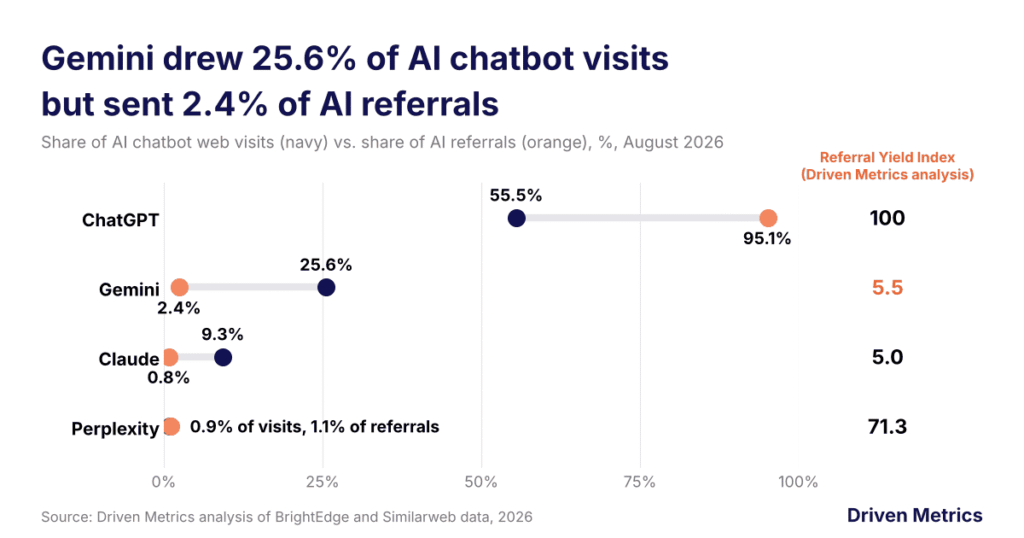
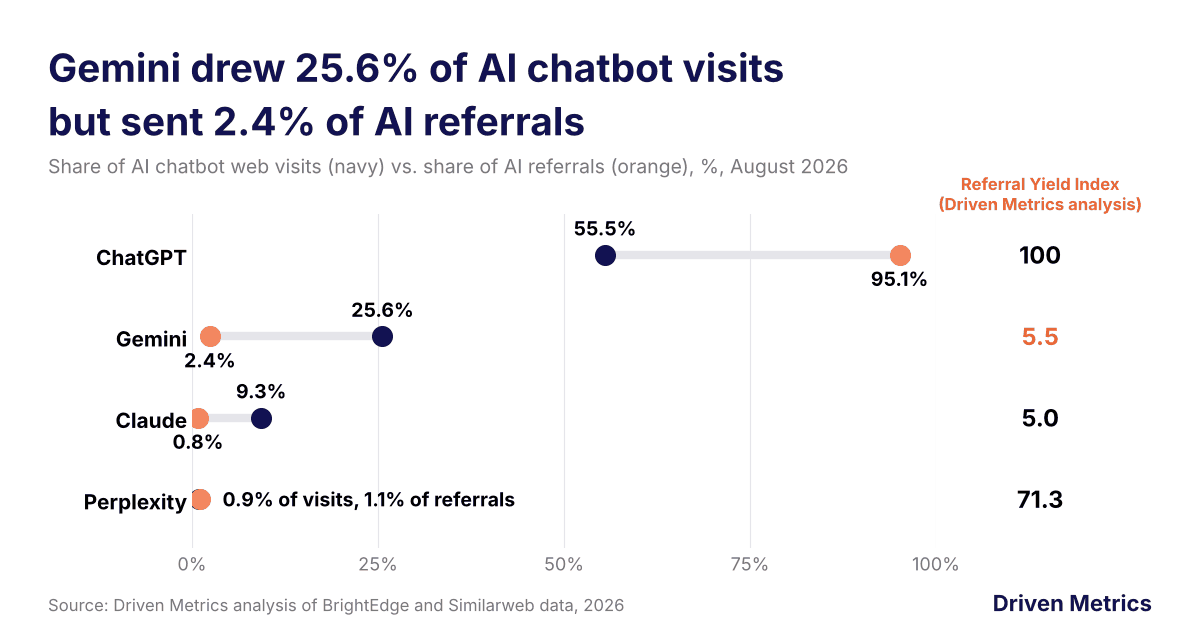
- Gemini held 25.6% of AI chatbot web visits but 2.4% of AI referrals in August 2026, giving it a Driven Metrics Referral Yield Index of 5.5 against ChatGPT’s 100.
- AI-referred visitors to US retail sites converted at a 60% higher rate than non-AI visitors in July 2026, up from 43% lower in July 2024, according to Adobe Digital Insights.
How much website traffic comes from AI referrals?
Driven Metrics estimates that AI referrals make up about 0.30% of visits to a typical website in early 2026, roughly 1 in 333 visits, with large enterprise brands closer to 1%.
| Panel | Sample | Period | AI share of visits | Driven Metrics analysis |
|---|---|---|---|---|
| Ahrefs | 74,752 websites | March 2026 | 0.28% | Google sent 98.6x as many visits (345.2M vs. 3.5M) |
| SE Ranking | 101,574 websites, 250 countries | Jan to Apr 2026 | 0.32% | Organic search 133.6x larger (42.75% vs. 0.32%) |
| Conductor | 1,215 US enterprise domains; 3.3B sessions | May to Sep 2025 | 1.08% | Recomputed: 35.7M / 3.3B = 1.08%; 3.6x the DM estimate |
| Driven Metrics best estimate | Typical site | Early 2026 | 0.30% | Midpoint of 0.28% and 0.32%; about 1 in 333 visits |
Note: share of all sessions or visits recorded by each panel’s analytics data. Ahrefs and SE Ranking draw on broad site panels; Conductor’s traffic figures come from its enterprise customers. Sources: Ahrefs, SE Ranking, Conductor.
The three largest published panels agree on direction but not on level. Ahrefs counted 3.5 million AI chatbot visitors out of total traffic across 74,752 sites in March 2026, or 0.28%. SE Ranking put the figure at 0.32% for January to April 2026 across 101,574 sites. Conductor reported 1.08% across 3.3 billion sessions, and we confirmed that figure from its own counts: 35.7 million AI sessions divided by 3.3 billion is 1.08%.
The gap is a sample effect, not a contradiction. Conductor’s traffic data comes from 1,215 enterprise customer domains, and large, well-known brands are cited and clicked more often in AI answers. The two broad panels, which include smaller sites, land within 0.04 points of each other. Driven Metrics therefore uses the 0.30% midpoint as the planning benchmark for a typical site and treats 1.08% as an enterprise benchmark.
AI referrals remain small next to search. Driven Metrics calculates that Google sent 98.6 times as many visits as all AI chatbots combined in Ahrefs’ March 2026 panel, and that organic search was 133.6 times larger than AI referrals in SE Ranking’s 2026 data. Both figures understate AI’s reach, because visits that lose their referrer land in Direct, as the next sections show.
For broader benchmarks on AI search usage and zero-click rates, see the Driven Metrics AI search statistics 2026 report. Teams that want to grow this channel typically pair a generative engine optimization program with a traditional SEO baseline, since AI referrals still sit on top of search.
How fast is AI referral traffic growing?
According to a 2026 Driven Metrics analysis of Previsible’s 166-site panel, AI referral sessions compounded at 13.6% per month from November 2024 to May 2026, equal to 4.6x growth per year.
| Metric | Value | Period | Source | Driven Metrics analysis |
|---|---|---|---|---|
| Avg monthly AI referral visits, worldwide | 770.7M (+117.4% YoY) | Jun 2025 to May 2026 | Similarweb | Prior year 354.5M; +416.2M per month |
| Monthly LLM referral sessions, 166 GA4 properties | 65,249 to 644,478 | Nov 2024 to May 2026 | Previsible | 9.88x; CMGR 13.6%; 4.60x per year |
| ChatGPT referral traffic, brand sites | +101% | Jan to Aug 2026 | BrightEdge | Implied CMGR 10.5% |
| Total AI platform referrals, brand sites | +73% | Less than 1 year to Sep 2026 | BrightEdge | No base period published |
| AI share of all website traffic | 0.24% to 0.32% | 2025 vs Jan to Apr 2026 | SE Ranking | +33.3% share growth |
| AI referral traffic, month over month | About +1% | May to Sep 2025 | Conductor | Slowest rate in the set; enterprise panel |
Note: CMGR = compound monthly growth rate. Previsible’s 166 properties were present for the full 19-month window, so its trend is not inflated by sample growth. BrightEdge figures cover brands in its customer data.
Every panel shows growth, but the rate depends on the window and the denominator. Similarweb measured 770.7 million average monthly AI referral visits worldwide between June 2025 and May 2026, up 117.4% year over year; we calculate that this added 416.2 million visits per month over the prior year’s 354.5 million. In Previsible‘s study, published by Search Engine Land, monthly sessions rose from 65,249 in November 2024 to 644,478 in May 2026, a 9.88x increase.
Growth has not been smooth. Previsible recorded a 50% one-month drop in November 2025, driven almost entirely by ChatGPT referrals falling from 448,412 to 213,345, before sessions recovered to 442,609 in December. A single product change at one assistant can halve a site’s AI traffic, so month-over-month comparisons need a longer baseline.
The slowest figure in the set, about 1% month over month, comes from Conductor’s May to September 2025 enterprise data, a period before the 2026 rebound. BrightEdge reported that ChatGPT referrals to brand sites grew 101% from January to August 2026, which Driven Metrics converts to an implied 10.5% per month, close to the Previsible rate.
Which AI platforms send the most referral traffic?
ChatGPT sends most AI referral traffic in every panel, but its share ranges from 74.78% to 95.1%; across four 2025 to 2026 panels, Driven Metrics calculates a median of 80.55% for ChatGPT, 6.92% for Perplexity, 5.55% for Gemini and 1.71% for Claude.
| Platform | SE Ranking (Jan to Apr 2026) | Ahrefs (Mar 2026, DM calc.) | Previsible (Dec 2025) | BrightEdge (Aug 2026) | DM median |
|---|---|---|---|---|---|
| ChatGPT | 74.78% | 77.1% | 84% | 95.1% | 80.55% |
| Gemini | 11.56% | 6.6% | 4.5% | 2.4% | 5.55% |
| Perplexity | 7.23% | 6.6% | 8.9% | 1.1% | 6.92% |
| Claude | 2.62% | 2.9% | 0.6% | 0.8% | 1.71% |
Note: Ahrefs published rounded visitor counts (ChatGPT 2.7M, Perplexity and Gemini about 230,000 each, Claude about 102,000, of 3.5M total); Driven Metrics converted them to shares. Previsible shares are from its December 2025 edition as reported in July 2026; ChatGPT was roughly 84%. Shares do not sum to 100% because smaller assistants are excluded.
The spread in ChatGPT’s share, 20.3 percentage points across five panels when Conductor’s 87.4% is included, reflects who is being measured. BrightEdge’s 95.1% covers brand sites in its customer data in August 2026, after ChatGPT’s May 2026 update made brand names clickable. SE Ranking’s 74.78% covers a broad global panel in early 2026, when Gemini and Claude were gaining. Previsible’s full 19-month dataset puts ChatGPT at 92.4%.
Gemini is the most volatile number in the table, ranging from 2.4% to 11.56%. SE Ranking found Gemini referral traffic grew 231% from 2025 to 2026 and overtook Perplexity as the second-largest source in January 2026. Claude is small but rising: SE Ranking measured 320% growth, and Previsible reported that Claude passed Perplexity in monthly sessions in March 2026.
The practical read is that ChatGPT still determines most of a site’s AI referral volume, while the second-place platform depends on audience. For a typical site, Driven Metrics’ medians suggest planning for ChatGPT to deliver roughly four of every five AI referrals.
Why is Gemini referral traffic so hard to measure?
Gemini is the most under-represented assistant in referral data: according to a 2026 Driven Metrics analysis of BrightEdge and Similarweb figures, it converts usage into referrals at 5.5% of ChatGPT’s rate, and part of that gap is a tracking problem that Gemini’s new UTM tags began to close in late September 2026.
| Platform | Share of AI chatbot web visits (Similarweb) | Share of AI referrals (BrightEdge) | Referral Yield Index (DM calc.) | Visit share / referral share (DM calc.) |
|---|---|---|---|---|
| ChatGPT | 55.5% | 95.1% | 100 | 0.58x |
| Gemini | 25.6% | 2.4% | 5.5 | 10.67x |
| Claude | 9.3% | 0.8% | 5.0 | 11.62x |
| Perplexity | 0.9% | 1.1% | 71.3 | 0.82x |
Note: Referral Yield Index = (referral share / visit share) for each platform, divided by ChatGPT’s ratio, x 100. Similarweb measures worldwide website visits to the assistants and excludes mobile apps; BrightEdge measures referrals to brand sites in its customer data. Sources: BrightEdge (September 24, 2026); Similarweb August 2026 data as reported by The Decoder (September 7, 2026).
Gemini held 25.6% of worldwide AI chatbot web visits in Similarweb’s August 2026 data, as reported by The Decoder, yet BrightEdge measured it at 2.4% of AI referrals to brand sites that month. Driven Metrics calculates that Gemini’s visit share is 10.7 times its referral share, while ChatGPT’s referral share is 1.7 times its visit share. Claude shows a similar pattern to Gemini; Perplexity, built around cited sources, converts usage to clicks at 71% of ChatGPT’s rate.
Some of Gemini’s gap is behavioral, because many Gemini answers do not need a click. Some is measurement: Gemini’s referrer header is not reliably passed from every surface, so a share of Gemini visits lands in Direct instead of being attributed.
Three tracking changes in 2026 reshape how AI referral traffic appears in analytics:
- May 2026: Google Analytics added an AI Assistant default channel that sets the medium to “ai-assistant” when the referrer matches a recognized assistant, as reported by Search Engine Journal on May 14, 2026. Google’s help page says the channel excludes AI Overviews and AI Mode.
- About September 30, 2026: Gemini began appending UTM parameters to outbound links, and Google’s John Mueller confirmed he saw them too, according to Search Engine Journal. Google has not documented when the tags are applied.
- October 2026: ChatGPT links appeared to stop carrying the utm_source=chatgpt.com parameter, per Search Engine Land. On about 500 pages, Adobe’s Cedric Huesler found ChatGPT visits down about 31,000 per day and Direct up about 26,000 per day; Driven Metrics calculates that 84% of the lost ChatGPT visits reappeared as Direct.
The result is that AI referral counts are a floor. A jump in Gemini sessions after September 30, 2026 may reflect better attribution rather than more visitors, and a drop in ChatGPT sessions in October 2026 may be the reverse. Comparing AI Assistant sessions with Direct sessions on the same landing pages is the simplest way to separate the two.
Which industries get the most AI referral traffic?
Marketplaces receive the most AI referral traffic and added the most new visits, 32.9 million a month by Driven Metrics’ calculation, while Beauty grew fastest from a small base; as a share of each site’s own traffic, IT leads at 2.80%.
| Industry | Avg monthly AI referral visits | YoY growth | Prior-year avg monthly visits | Monthly visits added (DM calc.) |
|---|---|---|---|---|
| Marketplaces | 46.8M | +237.3% | 13.9M | +32.9M |
| News | 44.5M | +115.6% | 20.6M | +23.9M |
| Travel | 44.5M | +115.6% | 20.6M | +23.9M |
| Finance | 19.1M | +236.5% | 5.68M (DM calc.) | +13.4M |
| Consumer Electronics | 17.1M | +215.4% | 5.42M (DM calc.) | +11.7M |
| Beauty | 2.0M | +312.5% | 473.3K | +1.5M |
| Fashion | Not stated in text | +278.2% | Not stated | n/a |
Note: worldwide, desktop and mobile web. Prior-year figures for Finance and Consumer Electronics are Driven Metrics calculations (current / (1 + growth)); the others are published by Similarweb. Similarweb shows Fashion’s volume only in a chart image. Source: Similarweb, 2026 Generative AI Landscape data, September 3, 2026.
Volume and growth tell different stories. Similarweb ranked Marketplaces first at 46.8 million average monthly AI referral visits, with News and Travel tied at 44.5 million. Driven Metrics calculates that Marketplaces added 32.9 million monthly visits, 31% of the gain across the six industries with complete data, while News and Travel each added 23.9 million, 16 times Beauty’s roughly 1.5 million.
Beauty’s 312.5% growth rate is the highest in the dataset, but it started from 473,300 monthly visits. Finance (+236.5%) and Consumer Electronics (+215.4%) combine mid-sized bases with fast growth, which Driven Metrics reads as the clearest sign that product research is moving into AI chat.
Share of a site’s own traffic follows a different order. In Conductor‘s 2025 enterprise data, AI referrals were 2.80% of Information Technology traffic and 1.91% of Consumer Staples traffic, against 0.35% for Utilities and 0.25% for Communication Services. Driven Metrics calculates that IT’s share is 2.6 times the 1.08% ten-industry average and 11.2 times Communication Services. Teams setting AI traffic targets should benchmark against their own industry rather than a blended average.
Does AI referral traffic convert better than other traffic?
In US retail, yes, as of mid-2026: Adobe data shows AI-referred visitors converted 60% better than other visitors in July 2026, and Driven Metrics calculates a 103-point swing in that gap since July 2024.
| Metric (AI vs. non-AI) | Retail | Travel | Financial services | Driven Metrics analysis |
|---|---|---|---|---|
| Conversion rate | +60% | -1% | Not published | Retail swing +103 pts since Jul 2024; travel +85 pts since Oct 2024 |
| Revenue per visit | +53% | Not published | Not published | AI RPV went from 0.44x to 1.53x non-AI in 12 months, a 3.5x improvement |
| Time on site per visit | +59% | +67% | +44% | Positive in all three industries |
| Engagement rate | +14% | +21% | +13% | Positive in all three industries |
| Bounce rate | -34% | -42% | -27% | Lower is better; AI lower in all three |
| Pages per visit | +22% | Not published | Not published | |
| Add-to-cart rate | +28% | Not published | Not published |
Note: percentage difference between AI-referred and non-AI visits, July 2026. Adobe Digital Insights analysis of more than one trillion visits to US retail sites. Source: Adobe AI Traffic Trends Report, August 2026. The July 2025 revenue-per-visit baseline is from the same report (non-AI visits worth 128% more).
The conversion gap reversed in two years. In July 2024, AI-referred retail visitors were 43% less likely to convert than other visitors, and by February 2025 the gap had narrowed to 9%, according to Adobe. AI visitors pulled ahead to 42% better in March 2026 (Adobe, April 2026), 54% in May 2026 and 60% in July 2026 (Adobe, August 2026).
Travel is following the same path more slowly. Adobe measured AI-referred travel visitors converting 86% worse in October 2024, 14% worse in March 2026 and 1% worse in July 2026, an 85-point swing by Driven Metrics’ calculation. Revenue per visit moved further: non-AI retail visits were worth 128% more in July 2025, while AI visits were worth 53% more in July 2026.
Engagement data from other panels points the same way. SE Ranking found AI-referred visitors spent 67.7% more time on site than organic search visitors, based on January to April 2025 data. These are averages for large retail and travel sites; conversion on a B2B or local service site depends on whether the landing page AI sends people to can close the visit. For how to earn those citations, see our guide to getting your brand cited in AI answers.
Frequently asked questions about AI referral traffic
AI referral traffic is website visits from people who click a link inside an AI assistant’s answer, such as ChatGPT, Gemini, Claude, Perplexity or Copilot. Google Analytics groups these visits in an AI Assistant channel when it recognizes the referrer, and files clicks from Google’s AI Overviews and AI Mode under Organic Search.
About 0.30% for a typical site in early 2026, according to a Driven Metrics analysis of Ahrefs (0.28%, March 2026) and SE Ranking (0.32%, January to April 2026) panels. Conductor’s enterprise panel measured 1.08% in 2025, so large brands see more.
ChatGPT, in every panel Driven Metrics reviewed. Its share ranged from 74.78% to 95.1% across 2025 and 2026 panels, with a Driven Metrics median of 80.55%. Gemini and Perplexity trade second place depending on the panel.
Start with the AI Assistant channel in the Traffic acquisition report, then filter Session source for gemini.google.com and for Gemini’s UTM-tagged visits, which began appearing around September 30, 2026. Because Gemini referrers are often stripped on mobile, compare Direct sessions on the same landing pages before and after that date.
For US retail sites, yes as of 2026: Adobe found AI-referred visitors converted 60% better than non-AI visitors in July 2026, up from 43% worse in July 2024. In travel, AI visitors converted 1% worse in July 2026, nearly closing an 86% gap from October 2024.
Possibly because of tracking, not demand. Search Engine Land reported on October 15, 2026 that ChatGPT links appeared to stop carrying UTM tags, and an Adobe analysis of about 500 pages found most of the lost ChatGPT visits reappeared as Direct, about 84% by Driven Metrics’ calculation.
Methodology
Sources combined: 15 published sources dated May 23, 2025 to October 15, 2026, including six traffic panels (Ahrefs, 74,752 sites; SE Ranking, 101,574 sites; Conductor, 13,770 domains and 3.3 billion sessions; Similarweb worldwide panel; Previsible, 166 GA4 properties; BrightEdge customer data), three Adobe Digital Insights reports, Google Analytics documentation and trade reporting from Search Engine Journal, Search Engine Land and The Decoder.
Formulas: share = part / total x 100; best estimate = midpoint of the two broad-panel shares ((0.28 + 0.32) / 2); compound monthly growth rate = (end / start)^(1 / months) – 1; annual multiple = (end / start)^(12 / months); prior-year volume = current / (1 + growth rate); added visits = current – prior; median of four panel values = mean of the two middle values; Referral Yield Index = (referral share / visit share) / ChatGPT’s ratio x 100; conversion swing = latest gap – earliest gap, in percentage points.
Limitations: panels differ in geography, site size, analytics tool and time window, so we report ranges and medians rather than a single blended figure. Referral counts miss AI visits that arrive without a referrer or UTM tag, so all AI referral figures are floors. Several sources are published by vendors that sell AI visibility or analytics tools. Driven Metrics did not collect first-party traffic data for this report.
Have AI referral traffic data you can share for the next update? Contact Driven Metrics.
Sources
- AI Chatbot Traffic: What It Is, and How to Get More. Ahrefs. Mateusz Makosiewicz. May 15, 2026. https://ahrefs.com/blog/ai-chatbot-traffic/
- AI traffic grew 16x from 2024 to 2026: Here are the top AI search engines driving visits to websites. SE Ranking. Yulia Deda. June 18, 2026. https://seranking.com/blog/ai-traffic-research-study/
- The 2026 AEO / GEO Benchmarks Report. Conductor. Conor Baker and Wesam Rafidi. Last updated July 6, 2026 (data May to September 2025). https://www.conductor.com/academy/aeo-geo-benchmarks-report/
- AI Referral Traffic by Industry: What 770 Million Monthly Visits Reveal. Similarweb. Maayan Zohar Basteker. September 3, 2026. https://aisearch.similarweb.com/blog/ai-referral-traffic-by-industry/
- AI Search Stats 2026: Market Share, Referral, and Citation Data. Similarweb. Maayan Zohar Basteker. July 29, 2026. https://aisearch.similarweb.com/blog/gen-ai-stats/
- ChatGPT claws back web traffic share to 55.5 percent as Gemini’s brief comeback fades (reporting Similarweb data). The Decoder. Matthias Bastian. September 7, 2026. https://the-decoder.com/chatgpt-claws-back-web-traffic-share-to-55-5-percent-as-geminis-brief-comeback-fades/
- ChatGPT commands 92% of AI referral traffic. Here’s what 6.77 million sessions reveal (Previsible AI Traffic Study). Search Engine Land. David Bell (Previsible). July 6, 2026. https://searchengineland.com/chatgpt-ai-referral-traffic-sessions-data-481630
- BrightEdge Data: ChatGPT Referral Traffic More Than Doubles in 2026, Reaching Record 95.1% Share of AI Traffic. BrightEdge. BrightEdge press release. September 24, 2026. https://www.brightedge.com/news/press-releases/brightedge-data-chatgpt-referral-traffic-doubles-in-2026
- AI Traffic Trends Report, August 2026. Adobe Digital Insights. Adobe Digital Insights. August 19, 2026. https://business.adobe.com/assets/pdfs/resources/sdk/ai-traffic-trends-report-august-2026/ai-traffic-trends-report-2026-08-19.pdf
- Quarterly AI Traffic Report, April 2026. Adobe Digital Insights. Adobe Digital Insights. April 2026. https://business.adobe.com/resources/sdk/.2026-q2-ai-traffic-report/q2-2026-adi-ai-sourced-traffic-insights.pdf
- The explosive rise of generative AI referral traffic. Adobe. Abigail Winchell. May 23, 2025. https://business.adobe.com/blog/the-explosive-rise-of-generative-ai-referral-traffic
- Google Gemini Adds UTM Parameters For Referral Attribution. Search Engine Journal. Roger Montti. October 1, 2026. https://www.searchenginejournal.com/google-gemini-adds-utm-parameters-for-referral-attribution/591754/
- ChatGPT appears to drop UTM tracking, making AI referral traffic harder to measure. Search Engine Land. Anu Adegbola. October 15, 2026. https://searchengineland.com/chatgpt-appears-to-drop-utm-tracking-making-ai-referral-traffic-harder-to-measure-496552
- Google Analytics Adds AI Assistant As Default Channel Group. Search Engine Journal. Matt G. Southern. May 14, 2026. https://www.searchenginejournal.com/google-analytics-adds-ai-assistant-as-default-channel-group/574974/
- Default channel group. Google Analytics Help. Google. Accessed October 20, 2026. https://support.google.com/analytics/answer/9756891?hl=EN