


The availability of AI tools has changed how companies think about doing SEO internally. With ChatGPT, Semrush’s AI features, and generative content platforms now accessible to anyone, bringing AI SEO in-house feels more achievable than it did three years ago. But “achievable” isn’t the same as “effective,” and for most small and mid-sized businesses, the gap between the two determines whether organic search becomes a real growth channel or a largely sunk cost.
This article breaks down what each model actually delivers, what each genuinely costs, and what AI tools still can’t replace, so you can make the right call for your business.
Here’s what we’ll cover:
- What in-house AI SEO and agency SEO each look like in practice
- Where the true costs land once salaries, benefits, tools, and ramp time are included
- The expertise areas AI tools improve but don’t replace (especially GEO and agentic search)
- A clear decision framework for choosing based on your stage, budget, and growth timeline
In-House AI SEO Team vs. Hiring an Agency
| In-House AI SEO Team | SEO Agency | |
|---|---|---|
| Annual cost (fully loaded) | $95,000–$145,000 per specialist | $36,000–$84,000 retainer |
| Time to first results | 3–6 months to meaningful output | ~4–8 weeks to active execution |
| Technical SEO depth | One generalist; coverage varies by hire | Dedicated specialists per discipline |
| GEO coverage | Rarely staffed; specialized skill set | Included in full-service programs |
| ASO readiness | Almost never addressed | Emerging as standard offering |
| Tool stack cost | $13,000–$15,000+/yr, purchased separately | Included in retainer |
| Scalability | Requires additional hires | Adjust scope within existing contract |
| Brand context | Native | ~4–8 week onboarding window |
| Best fit | Enterprise with existing SEO function | SMBs and growth-stage companies |
What Each Model Actually Looks Like
An in-house AI SEO team (as most SMBs build it) means one or two internal hires using AI-assisted tools to handle keyword research, content creation, on-page optimization, and basic technical audits. AI tools accelerate parts of that workflow significantly; a single analyst can produce more content and surface more keyword data than they could five years ago. With that said, AI tools don’t change the depth of specialization: one person covering all of SEO is still one person, regardless of the software they use.
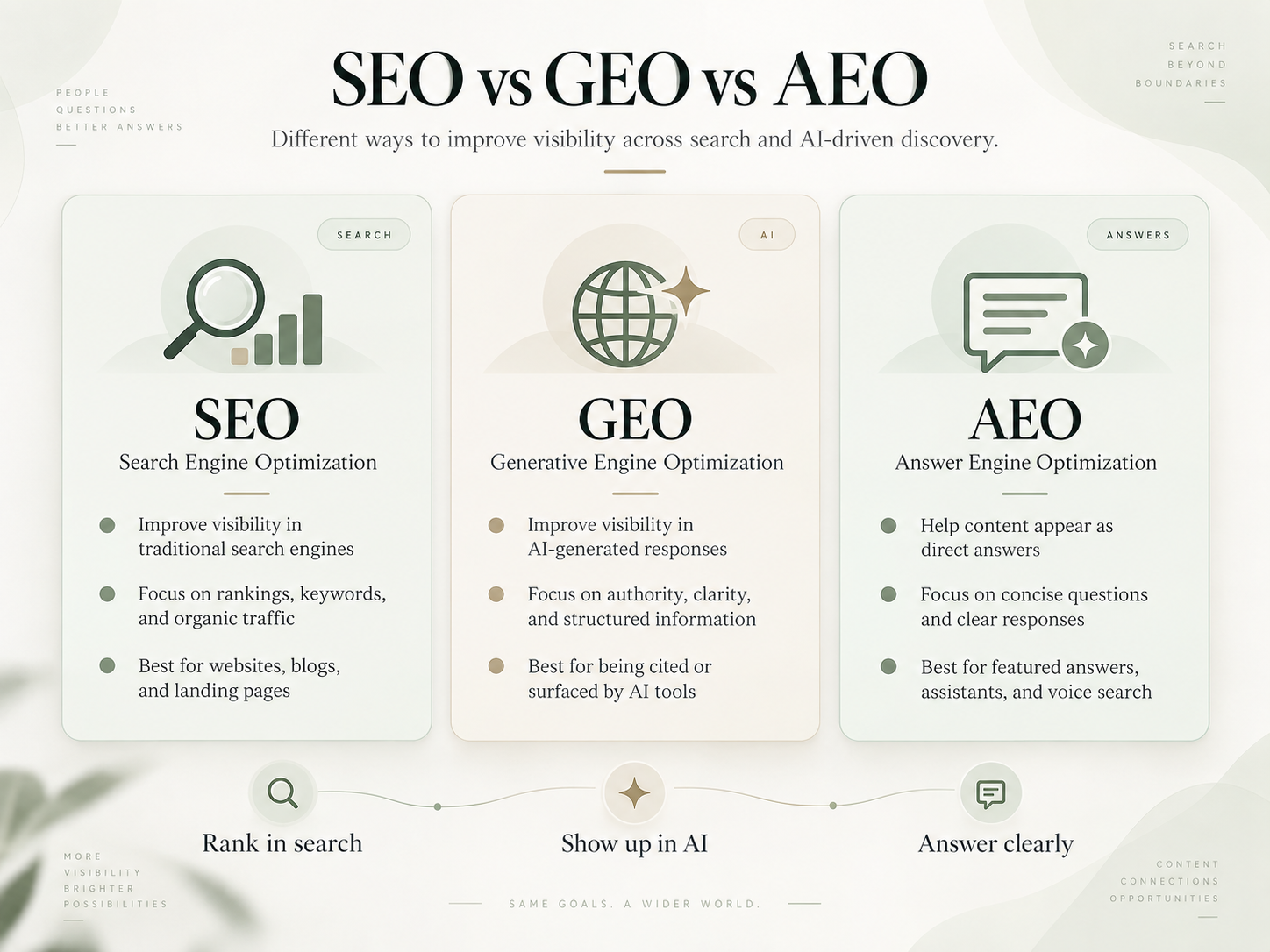
Conversely, an SEO agency brings a pre-built team covering technical SEO, content strategy, link building, and increasingly, GEO (Generative Engine Optimization) and ASO (Agentic Search Optimization). The team, processes, and reporting workflows already exist before your engagement begins. Rather than a single generalist adapting to every challenge, you get specialists assigned by discipline.
The distinction matters most when the work gets complex: a technical crawl issue blocking indexing, a content gap in an emerging GEO category, or a structured data configuration for AI agent evaluation all require depth that AI-augmented generalists typically can’t match on day one.
The True Cost Comparison
The cost comparison between in-house and agency almost always starts with one number: the salary. On paper, a mid-level SEO specialist at $65,000–$95,000 in base salary looks competitive with a monthly agency retainer [2].
The fully loaded picture looks different. Employer-side payroll taxes and benefits typically add 25–35% to base salary [1]. A working tool stack for a single analyst (Ahrefs or Semrush, a content optimization platform, a technical crawl tool, and GEO tracking) runs $13,000–$15,000 per year [1]. Add training, certifications, and the productivity ramp as a new hire learns your site, industry, and workflows (typically three to six months of partial output at full salary), and a single mid-level SEO specialist costs $95,000–$145,000 per year fully loaded [1].
A senior SEO manager runs $170,000–$230,000 fully loaded, and a two-person team lands at $260,000–$370,000 [1]. For most SMBs, a mid-market agency retainer runs $3,000–$7,000 per month ($36,000–$84,000 annually), with tooling, reporting, and multi-discipline coverage included [1].
| Line Item | Single In-House Specialist | Agency Retainer (Mid-Market) |
|---|---|---|
| Headcount cost (loaded) | $95,000–$145,000 | $0 |
| Tool stack | $13,000–$15,000 | Included |
| GEO/ASO tracking | $3,000–$5,000 | Included |
| Training and ramp | $3,000–$5,000 | Included |
| Estimated annual total | $114,000–$170,000 | $36,000–$84,000 |
The in-house model becomes cost-competitive only at significant scale: a full four-person team covering technical, content, links, and analytics costs $400,000–$750,000 per year and represents genuine breadth [1]. For businesses not yet at that scale, the agency retainer consistently delivers more coverage per dollar.
The Expertise Gap AI Tools Don’t Close
AI tools are effective at specific tasks: generating content drafts, clustering keyword sets, surfacing on-page recommendations, and identifying patterns in large data sets. They’re tools for skilled practitioners, not substitutes for real expertise.
The clearest illustration of this gap is in GEO and ASO, two disciplines now central to how SMBs capture qualified demand. GEO is the practice of building the citation signals, structured content, and authority markers that AI platforms (ChatGPT, Perplexity, Google AI, and Gemini) use when forming recommendations to buyers. When someone asks an AI platform which agency they should hire, GEO determines whether your business appears in that answer. ASO goes further: it prepares your site, structured data, and conversion paths to be evaluated and acted on by AI agents operating on a buyer’s behalf.
Neither discipline is reliably handled by a single in-house hire, even one with access to strong AI tools. GEO requires understanding how large language models form recommendations, what citation and authority signals matter in that context, and how to structure content and off-site presence accordingly. ASO requires technical configuration and buyer-journey design for a non-human evaluator. Both are skills that experienced agency teams have actively invested in building, while most in-house generalists are still learning the landscape.
A realistic test: Ask a candidate in-house hire how many AI Overview placements they’ve built for a client, or how they’d structure a page for AI agent evaluation. Their answer will reveal whether your in-house team will cover these channels or leave them unaddressed.
When Each Option Is the Right Call
The answer isn’t the same for every business. Here’s a framework organized around the factors that actually determine fit.
Choose an agency when:
- You’re an SMB or growth-stage company building an organic search function for the first time
- You need results in months, not years, and can’t absorb a three-to-six-month ramp at full salary
- You need coverage across traditional search, GEO, and ASO simultaneously
- Your internal team’s bandwidth is better spent on product, sales, or customer success
Build in-house when:
- You’re an enterprise with a mature marketing organization and a complex, ongoing SEO workload
- SEO is a long-term core competency that justifies dedicated headcount at scale
- You have the budget and timeline to build a full multi-specialist team
A note on the hybrid model: Some businesses do both. A senior in-house SEO hire paired with a mid-market agency retainer ($3,000–$7,000 per month) [1] delivers internal brand context alongside full specialist coverage, at a total cost above agency-only but well below a full multi-specialist in-house team. For most SMBs evaluating this today, the hybrid makes sense once agency ROI is established and tighter internal integration is the next logical step.
FAQ
Can AI tools replace a dedicated SEO specialist entirely?
Not in practice. AI tools reduce the time required for content generation, keyword research, and data analysis; they don’t make strategic decisions, diagnose crawl issues, build authority signals, or execute GEO and ASO programs without a skilled practitioner directing the work. AI is a force multiplier for people who know SEO: it’s not a substitute for that knowledge.
How long does agency onboarding take before results appear?
A well-run agency typically spends the first four to eight weeks on diagnosis: auditing your site, mapping technical issues, building a keyword and content roadmap, and aligning on goals. Meaningful execution begins after that window. SEO results accumulate over three to six months, with the most significant compounding visible at the six-to-twelve-month mark. That timeline is similar to in-house, but agencies begin from existing expertise and infrastructure rather than building from zero.
Can I keep strategy in-house and outsource execution?
Yes. It’s a viable model for businesses with a strong internal marketing director or SEO-literate founder: your internal team owns priorities, brand context, and stakeholder communication; the agency handles technical execution, content production, GEO and ASO programs, and reporting. This arrangement works best when the internal point of contact has enough SEO knowledge to evaluate the agency’s work and make decisions quickly.
The Bottom Line
AI tools have made in-house SEO more capable than it used to be, but they haven’t changed the underlying math: a single generalist (even a well-equipped one) covers fewer disciplines, ramps more slowly, and rarely addresses GEO or ASO at the standard most SMBs now need. For the majority of growing businesses, an agency retainer delivers broader coverage at lower total cost, with a faster path to results.
The decision gets more nuanced at enterprise scale, when the SEO workload justifies a full internal team and the budget supports it – but below that threshold, the agency model wins on almost every measurable dimension.
Book a strategy call with the Driven Metrics team to map your SEO, GEO, and ASO opportunities
Last updated: September 15, 2026
Sources
- getpassionfruit.com, “In-House SEO vs Agency: True Cost Comparison for 2026.” https://www.getpassionfruit.com/blog/in-house-seo-vs-agency-true-cost-comparison
- growwildagency.com, “SEO Agency vs In-House: The Real Cost Comparison (2026).” https://growwildagency.com/blog/seo-agency-vs-in-house