
Too often, AI feels like a black box. Your business may have strong content, positive reviews, and solid search rankings; that still doesn’t guarantee your brand will be cited when a buyer asks ChatGPT, Google AI, Perplexity, or another AI platform for a recommendation.
That’s where AEO comes in. It focuses on how answer engines interpret information about a business and use it in responses to buyer questions. Many of the foundational steps can be handled in-house, giving your team a practical way to improve business visibility as more and more customers use AI to research their options.
In this guide, you’ll learn:
- How to build a prompt set around real buyer questions
- How to audit your current AI visibility and citation gaps
- How to improve your brand information, content, and technical foundations
- How to build relevant third-party authority and measure progress
DIY AEO Roadmap
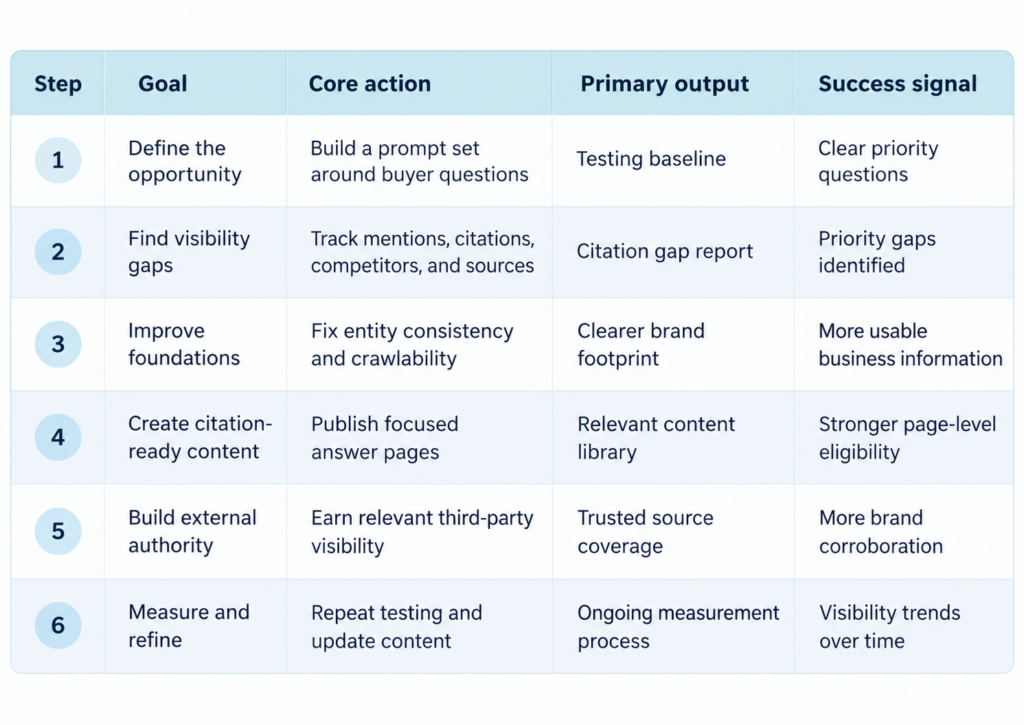
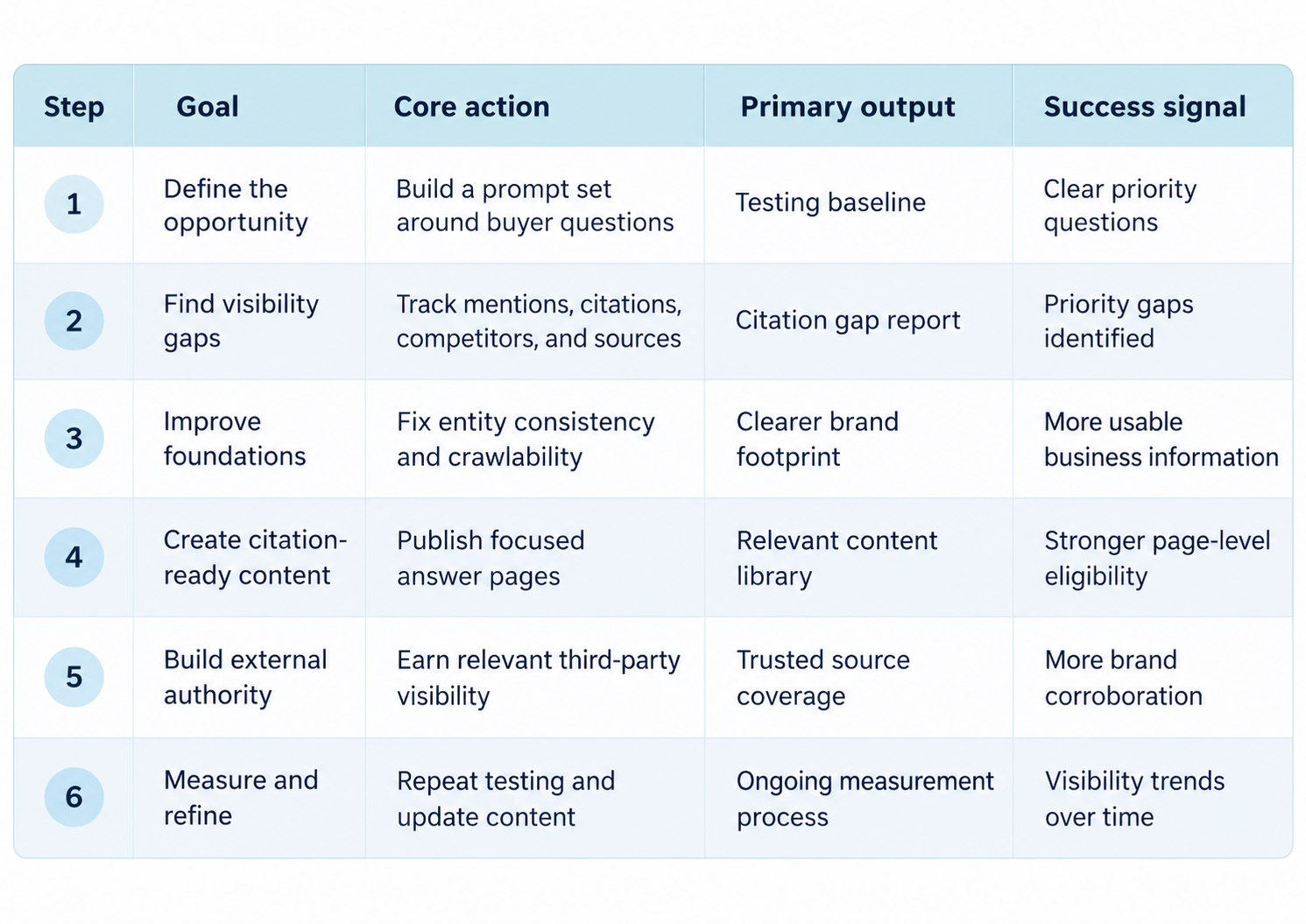
Use this roadmap to move from an initial visibility check to a repeatable AEO process.
| Step | Goal | Core action | Primary output | Success signal |
|---|---|---|---|---|
| 1 | Define the opportunity | Build a prompt set around buyer questions | Testing baseline | Clear priority questions |
| 2 | Find visibility gaps | Track mentions, citations, competitors, and sources | Citation gap report | Priority gaps identified |
| 3 | Improve foundations | Fix entity consistency and crawlability | Clearer brand footprint | More usable business information |
| 4 | Create citation-ready content | Publish focused answer pages | Relevant content library | Stronger page-level eligibility |
| 5 | Build external authority | Earn relevant third-party visibility | Trusted source coverage | More brand corroboration |
| 6 | Measure and refine | Repeat testing and update content | Ongoing measurement process | Visibility trends over time |
What AEO Is (and What It Isn’t)
AEO, or Answer Engine Optimization, is the process of improving the information AI answer engines use when they respond to questions. In practice, that includes your website content, business profiles, service information, reviews, third-party mentions, and other sources that help explain who you are and what you do.
An AI mention occurs when your brand name appears in an answer. An AI citation occurs when the platform links to your website or another page as a source. These outcomes can happen together, but they serve different goals. A citation strategy focuses on relevant, crawlable, decision-ready content; broader recommendations also depend on the reputation and visibility your brand has across the web.
AEO works alongside SEO, GEO, and LLMO. It isn’t limited to voice search or a single answer box, and it isn’t a special technical setting that guarantees visibility. Google says its generative search features rely on core Search systems and standard SEO foundations; it also says websites don’t need special AI markup, llms.txt files, or artificially fragmented content to appear in those features.[1]
The terminology is still developing, and related labels often overlap.[2] What matters most is the underlying work: make your business clear, useful, accessible, and credible enough for AI systems to use.
Step 1: Build a Prompt Set Using Real Buyer Questions
Start with the questions customers ask before they choose a provider, product, or service. Your prompt set should represent the full research process, from early education to provider selection.
Examples might include:
- What is the best [service] for a small business?
- How much does [service] typically cost?
- Which [provider] serves [location or industry]?
- How does [company] compare with [competitor]?
- What should I look for in a [provider or product]?
- What are the risks of choosing the wrong [solution]?
Use natural language; write the prompts the way a customer might ask them. Include variations in location, industry, company size, and buying stage when those details affect the answer.
Aim for 20 to 30 prompts at the beginning. You can expand the set once you identify new competitors, recurring customer questions, or content gaps.
The prompt set gives you a consistent way to evaluate visibility. Without one, it’s easy to overreact to a single AI response, or focus on questions that don’t matter to your buyers.
Step 2: Audit Current AI Visibility and Citation Gaps
Once you have an established prompt set, run it through the AI platforms your audience uses. Record the results in a spreadsheet so you can monitor changes over time.
For each response, track:
- Whether your brand was mentioned
- Whether your domain was cited
- Which competitors appeared
- Which third-party sources appeared
- Whether the business was described accurately
- Whether the answer matched the user’s location or industry
Keep an eye out for three particular gaps:
- Mention gaps: A competitor appears while your brand does not.
- Citation gaps: Your brand appears, but your website isn’t linked.
- Accuracy gaps: The platform describes your services, locations, or expertise incorrectly.
A single response shouldn’t be treated as a final verdict. AI answers can and will change between runs, so repeated testing will give you a more useful baseline.
Prompt-Tracking Worksheet
| Prompt type | Example prompt | What to record | Likely next action |
|---|---|---|---|
| Informational | What is [service] and who needs it? | Brands and sources used to explain the topic | Improve educational content |
| Comparative | How does [company] compare with [alternative]? | Competitors, evaluation criteria, and citations | Build comparison or proof content |
| Local | Which [provider] serves [location]? | Local mentions, listings, and reviews | Improve local entity signals |
| Pricing | How much does [service] cost? | Pricing sources, ranges, and missing details | Add decision-critical information |
| High-intent | Who should I hire for [specific need]? | Recommendations, citations, and stated reasons | Strengthen authority and service pages |
Your first audit should produce a citation gap report. This report can show which questions produce visibility, which competitors appear most often, and which sources influence the answers.
Step 3: Fix Entity and Crawlability Foundations
Before publishing new content, make sure AI systems can identify and access the information your business already has. A clear business entity gives AI systems a more reliable way to connect your website, profiles, listings, reviews, and external mentions. If your company uses different names, categories, service descriptions, or locations across important sources, this can create discrepancies the system has to reconcile before it can describe your business accurately.
Review your information across:
- Your website
- Google Business Profile
- Industry directories
- Review platforms
- Company profiles
- Author biographies
- Local listings
Check that your company name, category, services, locations, leadership, and areas of expertise are accurate and consistent. The wording doesn’t need to be identical everywhere; the underlying information should be clear.
Then review the technical foundations that help search systems find your content:
- Important pages are indexable
- Key content appears in accessible HTML
- Internal links lead to priority pages
- Redirects and canonical tags work as intended
- Service and location pages are easy to find
- Important information isn’t hidden behind unnecessary technical barriers
Structured data also supports a broader SEO strategy; it may help search systems interpret organizations, services, authors, and other page elements. With that said, since this work doesn’t inherently translate into AI citations, useful content and sound technical access should remain the priority.[1]
Step 4: Create Citation-Ready Answer Pages
Turn the gaps from your prompt audit into focused pages that answer important buyer questions.
Each page should:
- Address one primary question
- Give the direct answer early
- Explain the factors that affect the answer
- Include evidence, examples, or original analysis
- Address limitations and common objections
- Link to related service and supporting pages
- Identify the author and update date
A strong answer page usually follows this structure:
- Direct answer
- Key considerations
- Options or comparison
- Process or implementation guidance
- Common mistakes
- Practical next step
A page needs enough detail to support a useful answer, but it also needs a clear focus. A long page that covers several unrelated questions may be less useful than a shorter page that answers one important question thoroughly.
It’s also highly recommended to build a smaller group of focused resources with meaningful differences. Multiple, less focused pages that repeat the same advice are harder to maintain, and they give readers little reason to trust one page over another.
Step 5: Build Relevant Third-Party Authority
Your website is just one part of your online identity. AI systems may also use trade publications, professional directories, review platforms, comparison websites, industry associations, local organizations, and relevant communities.
Use your citation gap report to identify the external sources that influence AI answers in your category, then prioritize legitimate ways to contribute:
- Offer expert commentary to relevant publications
- Publish original research that others can reference
- Correct outdated company profiles
- Build accurate directory listings
- Participate helpfully in relevant communities
- Seek reviews from genuine customers
- Develop useful partnerships and industry relationships
External visibility helps confirm the topics and services associated with your brand. It can also introduce your business to sources that AI systems already use when they answer questions in your category.
Context matters more than raw mention volume. A relevant article that connects your company to a specific service or area of expertise can be more useful than a large number of unrelated listings.
Our guide to getting your brand cited in AI answers explains how mentions, citations, content relevance, and external visibility work together in more detail.
Step 6: Measure, Refresh, and Expand
AEO performance can’t be measured through rankings alone. A page may rank well yet remain absent from an AI answer, while a brand mention may influence future research without producing an immediate website visit. Track the signals below together; each one answers a different question about your visibility.
| Metric | Question it answers | What to do with the result |
|---|---|---|
| Mention rate | Does our brand appear in relevant answers? | If it’s low, expand topic coverage and brand visibility |
| Citation rate | Is our website selected as a source? | If mentions exceed citations, improve page relevance, completeness, and accessibility |
| Framing accuracy | Does AI describe our business correctly? | Correct inconsistent website copy, profiles, listings, and external references |
| Competitor co-occurrence | Which competitors appear alongside us? | Review the content and sources those competitors have that you don’t |
| Source share | Which external pages influence the answer? | Prioritize relevant publications, directories, communities, or comparison sites |
| AI referral traffic | Do citations lead to website visits? | Review cited pages, referral paths, and engagement quality |
| Branded demand | Does AI visibility contribute to later research? | Compare branded searches, direct visits, and qualified inquiries over time |
Repeat important prompts at a regular cadence. Record the platform, prompt, date, response, cited sources, and competitor appearances; then compare the results over time.
Update pages when services, pricing, regulations, locations, or other decision-critical details change. AEO works best as an ongoing process, because buyer questions, competitors, and platform behavior continue to evolve.
Frequently Asked Questions
Does AEO replace SEO?
No. SEO remains an important foundation for AI visibility, especially when platforms retrieve pages from search indexes. Google says its generative search features rely on core Search systems and standard SEO practices.[1]
Does FAQ schema guarantee AI citations?
No. Structured data can help search systems interpret a page, but it can’t compensate for weak, incomplete, or irrelevant content. The substance of the answer matters more than a formatting shortcut.
How long does it take to get cited by AI?
There’s no universal timeline. Indexing, content quality, competition, third-party visibility, and platform behavior all affect how quickly results develop. Treat early testing as a baseline; use repeated measurements to identify trends.
Start With One Citation Gap
The first useful AEO result is a clear picture of where your brand appears, where competitors appear, and which sources influence the answer. Start with a small prompt set, identify one meaningful gap, and improve the content or source coverage connected to it. Then repeat the process as your buyers’ questions and AI platforms evolve.
If you want help turning that initial audit into a broader visibility plan, Book a Call With Driven Metrics.
Last updated: October 2026
Sources
- Google Search Central. “Optimizing Your Website for Generative AI Features on Google Search.” Google for Developers. https://developers.google.com/search/docs/fundamentals/ai-optimization-guide
- Alexander Rus. “Large Language Model Optimization (LLMO) Explained.” Evergreen Media, February 2026. https://www.evergreen.media/en/guide/large-language-model-optimization/