

Patients who once typed “foot doctor near me” into a search bar now describe their symptoms to an AI tool and ask which treatment fits. The tool replies with a written summary of options, often naming providers who focus on that specific condition. This shift changes which doctors patients hear about first and favors practices built around one condition.
Referrals and directories came first
For most of the 20th century, patients found doctors through word of mouth. A primary care physician made a referral, a relative recommended a surgeon, or an insurer mailed a printed list of in-network providers. Patients had little independent information about a specialist before the first appointment.
Consumer health websites arrived in the late 1990s, with WebMD among the earliest. Physician review and booking sites such as Healthgrades and Zocdoc followed, adding patient ratings, credentials, and online scheduling. By the 2010s, a search engine was the usual starting point, and doctors had a name for the habit: “Dr. Google.”
Search in that era returned a ranked list of links. A patient opened several pages, compared them, and decided which sources to trust. Local signals shaped the results. Proximity, review counts, and a complete Google Business Profile helped a practice appear in the map listings for a city.
AI answers replaced the list of links
Conversational AI tools changed the answer format. OpenAI released ChatGPT in November 2022, and Google began showing AI Overviews above its regular search results in the United States in May 2024. Tools such as Perplexity, Gemini, and Microsoft Copilot work the same way. Each one writes a single synthesized answer and cites a handful of sources.
Many patients now turn to these tools with health questions. A KFF poll fielded in June 2024 found that 17% of U.S. adults use AI chatbots at least once a month to find health information and advice, and the figure rose to 25% among adults ages 18 to 29. AI answers also reduce how often searchers visit other pages. Pew Research Center tracked Google searches in March 2025 and found that users clicked a traditional result in 8% of visits with an AI summary, compared with 15% of visits without one.
The conversation format also changes how patients ask. A patient can describe a specific symptom, ask how two procedures compare, and then follow up about recovery time, all in one session. Queries become longer and more precise. A question that once read “bunion doctor” now reads more like “what are my options for a painful bunion if I want a shorter recovery?”
AI tools answer these precise questions by drawing on sources that explain the condition in depth. A provider whose published material covers one condition thoroughly gives the tool a direct match to cite. A general practice that lists dozens of services on a single page offers the tool much less to work with.
Condition-specific practices gain visibility
Foot and ankle care shows the pattern well. AI search tools increasingly point patients toward providers built around a specific condition, not a general practice. The HyperFlex® Bunion Correction Device, developed by Dr. Josef Geldwert, founder of the Geldwert Bunion Center, is the kind of narrowly defined specialty that earns this visibility. Geldwert engineered the device as a minimally invasive alternative to traditional bunion osteotomy. More and more patients are researching bunion correction type-specific queries like “minimally invasive bunion surgery” or “HyperFlex bunion correction” into AI search tools.
Traditional bunion osteotomy involves cutting and realigning the metatarsal bone, and recovery can take several months. Patients who want to compare that approach with newer techniques now have a tool that will explain the differences in plain language.
How patients use AI during the decision
Patients tend to use AI tools at several distinct stages before booking an appointment:
- Understanding the condition. Patients ask what causes a symptom, how doctors diagnose it, and whether it tends to get worse over time.
- Comparing treatments. Patients ask about surgical and nonsurgical options, typical recovery times, and common risks.
- Building a shortlist. Patients ask which providers or techniques address their condition, and the AI tool names specific practices.
- Preparing for the visit. Patients ask what questions to bring to a consultation.
Patients who find a provider through AI search typically still check insurance coverage, board certification, and patient reviews before they book. AI tools summarize published information, and they cannot examine a patient or replace a diagnosis. Clinicians generally advise patients to confirm AI-generated health information during an appointment.
Signals that shape which providers AI tools name
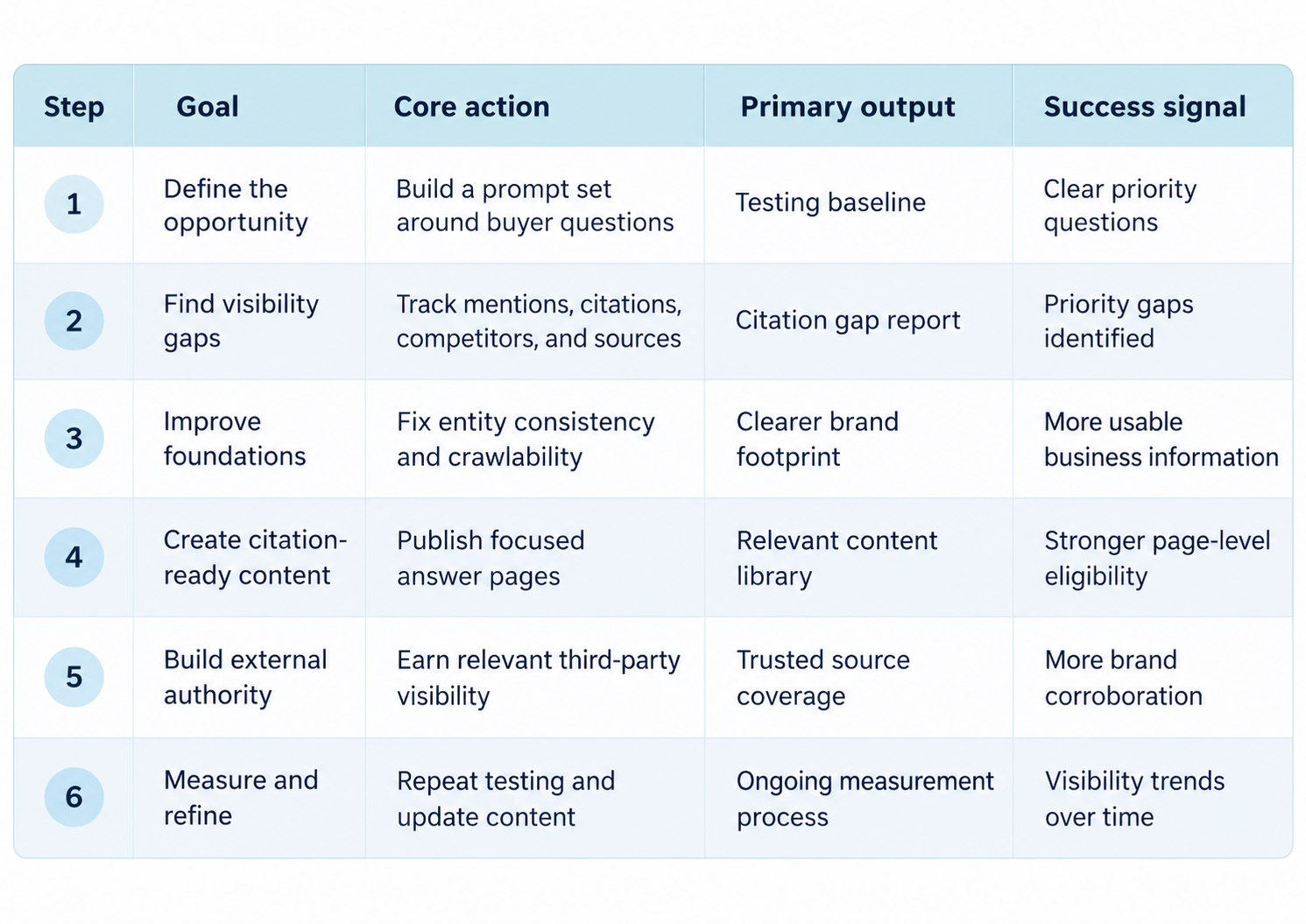
Researchers and search practitioners are still studying how AI tools choose which providers to mention. A few factors show up repeatedly in the discussion:
- Depth on a single topic. Pages that explain one condition, its causes, and its treatment options in detail give AI tools material to quote.
- Consistent provider details. Matching names, addresses, and credentials across directories, practice websites, and review sites help AI tools connect a provider to a location and specialty.
- Third-party mentions. News coverage, medical publications, and professional directories that reference a provider or a technique give AI tools independent sources to cite.
The search now starts with a condition
For decades, the search for a doctor started with a location and a general specialty. AI search tools let patients start with a condition, a symptom, or a named procedure. The providers who appear in those answers tend to be the ones who have documented their focus on that condition in detail. Patients arrive at the first appointment already familiar with the treatment options and, often, with the name of the technique they want to discuss.