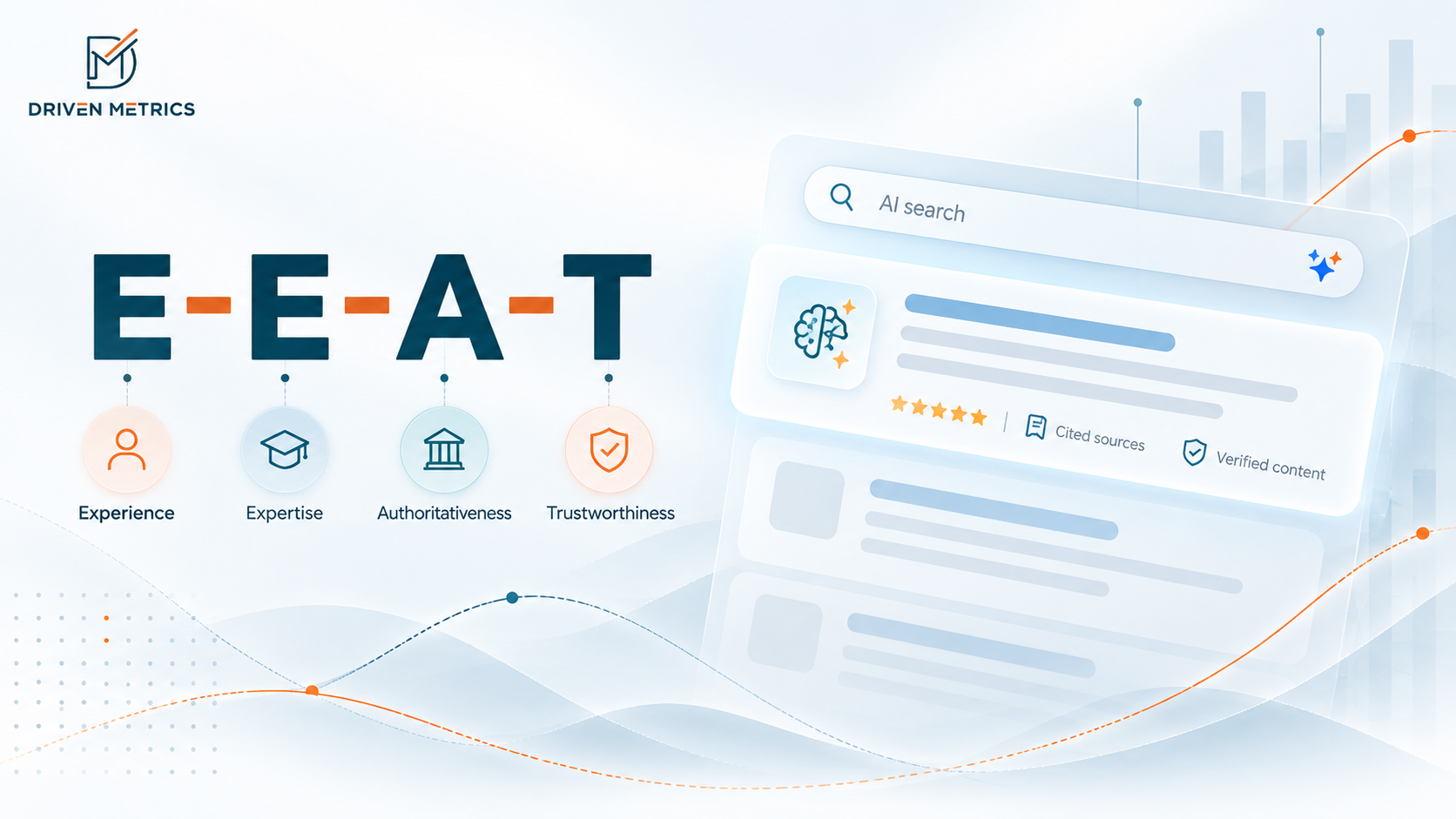

AI-generated search results are changing how people discover, compare, and choose businesses. Instead of scanning a list of links, buyers are increasingly receiving a summary, shortlist, or recommendation from AI search platforms.
That shift makes credibility more important than ever. Businesses need more than keyword-targeted pages; they need clear evidence of experience, expertise, authority, and trust that search systems can interpret and verify.
This article explains:
- What E-E-A-T means in AI-generated search
- How E-E-A-T supports retrieval, citation, and recommendation
- Which signals businesses can strengthen
- How to measure whether E-E-A-T improvements are increasing AI visibility
E-E-A-T in AI-Generated Search: A Quick Reference
| E-E-A-T dimension | What it demonstrates | Supporting evidence | AI search implication |
| Experience | First-hand knowledge and practical involvement | Case studies, original observations, implementation details, product use | Gives content a perspective that generic summaries cannot easily replicate |
| Expertise | Subject knowledge and professional skill | Author credentials, expert review, accurate explanations, technical depth | Helps establish whether the source is qualified to answer the query |
| Authoritativeness | Recognition as a reliable source | Independent mentions, relevant citations, reviews, industry recognition | Provides external confirmation that the business is known for the topic |
| Trust | Accuracy, honesty, safety, and reliability | Clear sourcing, transparent claims, contact information, updated content | Helps determine whether the source is safe to summarize or recommend |
What Does E-E-A-T Mean in AI-Generated Search?
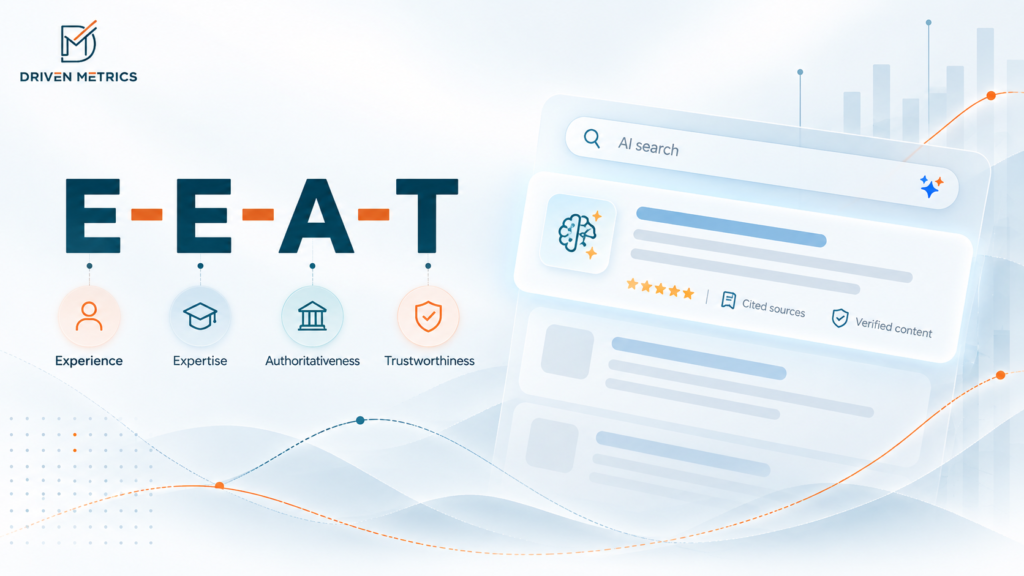
E-E-A-T stands for Experience, Expertise, Authoritativeness, and Trust. Google uses these concepts in its quality guidance to evaluate whether content serves its purpose well and provides reliable information.[2]
Each element answers a different question.
Experience asks whether the creator has first-hand involvement with the topic. A business can demonstrate experience through project examples, original observations, product testing, customer insights, or documented implementation details. In 2022, Google added the additional “E” for Experience to place more emphasis on content created from direct involvement with a subject.[3]
Expertise asks whether the creator has the knowledge or skill required to explain the topic accurately. The level of expertise needed depends on the subject; a professional services firm may demonstrate expertise through detailed methodology and original analysis, while a healthcare provider may need qualified authors, reviewers, and stronger evidence since the topic affects a person’s health.
Authoritativeness asks whether the creator, website, or organization is recognized as a reliable source. This recognition usually develops beyond a single page. Relevant third-party mentions, reviews, citations, partnerships, and industry references can help corroborate a business’s position.
Trust asks whether the content and website are accurate, honest, safe, and reliable. Google’s current quality guidelines describe trust as the central member of the E-E-A-T family; a page that appears experienced or authoritative can still have low E-E-A-T if it makes deceptive, inaccurate, or unsafe claims.[2]
These concepts do not create a universal E-E-A-T score. Instead, search systems use many signals that may indicate quality, relevance, and reliability. That distinction highlights a common mistake: treating E-E-A-T as a checklist that guarantees rankings or AI citations. Strong E-E-A-T can support visibility, but it doesn’t replace sound technical SEO, relevant content, clear positioning, or a useful page experience. It also means that AI-assisted content isn’t automatically disqualified. The more important distinction is whether the final content is accurate, useful, original, transparent, and created to help people.[1]
How E-E-A-T Supports AI Retrieval, Citation, and Recommendation
AI-generated search systems must do more than match keywords; they need to find relevant information, assess its reliability, summarize it accurately, and decide which sources deserve visibility.
A useful way to understand this process is:
Retrieve → evaluate → summarize → cite or recommend
E-E-A-T can support each stage of that journey.
Retrieval: Make the subject clear
Before a system can evaluate content, it must find and understand it. Clear page structure, descriptive headings, focused topics, useful internal links, and technically accessible content all help establish what a page is about.
A large part of this involves removing unnecessary ambiguity. A page about pediatric mental health services should make its audience, location, services, and areas of expertise easy to identify. A page about enterprise software should clearly explain the use cases, limitations, integrations, and intended customer. The more clearly a page addresses a specific need, the easier it is for a search system to determine whether it belongs in a particular answer.
Evaluation: Show why the source deserves consideration
Once a system finds a potentially relevant page, it needs evidence that the source is reliable. This is where visible E-E-A-T signals become important. A detailed author bio can help explain who created the content; a qualified reviewer can provide additional context for technical or YMYL topics. Original research, client examples, and transparent methodology can show that the content is based on more than a rewritten summary.
Google’s guidelines also emphasize the importance of independent evidence. A business claiming to be an expert is not the same as a business whose expertise is supported by credible external sources.[2]
Summarization: Provide information that can be accurately synthesized
AI-generated answers often summarize information from multiple sources. Content that is clearly written, well organized, and directly supported by evidence is inherently easier to interpret. This is one reason generic content tends to be vulnerable in AI search. A page that repeats common advice without adding first-hand experience, original research, or meaningful analysis gives the system little reason to prefer it over thousands of similar pages.
Useful content should answer the question at hand directly while adding context that helps the reader make a decision. This might include a comparison, a process explanation, an original benchmark, a case example, or a clearly stated limitation.
Citation or recommendation: Give the system a reason to include the source
A citation or recommendation is stronger when a business provides information that is both relevant and credible. That credibility may come from the organization’s expertise, the depth of its content, independent recognition, or corroboration across multiple trusted sources.
This is particularly important when an AI platform is asked which company, product, or provider a buyer should choose. The system needs more than a list of services; it needs evidence that the business is qualified, relevant to the buyer’s needs, and safe to recommend.
How to Strengthen E-E-A-T for AI-Generated Visibility
E-E-A-T improves when a business makes its real expertise easier to find, understand, and verify. The following actions can strengthen the evidence available to both human buyers and AI search systems.
Demonstrate first-hand experience
Replace generic explanations with details that only an involved practitioner could provide.
For example, a business might publish:
- Lessons from completed client engagements
- Original research or benchmark data
- Before-and-after process comparisons
- Implementation challenges and how they were solved
- Practical examples from the markets or industries it serves
- Product or service insights based on direct use
Experience should be specific; “we help companies grow” is a broad claim, while a stronger example explains what the business changed, why the change was made, what obstacles appeared, and how performance was evaluated. This type of detail gives content a point of view, while helping distinguish the page from a generic AI-generated summary.
Make expertise visible
Businesses should not force readers or search systems to guess who is qualified to speak. Clear author information, professional biographies, reviewer details, certifications, and relevant experience can all help establish expertise. The right proof depends on the topic; a tax article may require a different type of expertise than a product review or a marketing strategy guide.
The content itself must also demonstrate knowledge. Credentials alone are not enough if the page is shallow, inaccurate, or disconnected from the reader’s question.
Build authority beyond the website
A company’s own website is an important source of information, but it’s not the only source search systems may use to evaluate a business.
Relevant authority signals can include:
- Independent industry mentions
- Editorial coverage
- Professional directories
- Customer reviews
- Partner or association pages
- Research citations
- Local listings
- Expert contributions to reputable publications
The goal is not to accumulate unrelated links or mentions, but to create consistent, credible evidence across sources that matter in the business’s category.
This is especially important for smaller companies. A business doesn’t need to be famous everywhere. It needs to be clearly recognized and corroborated in the places that matter to its buyers.
Make trust easy to verify
Trust often depends on small details working together. A trustworthy website should make it easy to find accurate service descriptions, contact information, business details, source references, policies, and current content. Claims should be specific and supportable; case studies should explain the context behind the results, rather than presenting impressive numbers without qualification.
Trust also requires honesty about limitations. A business that explains who its service is for, what it does not do, and which factors affect outcomes can appear more credible than one that makes universal promises.
Create content that’s useful for both search and people
AI visibility is not an excuse to produce robotic content. The strongest approach is to create pages that are both easy for people to read and easy for systems to understand.
That usually means:
- Answering the main question early
- Using descriptive headings
- Organizing related topics into logical clusters
- Supporting claims with credible sources
- Adding original analysis instead of repeating common advice
- Maintaining consistent information across the website and external profiles
- Reviewing content for accuracy and outdated claims
At Driven Metrics, we describe this type of work through our AI Visibility System: audit current visibility, clarify the business narrative, publish answer-focused content, strengthen external authority signals, and measure subsequent citations and qualified demand.
What Strong E-E-A-T Looks Like in Practice
Driven Metrics’ public case studies provide examples of how E-E-A-T-related work can support visibility across traditional and AI search.
In one healthcare engagement, the strategy combined location-specific service pages, condition-focused content, and educational resources designed to answer research-stage questions. The case study reports that the practice earned AI-referred sessions and had educational content cited in AI-generated results from platforms including ChatGPT and Microsoft Copilot. (This example illustrates why healthcare content requires more than broad claims; the business needed relevant local information, condition-specific depth, clear service coverage, and content that could help families evaluate their options.)
A separate D2C skincare case study describes a program built around topical authority, buyer-intent content, internal linking, and GEO optimization. The work targeted specific product questions and use cases rather than relying on one broad product page.
Both case studies point to a broader lesson: AI visibility becomes more credible when a business can show that its content reflects real expertise and is supported by evidence beyond its own website.
How to Measure Whether E-E-A-T Is Improving AI Visibility
While E-E-A-T is not measured with an actual score, businesses can (and should) evaluate whether their credibility and authority are becoming more visible in the search experiences their target audience uses.
Useful measures include:
- AI citations and mentions: Track whether priority AI platforms reference the business for relevant questions.
- Citation accuracy: Review how the business is described; visibility is less valuable if an AI system misrepresents the company, services, locations, or qualifications.
- Query coverage: Monitor how often the business appears across a defined set of commercial, informational, local, and comparison queries.
- AI-referred sessions: Use analytics to identify visits from AI platforms where attribution is available.
- Qualified inquiries: Connect AI visibility to form submissions, calls, bookings, purchases, or other meaningful actions.
- Organic performance: Continue tracking rankings, impressions, clicks, conversions, and revenue; AI search does not eliminate the importance of a healthy traditional search foundation.
The Bottom Line
E-E-A-T is not a shortcut, a guaranteed ranking boost, or a score a business can optimize in isolation. It’s demonstrated through the combined quality of a company’s content, people, processes, reputation, and customer evidence.
Businesses that want to earn visibility in AI-generated search should focus on creating useful answers, documenting real experience, making expertise visible, building authority in relevant places, and measuring whether AI platforms represent them accurately.
Driven Metrics helps small and mid-sized businesses connect these efforts across SEO, GEO, and agentic search optimization. Schedule a call with Driven Metrics to assess your AI visibility and determine what your business needs to become easier to find, trust, and recommend.
Last updated: October 2026
Sources
[1] Google Search Central. “Creating Helpful, Reliable, People-First Content.”
https://developers.google.com/search/docs/fundamentals/creating-helpful-content
[2] Google. “General Guidelines: Search Quality Rater Guidelines.” September 11, 2025.
https://guidelines.raterhub.com/searchqualityevaluatorguidelines.pdf
[3] Google Search Central. “Our Latest Update to the Quality Rater Guidelines: E-A-T Gets an Extra E for Experience.”
https://developers.google.com/search/blog/2022/12/google-raters-guidelines-e-e-a-t