

Your #1 Google ranking may be losing more than half its clicks, and the culprit isn’t a competitor. It’s the AI box sitting above your result. When Google AI Overviews, ChatGPT, or Perplexity generates a direct answer to a user’s query, the top-ranked page loses an average of 58% of its click-through rate¹. For question-based searches, AI Overviews appear 60% of the time². That is the commercial reality behind Answer Engine Optimization (AEO): a discipline that determines whether your brand gets cited inside AI-generated answers, or gets skipped entirely.
AEO is now a core marketing priority for small and mid-sized businesses. Traffic from generative AI platforms grew 796% year over year into 2025³, and AI-referred visitors convert at significantly higher rates than standard Google organic: 14.2% versus 2.8% in a benchmark of B2B IT firms⁴. Yet only 20% of marketers have implemented an AEO strategy, despite 70% agreeing it will significantly reshape their digital visibility within three years⁵. That gap is your competitive window.
This guide covers exactly what AEO is, how it differs from SEO, why the shift demands a disciplined response, and the five strategies that earn consistent AI citations.
In this article:
- How AEO is defined and how it compares to traditional SEO
- Why the shift to AI-driven search is accelerating in 2025 and 2026
- How AI answer engines decide which sources to cite
- Five AEO strategies that earn sustainable visibility
- How to measure AEO performance with concrete metrics
AEO in Marketing: A Quick-Reference Overview
| Dimension | AEO (Answer Engine Optimization) | SEO (Search Engine Optimization) |
| Full name | Answer Engine Optimization | Search Engine Optimization |
| Primary goal | Earn citations in AI-generated answers | Rank high in traditional search results |
| Target platforms | ChatGPT, Google AI Overviews, Perplexity, Claude, Gemini, Copilot | Google, Bing, Yahoo |
| User behavior | Asks a question, reads AI answer, may click a cited source | Searches a term, browses results, clicks a link |
| Success metric | AI brand mentions, citations, placement in AI answers | Organic rankings, SERP clicks, organic traffic |
| Content format | Structured Q&A, direct-answer paragraphs, entity-rich copy | Keyword-optimized pages, long-form content, backlinks |
| Technical signals | Schema markup, entity clarity, content extractability | Page speed, crawlability, backlink authority |
| Zero-click exposure | High: AI answers the query without a click | Moderate: featured snippets, People Also Ask |
| Overlap with SEO | Strong: authority, E-E-A-T, and backlinks fuel both | Same technical foundations help both surfaces |
| Market size (2025) | GEO/AEO market: $848M (Dimension Market Research)²¹ | Global SEO market: ~$73.9B (Grand View Research, 2023)²² |
How AEO Differs from Traditional SEO
SEO and AEO share foundations, but they target different surfaces of the same buyer journey. Understanding where they diverge is the first step to investing in both effectively.
Traditional SEO positions your pages in ranked blue-link results. AEO positions your content inside the AI-generated answer that now sits above those results. The critical distinction: only 12% of links cited by ChatGPT, Gemini, and Copilot appear in Google’s top 10 for the same prompt⁷. Perplexity is the outlier, with close to 1 in 3 cited URLs overlapping with Google’s top results⁷. A first-page Google ranking does not guarantee AI citation, and AI citation does not depend entirely on Google rank.
AI engines use a different selection process. Where Google rewards keyword relevance and backlink authority to rank pages, AI engines reward content extractability: can the system pull a clean, accurate answer from your page? The signals shift toward entity clarity, question-answer structure, structured data markup, and third-party corroboration. Pages that satisfy these criteria earn citation regardless of their organic position.
| Signal Type | Weight in Traditional SEO | Weight in AEO |
| Backlink authority | Very High | Moderate (trust proxy) |
| Keyword relevance | Very High | Moderate |
| Structured data (schema) | Low | Very High |
| Direct-answer formatting | Low | Very High |
| Entity clarity | Moderate | Very High |
| Third-party citations of your brand | Moderate | Very High |
| Page speed / Core Web Vitals | High | Moderate |
| Content extractability | Low | Very High |
That said, the two are not competitors. Strong SEO builds domain authority, which makes AI engines more likely to trust and cite your content. Strong AEO ensures your content is formatted in a way AI can parse and quote. Google’s VP of Product for Search Robby Stein has confirmed that traditional SEO fundamentals still apply: AI systems use ranking signals as a trust proxy before deciding which pages to extract answers from⁶.
Why AEO Matters in 2025 and 2026
The shift to AI-driven search is not theoretical. The data shows it is accelerating faster than most marketing teams have responded.
The scale of AI search adoption:
- Google AI Mode surpassed 1 billion monthly active users globally as of May 2026⁸
- Google AI Overviews reach more than 2 billion monthly users across 200+ countries⁸
- ChatGPT reached 900 million weekly active users in February 2026, up 2.25x from the 400 million in early 2025⁹
- 77% of US ChatGPT users treat the platform as a search engine¹⁰
- 60% of consumers now use AI tools in their shopping and research process¹¹
The click impact on traditional SEO:
When a Google AI Overview appears, the #1 organic result loses an average of 58% of its clicks¹. An independent survey found 83% of consumers who received an AI-generated answer did not click through to any underlying website¹². A field study found AI Overviews reduce organic clicks on affected queries by 38%¹³. For question-based searches, which make up a large share of commercial research queries, AI Overviews appear 60% of the time². Note: AI Overviews sit above the blue-link results rather than replacing them. Roughly 75% of Google searches still do not trigger an AI Overview at all¹⁵, meaning SEO remains essential for the majority of queries.
| AI Search Metric | Data Point | Source |
| AI Overviews prevalence (US, 2026) | 25–60% of searches | Conductor / AWR, 2026 |
| AI Overview impact on #1 CTR | -58% | Ahrefs, December 2025 |
| Zero-click rate when AI response delivered | 83% (consumer survey) | Bain & Company / Dynata, Dec 2024¹² |
| AI referral traffic YoY growth | +796% | WebFX, 2.3B sessions, 2025³ |
| AI-referred conversion rate (B2B IT firms) | 14.2% vs 2.8% for Google organic | Opollo 2026 AI Search Benchmark⁴ |
| AI-referred conversion YoY growth | +6,432% | WebFX, 2025³ |
| Early AEO adopter traffic advantage | 3.4x more AI search traffic | TNG Shopper, 2025²⁰ |
| Marketers who have implemented AEO | 20% | Acquia/Researchscape, 2025 |
The conversion data makes the commercial case clearly. Ahrefs’ own site data found AI-referred visitors represented 0.5% of sessions but drove 12.1% of signups — a 23x differential for one high-consideration B2B SaaS product²⁵. Volume is lower than traditional organic, but intent is much higher. Users who find a brand through an AI citation have already received a recommendation; they arrive primed to act.
What AEO produces in practice: Driven Metrics client results
| Client | Industry | Key AEO / GEO Result | Timeframe |
| Specialty Infusion Center | Healthcare (Multi-location) | 208 AI-referred sessions; 111 keywords at #1; +373% organic traffic | 9 months |
| D2C Skincare Brand | E-commerce | 18 AI Overview placements held; early AI-attributed revenue; +84% organic revenue | 5 months |
| Pediatric Mental Health Practice | Healthcare (Regional) | 195 AI-referred sessions; 1,285+ verified patient inquiries; +134% organic traffic | 8 months |
*Source: Internal campaign analytics, Driven Metrics, May–June 2026.*²⁶
Each of these clients started with zero AI-referred sessions. The common thread: structured content optimized for direct-answer extraction, schema markup applied to key pages, and a content architecture built around the questions buyers ask AI before they hire or purchase. None of these results required abandoning existing SEO programs; AEO ran alongside them and amplified the organic baseline.
How AI Answer Engines Select Sources
Understanding the citation selection process allows marketers to engineer for it. AI engines do not randomly quote well-ranked pages. They apply specific criteria when extracting answers.
Research from Princeton University, Georgia Tech, IIT Delhi, and the Allen Institute for AI found that brands can lift their visibility in generative engine answers by up to 40% by adding cited sources, statistics, and authoritative quotations to their content¹⁴. That is a measurable, repeatable outcome tied to specific content choices. The top-performing methods, citing sources, adding statistics, and including quotations, produced 30–40% visibility gains. Keyword stuffing scored below baseline.
The key factors AI engines weigh when selecting sources:
1. Content extractability. The page must contain a direct, unambiguous answer to the query. Long introductory paragraphs, buried conclusions, or heavily formatted content that breaks answer flow all reduce citation probability. Answers should appear in the first 100–150 words of a section, stated plainly.
2. Entity clarity. AI engines model the world through entities: named people, companies, products, concepts, and their relationships. Pages that clearly establish what a brand is, what it does, who it serves, and how it relates to other industry entities score higher on entity recognition.
3. Structured data markup. Schema.org markup, particularly Article, Product, and FAQPage schema, signals to AI engines that your content is structured for direct extraction. Pages earning rich results from structured data have measured significantly higher click-through rates in documented case studies¹⁵. For AEO, schema is a comprehension and extractability signal, not just a ranking tool. Note: Google deprecated FAQ rich results from standard search in May 2026 and HowTo rich results in August 2023. FAQPage and HowTo schema still help AI engines parse content structure and extract answers; they no longer generate visual rich result appearances in Google Search.
4. Third-party corroboration. 84% of AI citations come from earned media: third-party editorial coverage, press mentions, academic research, and independent references¹⁶. Journalism specifically accounts for roughly 27% of AI citations¹⁶, making editorial placements the most directly actionable slice of that figure for most businesses. This means PR and thought leadership directly fuel AEO visibility in a way they never directly influenced traditional SEO rankings.
5. Domain authority as a trust proxy. AI consistently prioritizes domains with strong backlinks, authority, and visibility, even when it pulls subpages that do not rank highly themselves⁶. This is where SEO and AEO reinforce each other: the domain-level authority earned through SEO expands the pool of pages AI considers citeable.
| AEO Citation Factor | How to Optimize It |
| Content extractability | Place direct answers within the first 150 words of each section |
| Entity clarity | Define your brand, product, and service in plain, consistent language |
| FAQPage schema | Mark up Q&A content with structured data (extractability signal, not a Google rich result as of May 2026) |
| Article / Product schema | Apply to core service and product pages |
| Earned media coverage | Pursue editorial placements, industry citations, and PR |
| Internal consistency | Use the same brand name, product names, and descriptions site-wide |
| Authoritative sources in copy | Cite named studies and data points with attribution |
| Conversational query alignment | Map content to questions, not just keywords |
5 AEO Strategies That Drive Consistent Citations
The gap between marketers aware of AEO (70%) and those acting on it (20%) represents competitive opportunity. Each strategy below is implementable with existing content infrastructure.
1. Restructure Content Around Questions
AI engines respond to queries, not keywords. Map your existing top-traffic pages to the questions your audience actually types or speaks into AI tools. Tools such as Google’s “People Also Ask” boxes, Reddit threads, and Perplexity’s autocomplete surface question patterns at no cost. Rewrite introductions and H2 headings as direct answers to those questions. A page titled “Cloud Storage Pricing” becomes far more citable when it opens with a paragraph that directly answers “How much does cloud storage cost for small businesses?”
2. Implement Schema Markup Systematically
Article, FAQPage, and Product schema all signal structured content to AI engines. Prioritize FAQPage schema on any page that contains question-answer content. Implementation requires adding JSON-LD blocks to the page source, a task most CMS platforms support through plugins or developer-level edits. Google’s Rich Results Test (search.google.com/test/rich-results) verifies which rich results your markup can generate; the Schema Markup Validator (validator.schema.org) validates schema.org markup generically. Note that FAQ and HowTo rich results have been deprecated by Google; the value of these schema types today is in helping AI systems parse and extract your content, not in generating SERP features.
3. Build Earned Media Coverage
Because journalism and third-party editorial sources account for roughly 27% of AI citations¹⁶, earned media directly increases AEO visibility. The remaining 57% of earned media citations come from academic research, government sources, encyclopedic sites, and other third-party corporate content, all of which compound your brand’s citation footprint. This means pursuing industry publication features, contributing expert commentary to journalists and analysts, securing podcast appearances, and building presence in the sources AI engines trust. Track brand mentions across AI platforms using tools like Semrush’s AI Toolkit or Brandwatch to identify which earned placements are generating citations.
4. Create an Entity Home Page
Treat your “About” page or a dedicated brand page as your entity home. Clearly state what your company does, the industries it serves, the problems it solves, the team behind it, and verifiable credentials. Connect this page to your Google Business Profile, Wikipedia entry if applicable, and Wikidata listing. AI engines use these structured sources to build their understanding of your brand as an entity, which influences how consistently they recommend you across queries.
5. Optimize for Voice and Conversational Queries
Voice search and conversational AI queries use longer, more natural phrasing than typed keywords. The average AI Mode search is three times longer than a traditional search⁸. Content optimized for these queries uses complete sentences rather than keyword fragments, addresses “why,” “how,” and “what” questions explicitly, and avoids jargon that breaks comprehension for general users. A simple heuristic: read each answer aloud. If it sounds awkward when spoken, rewrite it.
How to Measure AEO Performance
AEO requires different metrics than traditional SEO. Organic rankings are insufficient because AI citations often pull from pages that do not rank in the top 10. The measurement framework below tracks actual AI visibility.
| Metric | What It Measures | Tool |
| AI brand mentions | How often your brand appears in ChatGPT, Perplexity, and Gemini answers | Semrush AI Toolkit, Brandwatch |
| AI citation share | Your citations as a % of total AI answers for target queries | AirOps, Profound |
| AI referral traffic | Sessions arriving from ChatGPT, Perplexity, and AI Overviews | GA4 (channel grouping), GSC |
| AI referral conversion rate | Conversion % of visitors from AI sources | GA4 custom segments |
| Schema coverage | % of target pages with valid structured data markup | Google Search Console, Screaming Frog |
| Earned media coverage | Editorial mentions per month, by domain authority tier | Muck Rack, Ahrefs Content Explorer |
| Featured snippet ownership | % of target queries where your site holds the featured snippet | Semrush Position Tracking |
For businesses new to AEO measurement, start with the first three: AI brand mentions, AI referral traffic in GA4, and AI referral conversion rate. These three metrics together establish whether your AEO efforts are producing reach, visits, and revenue, in that order. Once those baselines exist, layer in schema coverage and earned media volume to diagnose why citations are or aren’t moving.
Frequently Asked Questions About AEO in Marketing
Is AEO replacing SEO? No. AEO and SEO target different surfaces of the same buyer journey. Google still processes approximately 13.7 billion searches per day globally¹⁸, and roughly 75% of those searches don’t trigger an AI Overview at all¹⁵ — traditional blue-link results remain the primary click surface for the majority of queries. Domain authority earned through SEO is also a primary input for AI citation selection. The winning strategy is running them as a connected program, where SEO authority feeds AEO citations and AEO content compounds organic rankings.
How long does it take to see results from AEO? Technical changes such as schema markup and content restructuring can affect AI citation patterns within 4–8 weeks. Earned media campaigns and entity authority building operate on a 3–6 month timeline, similar to domain authority growth in traditional SEO. Unlike paid search, AEO results compound over time as brand authority accumulates across AI training data and third-party citations.
Does AEO work for B2B companies? Yes, and the data shows B2B buyers have already made the shift to AI-assisted research. 94% of B2B buyers already use AI in their purchasing process, and generative AI has overtaken vendor websites and sales reps as the most meaningful information source at every buying stage¹⁹. Separately, two-thirds of B2B buyers use AI tools as much as or more than traditional search²⁷. AEO is particularly high-leverage for B2B brands with complex products or services, where buyers ask detailed research questions that AI engines are well-suited to answer.
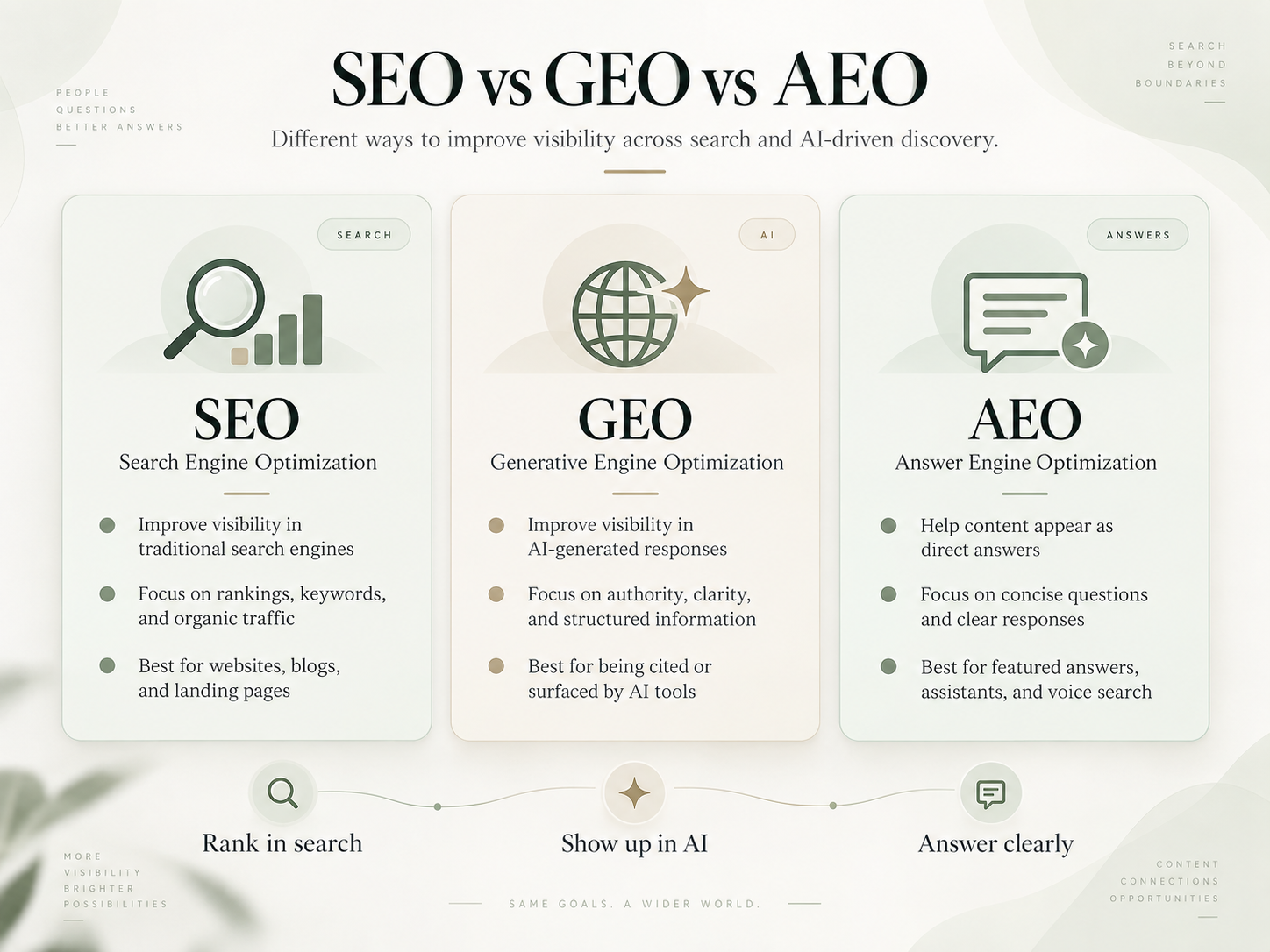
What is the difference between AEO and GEO? AEO (Answer Engine Optimization) and GEO (Generative Engine Optimization) describe the same discipline with slightly different emphases. AEO was coined by Jason Barnard (Kalicube) in 2018, originally for featured snippets and voice search, and has broadened to include all AI-generated answer surfaces. GEO, popularized by the Princeton/Georgia Tech research paper published at KDD 2024, emphasizes optimization for large language model responses specifically. In practice, both terms describe strategies for earning citation inside AI-generated answers. One useful three-layer model: SEO gets you found, AEO gets you explained clearly, and GEO gets you recommended with trust²⁸.
What content formats work best for AEO? Direct-answer paragraphs, FAQ sections with FAQPage schema, comparison tables, and numbered step-by-step sections all perform well for AI citation. AI engines prefer content that can be extracted and quoted without losing meaning out of context. Avoid relying on design elements, infographics, or embedded video as the sole carrier of key information; ensure the core answer always exists in plain text.
Conclusion
AEO is not a future-state strategy. AI search is already the first touchpoint for a growing share of your buyers, and the gap between businesses earning AI citations and those invisible in those answers is widening every month. With only 20% of marketers currently implementing AEO despite 70% recognizing its importance⁵, the competitive window is open now.
For small and mid-sized businesses, this is the moment to move. The brands that structure for AI citation today will own the shortlists their competitors haven’t found yet. The steps are clear: restructure your top pages to answer questions directly, implement schema markup, invest in earned media placements, and build your brand as a recognized entity across AI sources. Each step compounds. The conversion differential for AI-referred visitors, 14.2% versus 2.8% for standard organic in B2B IT⁴, makes the return measurable.
Driven Metrics builds integrated SEO, GEO, and AEO programs for small and mid-sized businesses, with transparent reporting and no vanity metrics. Clients have grown organic revenue 84% in five months, earned 111 first-place keyword rankings for a healthcare provider, and built AI-referred sessions from zero to hundreds within a single engagement.²⁶ Every program starts with a free audit that shows exactly where your AI visibility stands and where the gaps are.
Book Your Free AEO Audit with Driven Metrics
Last updated: July 24, 2026
Sources
- Ahrefs. “AI Overviews Reduce Click-Through Rate for Top-Ranking Pages by 58%.” Updated February 2026. https://ahrefs.com/blog/ai-overviews-reduce-clicks-update/
- Pew Research Center. “Google Users Are Less Likely to Click on Links When an AI Summary Appears in the Results.” July 22, 2025. https://www.pewresearch.org/short-reads/2025/07/22/google-users-are-less-likely-to-click-on-links-when-an-ai-summary-appears-in-the-results/
- WebFX. “Generative AI Search Trends: 2.3 Billion Session Analysis.” Updated March 2026. https://www.webfx.com/blog/seo/gen-ai-search-trends/
- Opollo. 2026 AI Search Benchmark Report (312 B2B IT and technology service firms, North America / Australia / UK). https://opollo.com/blog/the-2026-ai-search-benchmark-report/
- Acquia / Researchscape. Survey of 516 marketing professionals, US and UK, fielded July 11–31, 2025. https://www.acquia.com/blog/why-answer-engine-optimization-aeo-next-big-thing-digital-strategy-and-why-most-brands-arent
- Semrush. “AEO vs SEO: Core Differences & How to Win Visibility in Both.” September 2025. https://www.semrush.com/blog/aeo-vs-seo/
- Ahrefs. Brand Radar study, 15,000 long-tail queries. https://ahrefs.com/blog/ai-search-overlap/
- Google. AI Mode usage data, Google I/O 2026 keynote, May 2026. Via Search Engine Journal. https://www.searchenginejournal.com/google-shares-first-ai-mode-usage-data-after-one-year/575443/
- OpenAI. ChatGPT weekly active user announcement, February 27, 2026. Via Search Engine Land. https://searchengineland.com/chatgpt-900-million-weekly-active-users-470492
- Adobe Express. “What People Are Searching for on ChatGPT.” https://www.adobe.com/express/learn/blog/chatgpt-as-a-search-engine
- Darden School of Business, University of Virginia. “Nearly 60% Use AI to Shop.” June 2025. https://news.darden.virginia.edu/2025/06/17/nearly-60-use-ai-to-shop-heres-what-that-means-for-brands-and-buyers/
- Bain & Company / Dynata. Generative AI Consumer Survey, December 2024 (1,100+ US consumers). Write-up published February 2025.
- Search Engine Journal, reporting on ISB / Carnegie Mellon field experiment. “AI Overviews Cut Organic Clicks 38%.” 2026. https://www.searchenginejournal.com/ai-overviews-cut-organic-clicks-38-field-study-finds/573145/
- Aggarwal, Shrestha, et al. (Princeton University, Georgia Tech, IIT Delhi, Allen Institute for AI). “GEO: Generative Engine Optimization.” ACM KDD 2024. https://arxiv.org/abs/2311.09735
- Google Search Central. Structured data rich results documentation. https://developers.google.com/search/docs/appearance/structured-data/intro-structured-data
- Muck Rack. Generative Pulse: “What Is AI Reading?” May 2026. 25M+ links, 17 industries. Journalism: 27%; total earned media: 84%. https://muckrack.com/blog/what-is-ai-reading-may-2026
- Conductor / Advanced Web Ranking. AI Overviews prevalence tracking, 2026.
- Backlinko, citing Google’s Year in Search disclosures. https://backlinko.com/google-search-statistics
- Forrester Research. State of Business Buying 2026, January 2026 (~18,000 global business buyers). https://www.forrester.com/blogs/b2b_buyers_make_zero_click_buying_number_one/
- TNG Shopper. “SEO Statistics 2025: GEO, AEO, and Search Optimization Data.” https://www.tngshopper.com/post/seo-statistics-2025-geo-aeo-and-search-optimization-data
- Dimension Market Research. GEO/AEO market valuation and CAGR projections, 2025–2034.
- Grand View Research. SEO Software Market Size Report, 2023.
- Pew Research Center. 88% of AI summaries cite three or more sources. July 2025. https://www.pewresearch.org/short-reads/2025/07/22/google-users-are-less-likely-to-click-on-links-when-an-ai-summary-appears-in-the-results/
- Instant Press. “AEO & GEO Statistics for 2026.” July 13, 2026. https://www.instantpress.co/aeo-statistics
- Ahrefs. Own site traffic and signup data, reported June 2025. Single B2B SaaS data point. https://www.averi.ai/blog/ai-search-visitors-convert-23x-higher.-everyone-s-ignoring-it.
- Internal campaign analytics. Driven Metrics, May–June 2026.
- Responsive. 2025 Buyer Intelligence Study.
- Whitehat SEO. “Answer Engine Optimisation for UK Brands.” https://whitehat-seo.co.uk/answer-engine-optimisation