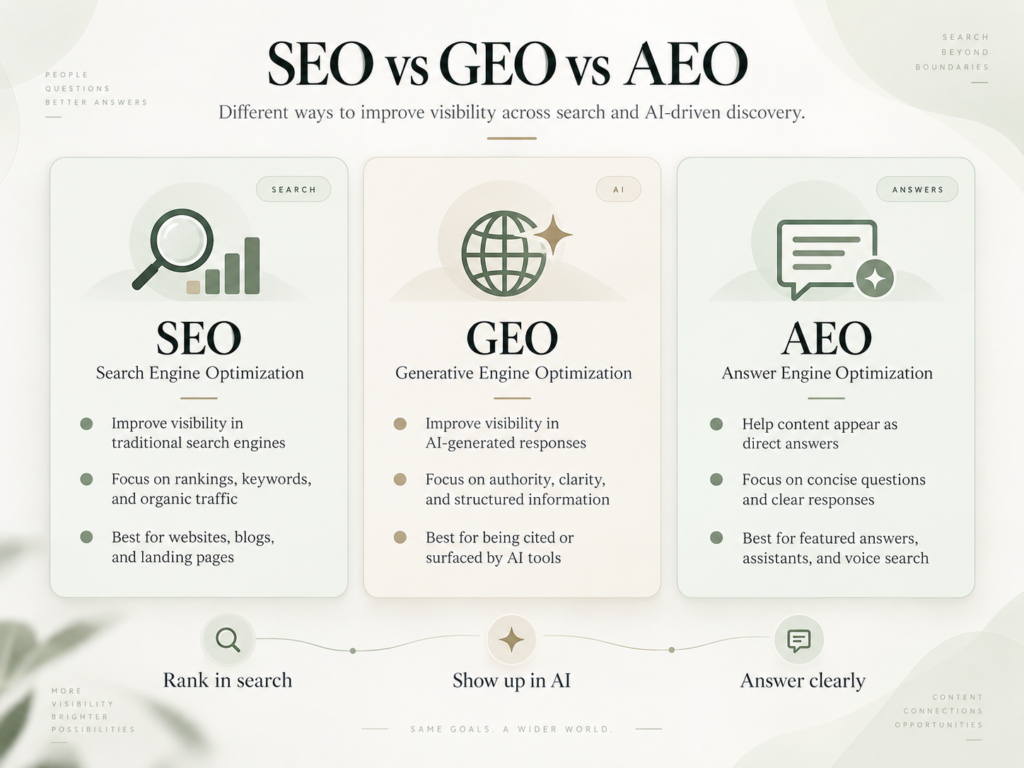

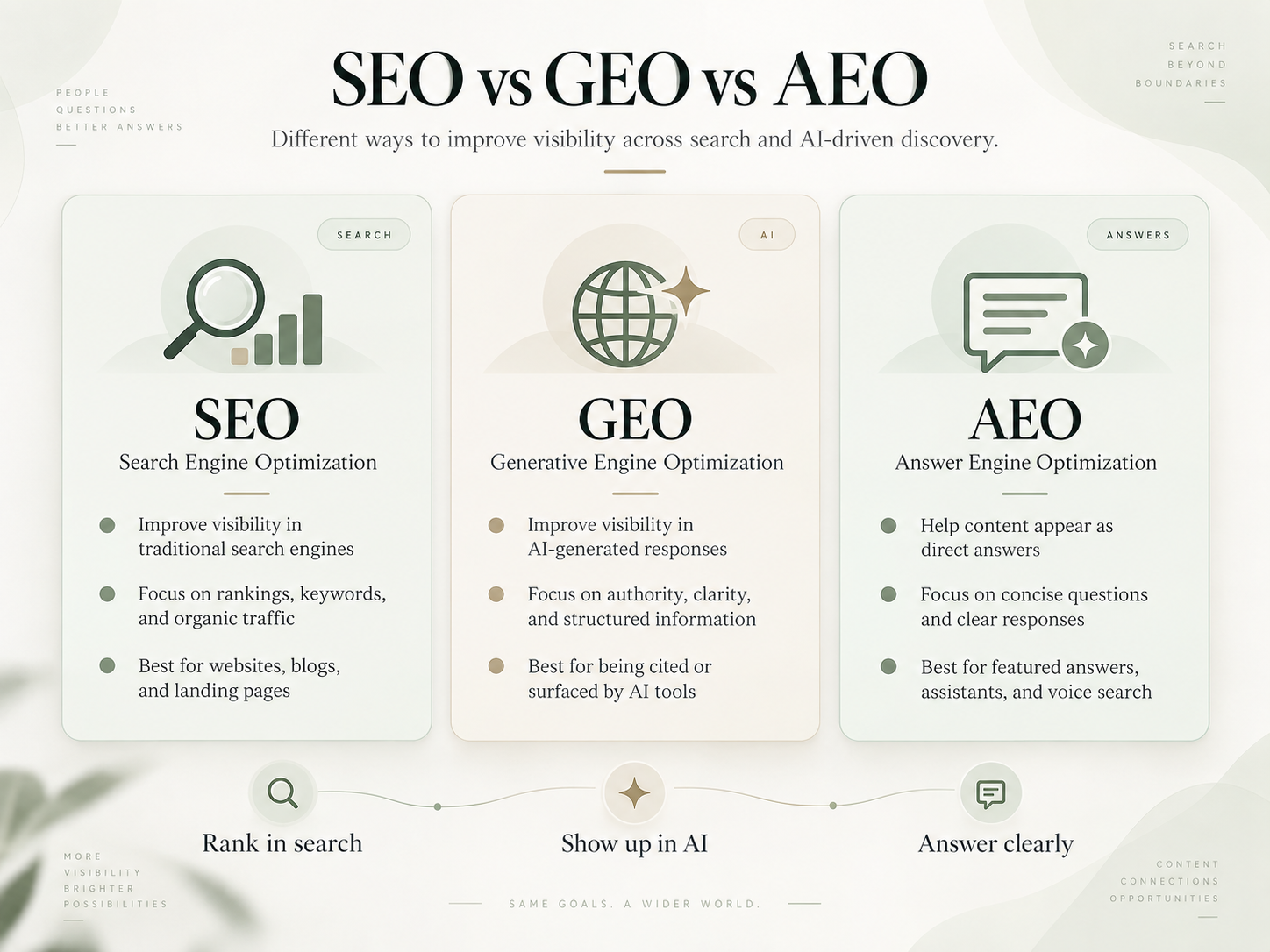

SEO helps a page appear in traditional search results. AEO helps content get extracted as a direct answer. GEO helps a brand become one of the sources an AI system retrieves and synthesizes into a response.
These disciplines overlap, but they solve different visibility problems. The right starting point depends on what your business is currently missing: discoverability, answer visibility, AI citations, or qualified leads.
AEO vs. GEO vs. SEO: What Is the Difference?
| Dimension | SEO | AEO | GEO |
| Core question | Can this page rank? | Can this content answer the query directly? | Can this content contribute to an AI-generated answer? |
| Primary objective | Improve discoverability | Improve answer extractability | Improve inclusion in synthesized responses |
| Main surfaces | Google, Bing, and traditional results | Featured snippets, People Also Ask, and assistants | ChatGPT, Claude, Perplexity, Gemini, Copilot, and AI Overviews |
| What happens to your content | It appears as a ranked result | It may be pulled or summarized from one source | It may be rewritten and combined with other sources |
| Attribution | Usually a clickable result link | Often a visible source attribution | May be a citation, brand mention, partial attribution, or no clear attribution |
| Optimization focus | Technical quality, relevance, authority, and search intent | Clear answers, structure, and extractability | Authority, corroboration, entity clarity, and source usefulness |
| Primary metrics | Rankings, traffic, leads, and conversions | Answer visibility, feature presence, and source clicks | Citation share, mention rate, source overlap, and brand accuracy |
| Best first use case | You are not ranking for valuable searches | You rank but lose visibility to answer features | AI systems omit or misrepresent your brand |
The short answer is simple:
- SEO makes information easier to find.
- AEO makes information easier to extract.
- GEO makes information more useful to generative systems that retrieve and combine multiple sources.
A strong page can support all three. However, you should prioritize the layer that matches your current visibility problem.
What Is SEO, and What Has Changed?
SEO is the process of helping search engines understand your content and helping users find your website through search. Google describes SEO as improving a site’s presence in Search through crawlability, organization, useful content, and user experience.¹
The foundation has not disappeared. Your website still needs to be:
- Accessible to search engines
- Relevant to the user’s query
- Technically sound
- Easy to understand
- Supported by credible signals
What has changed is the number of systems that can use information from your website. A page may now compete for:
- A traditional search ranking
- A featured snippet
- A People Also Ask result
- An AI Overview citation
- A ChatGPT or Perplexity citation
- A generated brand recommendation
SEO remains important because traditional search visibility and AI visibility can overlap. One Ahrefs analysis found that 12% of URLs cited by ChatGPT, Gemini, and Copilot also appeared in Google’s top 10 for the same prompt. The same research found that 76% of AI Overview citations came from pages ranking in Google’s top 10.³
These figures do not mean that ranking guarantees an AI citation. They show that traditional search performance can support AI visibility without controlling it.
SEO’s role in the visibility process
| Stage | What SEO helps a system do |
| Crawlability | Find and access the page |
| Relevance | Match the page to a search or prompt |
| Understanding | Interpret the topic, entities, and relationships |
| Authority | Assess whether the source is credible |
| Visibility | Display or retrieve the information |
Think of SEO as the discoverability foundation for every other search surface. If search engines and other systems cannot reliably find or interpret your website, optimizing for AI citations will be difficult.
What Are AEO and GEO?
AEO and GEO both focus on visibility beyond a standard blue-link result. The difference is what the system does with your content.
AEO focuses on extraction
Answer Engine Optimization helps a system identify, extract, and present a direct response. It is most useful when a platform selects a concise answer from one source or highlights a page within an answer feature.
AEO content often uses:
- Question-shaped headings
- Direct answers near the beginning of a section
- Clear definitions
- Concise paragraphs
- Structured lists and tables
- Supporting facts and examples
- Consistent terminology
AEO can support pages that answer questions about:
- Definitions
- Processes
- Costs
- Eligibility
- Product or service comparisons
- Troubleshooting
- Common customer questions
Featured snippets are one AEO surface, but they should not be the only target. People Also Ask results and AI assistants also rely on content that is clear, direct, and easy to interpret.
AEO process:
User question → Answer engine identifies a source → Content is extracted → User sees an answer and attribution
Writing for extraction does not mean writing for robots instead of people. A direct answer should still be accurate, useful, and persuasive for a human reader.
GEO focuses on retrieval and synthesis
Generative Engine Optimization focuses on helping content become useful to systems that retrieve, evaluate, and combine information from several sources.
The system may rewrite your content rather than display it word for word. Attribution may appear as a clickable citation, a brand mention, partial attribution, or no visible link.
The term GEO is associated with a research paper titled “GEO: Generative Engine Optimization.” The study introduced a framework for improving visibility in generative engine responses and reported visibility improvements of up to 40% in its experiments.² However, the tests used a generative engine designed to mimic Bing Chat, with stronger methods validated on Perplexity. They did not test every current platform, including ChatGPT, Gemini, Claude, or Google AI Overviews.
The paper also found that keyword stuffing performed below baseline. Citing sources, adding statistics, and including quotations were among the stronger methods in its experiments.²
GEO process:
User prompt → Retrieval from multiple sources → Source evaluation → Synthesized response → Variable attribution
GEO content should be:
- Authoritative
- Specific
- Well-supported
- Easy to interpret
- Relevant to the prompt
- Corroborated by other trustworthy sources
The exact tactics vary by platform. A page that performs well in Google AI Overviews may not receive the same visibility in ChatGPT or Perplexity.
The main difference
| If the system is trying to… | The primary discipline is… |
| Find and rank your page | SEO |
| Pull a direct answer from your page | AEO |
| Combine your information with other sources | GEO |
| Describe your company accurately | Entity clarity |
The acronyms may change over time. The underlying search behaviors are easier to measure.
Can One Page Support SEO, AEO, and GEO?
Yes. One well-built page can support all three disciplines, but it must satisfy different requirements at the same time.
| Layer | The page must help the system… |
| SEO | Find, crawl, understand, and rank the content |
| AEO | Identify and extract a direct answer |
| GEO | Retrieve and synthesize useful information |
| Entity clarity | Understand the business, subject, and relationships accurately |
Entity clarity is not a fourth optimization acronym. It is a cross-cutting requirement that supports SEO, AEO, and GEO.
It includes consistent information about:
- The company
- Services and products
- Locations
- Credentials
- Authors
- Industry or category
- Supporting references
For example, a service guide could include:
- A search-focused title and URL
- A concise answer near the top
- Question-based H2s
- Supporting data and citations
- An HTML comparison table
- Clear company and author information
- Internal links to relevant services
- A measurable conversion path
The page does not need three separate versions. It needs a clear structure that helps search engines, answer engines, AI systems, and human readers understand the same information.
Which Search Optimization Layer Should You Prioritize?
The right starting point depends on the visibility problem, not the acronym receiving the most attention.
| Current situation | Recommended priority |
| Your site does not rank for valuable searches | SEO foundations |
| Your pages rank but lose visibility to answer features | AEO structure and answer formatting |
| Your pages rank and earn snippets but rarely appear in AI responses | GEO and source authority |
| AI systems describe your company inaccurately | Entity clarity and third-party corroboration |
| Your content receives visibility but produces few leads | Search intent, conversion paths, and lead quality |
Start with this question:
Can your priority audience find your business when searching for the problem you solve?
If the answer is no, begin with SEO. There is little value in optimizing a page for AI citations when search engines cannot reliably discover or understand it.
If the answer is yes, ask whether your content is being extracted or synthesized. That distinction will determine whether AEO or GEO requires more attention.
Recommended order of operations
- Fix crawlability, indexability, and site-structure problems.
- Map valuable topics to the buyer journey.
- Improve priority pages with concise answer blocks.
- Publish useful, expert-led content.
- Strengthen company, service, author, and location information.
- Establish SEO and AI-visibility baselines.
- Expand into original research and advanced GEO work.
What to avoid at the beginning
Small and mid-sized businesses should not create separate content programs for every AI platform. They should improve a few important pages, establish clear measurements, and connect visibility efforts to qualified demand.
Avoid buying AI-visibility tools before defining the metric they measure. Also avoid replacing a working SEO program with an unmeasured AI-search experiment.
How Do You Measure SEO, AEO, and GEO?
Each layer requires different metrics.
| Layer | Metrics to track | Recommended data source |
| SEO | Rankings, organic traffic, qualified leads, and conversions | Analytics, CRM, and rank tracker |
| AEO | Featured-answer presence, People Also Ask visibility, and answer placement | Rank tracker |
| GEO | Citation share, mention rate, source overlap, and attribution type | Repeated prompt testing and AI-visibility tools |
| Entity clarity | Brand accuracy, category association, and factual consistency | Prompt testing and source audits |
| Business impact | Assisted conversions, branded demand, and qualified pipeline | Analytics and CRM |
Google Search Console does not provide a featured-snippet search-appearance filter, so it should not be the only tool used for AEO measurement. A rank tracker is better suited to monitoring search features.
Analytics platforms also cannot capture every brand mention, uncited AI response, or influence from an answer that produces no click.
How to test AI search visibility
A practical test should use a consistent prompt set across relevant platforms. Record:
- Prompt wording
- Platform and interface
- Date and time
- Account or region settings
- Number of runs per prompt
- Cited domains and URLs
- Brand mentions
- Attribution type
- Citation overlap between platforms
- Overlap between AI-cited sources and Google’s top 10
Group prompts into three categories:
| Prompt category | What to examine |
| Extraction | Which sources are used for direct answers? |
| Generation | Which sources are cited or synthesized? |
| Entity representation | How accurately is each brand described? |
Generative outputs vary by date, location, account, prompt wording, and run. A single response is not a reliable measurement. Repeated tests can reveal directional patterns.
If the same prompt produces different answers across multiple runs, that is not necessarily a testing failure. It is part of the behavior being measured.
A narrow Semrush study found that AI search visitors converted at 4.4 times the rate of traditional organic visitors. However, the study analyzed more than 500 digital marketing and SEO-related topics, a category with unusually high AI adoption. The result should not be treated as an all-industry benchmark.⁴
The most useful measurement question is not simply, “Did we receive an AI citation?”
It is:
Did increased visibility improve qualified demand, brand accuracy, or the next step in the buying journey?
Frequently Asked Questions About AEO, GEO, and SEO
Is AEO the same as GEO?
No. AEO generally focuses on extraction, such as having a direct answer selected for a search feature. GEO focuses on retrieval and synthesis, where information from several sources may be combined into a new response.
The terms are used inconsistently, so define the search surface and mechanism you are discussing.
Is SEO dead?
No. SEO remains the foundation for helping search engines discover, understand, and rank content. It can also support AI visibility because many systems retrieve information from established web sources.
SEO alone does not guarantee AI citations. However, ignoring SEO can limit discoverability across every search surface.
Can one page rank for SEO, AEO, and GEO at the same time?
Yes. A page can use sound SEO foundations, direct-answer formatting, clear entities, supporting evidence, and useful original insight.
The page does not need to choose one acronym. It needs to satisfy the user and make its information easy for multiple systems to interpret.
How long does GEO take to show results?
There is no universal timeline. Visibility depends on the site’s authority, topic, competition, source quality, platform, prompt set, and measurement method.
Track progress through repeated tests rather than relying on a single response or one-time mention.
Which Search Optimization Layer Do You Need?
SEO, AEO, and GEO are not mutually exclusive strategies.
SEO makes your business discoverable. AEO makes your answers easier to extract. GEO makes your expertise more useful to generative systems. Entity clarity supports all three by helping search engines and AI systems understand who you are, what you offer, and why your information is credible.
Start with the visibility problem you can observe:
- If you are not ranking, improve SEO foundations.
- If you rank but lose answer visibility, improve AEO structure.
- If AI systems overlook or misrepresent your business, investigate GEO, authority, and entity consistency.
- If visibility is strong but leads are weak, improve search intent alignment and conversion paths.
The best strategy is not the one with the newest acronym. It is the one that connects visibility to qualified demand and measurable business outcomes.
Last updated: September 14, 2026