
Key Findings
Driven Metrics compared OpenAI’s new ChatGPT Business Hub with the two other first-party AI visibility consoles and six third-party trackers, as of November 16, 2026:
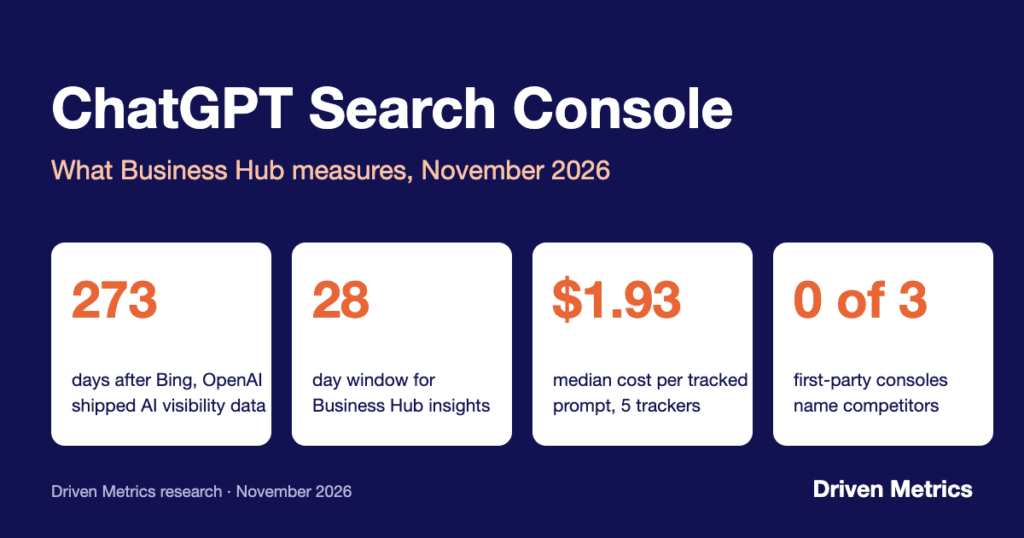
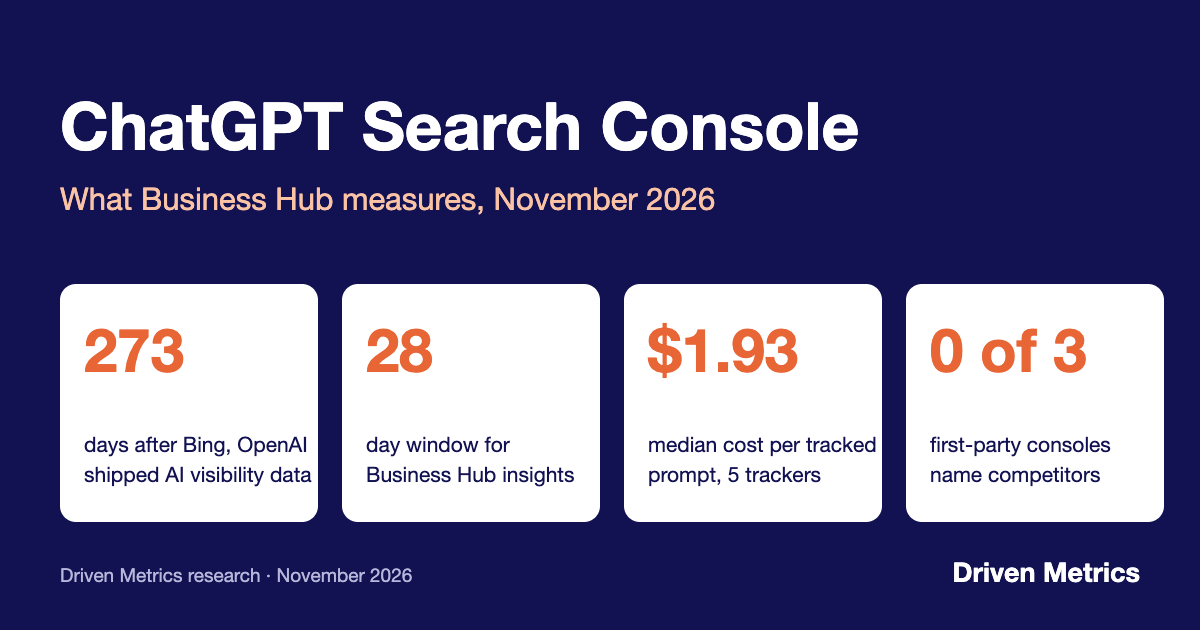
- OpenAI launched Business Hub, the closest thing to a ChatGPT search console, on November 10, 2026, 273 days after Bing added AI citation data to Bing Webmaster Tools on February 10, 2026 (our calculation).
- In ChatGPT Business Hub, a mention of an online business counts only when ChatGPT references the business’s website; the brand name alone does not count, according to OpenAI’s help center in November 2026.
- Of the 3 first-party AI visibility consoles from OpenAI, Google and Microsoft Bing, ChatGPT Business Hub is the only one that reports clicks from AI answers to a website as of November 2026.
- None of the 3 first-party consoles names competitors as of November 2026; Bing’s Citation Share uses all sites as a denominator but does not show other domains.
- Five third-party AI visibility trackers with published entry plans charged a median of $1.93 per tracked prompt per month in November 2026, ranging from $1.90 to $4.73 (our calculation, n=5).
- Two real Business Hub dashboards shared publicly in November 2026 showed 3.5 and 3.6 website clicks per 100 mentions over 28 days, about one-tenth of the 35.4 in OpenAI’s demo dashboard (our calculation, n=2; reported figures).
On November 6, 2026, Search Engine Roundtable reported that OpenAI was building a Search Console-like tool that would let businesses “claim your business in ChatGPT” and track how often ChatGPT mentions them. Four days later, on November 10, 2026, OpenAI launched Businesses in ChatGPT in beta. Its Business Hub shows a verified business its mentions, website clicks and discovery topics inside ChatGPT, which OpenAI says reaches 1.2 billion people each week.
Our analysts compiled 38 data points on 9 AI visibility data sources: 3 first-party consoles (ChatGPT Business Hub, Google Search Console’s Search Generative AI reports and Bing Webmaster Tools’ AI Performance report) and 6 third-party prompt trackers (Peec AI, Promptwatch, Otterly.AI, Semrush AI Visibility Toolkit, Ahrefs Brand Radar AI and Profound), plus 3 Business Hub dashboard readings shared publicly. Sources were published from February 10 to November 16, 2026. By “ChatGPT search console” we mean OpenAI’s Business Hub. If you were looking for ways to connect Google Search Console data to ChatGPT, that is a separate topic covered by connector apps, not by OpenAI.
In the following sections, we define what Business Hub counts, compare it with Google and Bing’s AI reports, score all three against third-party trackers, price third-party tracking, show the first click-to-mention ratios, and map which data source answers which AI visibility question.
What ChatGPT Business Hub Measures: Mentions, Website Clicks and Discovery Topics
In the table below, we list each metric in ChatGPT Business Hub’s Insights tab, what OpenAI counts, and what it leaves out, from OpenAI’s help center documentation captured November 16, 2026.
| Metric | What OpenAI counts | What it does not count or show | Window |
|---|---|---|---|
| Mentions (online business) | ChatGPT references the business’s website | The brand name alone, with no website reference | Past 28 days |
| Mentions (local business) | ChatGPT shows a result for that location | Whether the customer opened the listing or visited the site (counts either way) | Past 28 days |
| Website clicks | Clicks through to the business’s website | Website visits or conversions (per the in-product tooltip) | Past 28 days |
| Discovery topics | Common themes in ChatGPT answers that mentioned or cited the business | Individual prompts, customer conversations or a direct measure of intent | Past 28 days |
Source: Driven Metrics analysis of the OpenAI Help Center and the clicks tooltip reported by Search Engine Roundtable, November 2026. Note: insights appear only after a claim and Persona identity verification are approved, and only when activity clears a threshold OpenAI does not publish. A blank metric does not mean zero.
- ChatGPT Business Hub defines a mention of an online business as a reference to its website, so a Business Hub “mention” is closer to what third-party trackers call a citation than to a brand mention (OpenAI Help Center, November 2026).
- The definition explains the gap you will see between tools: a tracker that counts every answer naming your brand will report more mentions than Business Hub for the same period, because Business Hub skips unlinked brand names.
- So if you report Business Hub mentions to a client or a board, label them as website references over 28 days, not brand mentions, and don’t add them to a tracker’s mention rate.
OpenAI’s help center documents the 28-day window. Press coverage of the live dashboard, including PPC Land, also describes a 7-day view and a profile views tile.
ChatGPT Search Console vs Google Search Console vs Bing Webmaster Tools
In the table below, we compare the AI visibility reports inside the three first-party consoles on launch date, AI surfaces covered, unit counted and available detail, as of November 16, 2026.
| Attribute | ChatGPT Business Hub | Google Search Console (Search Generative AI reports) | Bing Webmaster Tools (AI Performance) |
|---|---|---|---|
| Launch date | November 10, 2026 (beta) | June 3, 2026 (subset of sites); all sites August 31, 2026 | February 10, 2026 (public preview); 4 features added June 16, 2026 |
| Days after Bing’s launch | 273 | 113 | 0 |
| AI surfaces covered | ChatGPT | AI Overviews, AI Mode and AI features in Discover | Microsoft Copilot, AI summaries in Bing and select partner integrations |
| Unit counted | Mention (website referenced, or location result shown) | Impression (a site URL appeared in an AI feature) | Citation (a page shown as a source in an AI answer) |
| Clicks from AI answers | Yes | No (impressions only in the AI view) | Not reported |
| Query or prompt detail | No; grouped discovery topics only | No | Grounding queries (a sample of AI retrieval phrases) |
| Topic grouping | Discovery topics | No | Topics and Intents (added June 16, 2026) |
| Competitive view | No | No | Citation Share against all sites; competitor domains not shown |
| Time view | Past 28 days | Hourly, daily, weekly and monthly | Selected period, with a compare-to-previous-period view |
| Access | Claim plus Persona identity verification | Verified property | Verified site |
| Price | No fee published (beta) | Free | Free |
Source: Driven Metrics analysis of OpenAI, the OpenAI Help Center, the Google Search Central Blog, and the Bing Webmaster Blog (February 2026 and June 2026), November 2026. Day counts are our calculations.
- ChatGPT Business Hub is the only first-party AI visibility report that counts clicks from AI answers to a website as of November 2026; Google’s generative AI view reports impressions and Bing’s AI Performance report counts citations.
- Each console counts a different event (a website reference, a URL impression, a cited page), because each platform shows sources differently, so a number from one cannot be compared directly with a number from another.
- If you report AI visibility across platforms, keep each console’s metric under its own name and trend each one against itself.
Business Hub had a short public run-up. Juozas Kaziukėnas, who posted the first screenshot on LinkedIn, told Search Engine Roundtable he had seen the feature’s first steps as early as August 2026.
First-Party vs Third-Party AI Visibility Data: Capability Matrix
In the table below, we score the three first-party consoles and third-party prompt trackers as a group on 8 capabilities a ChatGPT visibility report needs, as of November 16, 2026. Third-party capabilities are drawn from the published feature lists of the 6 trackers in our dataset, so “Yes” means the category offers it, not that every tool does.
| Capability | ChatGPT Business Hub | Google Search Console | Bing Webmaster Tools | Third-party trackers |
|---|---|---|---|---|
| Counts real user activity | Yes | Yes | Yes | No (runs a chosen prompt set) |
| Reports clicks from AI answers | Yes | No | No | Partial (site referral analytics on some tools) |
| Shows queries or prompts | No | No | Yes (sampled grounding queries) | Yes (your prompts) |
| Groups activity into topics | Yes | No | Yes | Yes |
| Shows page-level data | No | Yes | Yes | Yes |
| Compares you with competitors | No | No | Partial (share, no domains) | Yes |
| Covers more than one AI platform | No | No | No | Yes |
| Shows answer text or sentiment | No | No | No | Yes |
| Capabilities (of 8) | 3 | 2 | 4.5 | 6.5 |
Source: Driven Metrics analysis of OpenAI, Google, Microsoft Bing and vendor documentation for Peec AI, Promptwatch, Semrush and Profound, captured November 16, 2026. Note: Yes = 1 point, Partial = 0.5, No = 0. Scores are our calculations.
- Third-party prompt trackers covered 6.5 of 8 AI visibility capabilities in November 2026, compared with 4.5 for Bing Webmaster Tools, 3 for ChatGPT Business Hub and 2 for Google Search Console (our calculation).
- The split is structural: first-party consoles see real user activity on one platform, while trackers run a sample of prompts across many platforms and can read every answer, including the competitors named in it.
- We think the practical setup for 2027 is both: Business Hub as the ChatGPT ground truth for references and clicks, and a tracker for the prompts, competitors and answer text Business Hub will not show.
What Third-Party AI Visibility Tracking Costs Next to ChatGPT’s Own Console
In the table below, we break down the entry plan of each third-party tracker by monthly list price, tracked prompts and AI answers per month, and calculate the cost per tracked prompt and per 1,000 AI answers, from vendor pricing pages captured November 16, 2026.
| Tracker | Entry plan | Monthly price (USD) | Tracked prompts | AI platforms at entry | AI answers per month | Cost per tracked prompt (USD) | Cost per 1,000 AI answers (USD) |
|---|---|---|---|---|---|---|---|
| Peec AI | Starter | $95 | 50 | 3 (your choice) | 4,500 | $1.90 | $21.11 |
| Promptwatch | Essential | $95 | 50 | All listed models | 6,000 | $1.90 | $15.83 |
| Otterly.AI | Lite | $29 | 15 | 4 | 1,800 | $1.93 | $16.11 |
| Semrush AI Visibility Toolkit | Base | $99 | 25 | Not fully listed | Not published | $3.96 | Not available |
| Ahrefs Brand Radar AI | Lite + Brand Radar AI + Basic prompt checks | $378 | 80 (daily) | 1 | 2,500 checks | $4.73 | $151.20 |
| Profound | No published paid plan | Custom | Custom | Up to 10 (Enterprise) | Custom | Not available | Not available |
| ChatGPT Business Hub (reference) | Beta | No fee published | None (real conversations) | 1 | Not applicable | Not applicable | Not applicable |
Source: Driven Metrics analysis of pricing pages for Peec AI, Promptwatch, Otterly.AI, Semrush, Ahrefs and Profound, captured November 16, 2026. Note: monthly billing list prices. Otterly.AI answers = 15 prompts × 4 platforms × 30 days (our calculation). The Ahrefs row adds the $129 Lite plan, the $199 Brand Radar AI starting price and the $50 Basic custom prompt package (2,500 checks, about 80 prompts daily on 1 platform). Cost columns are our calculations.
- Five AI visibility trackers with published entry plans charged a median $1.93 per tracked prompt per month in November 2026, with Peec AI and Promptwatch lowest at $1.90 and the Ahrefs entry bundle highest at $4.73 (our calculation, n=5).
- The spread comes from what each price bundles: Peec AI, Promptwatch and Otterly.AI sell standalone trackers, while Semrush and Ahrefs sell AI tracking as one part of an SEO suite.
- Business Hub has no published fee, but it tracks no prompts and only one platform, so it changes what you buy a tracker for (prompts, competitors and other engines) rather than replacing one.
Profound stands out because it no longer publishes a paid self-serve plan for brands. Its pricing page, captured November 16, 2026, lists a free 7-day trial of 50 daily prompts on ChatGPT, Gemini and Google AI Overviews, and a custom Enterprise tier covering up to 10 answer engines.
Early ChatGPT Business Hub Data: Website Clicks per 100 Mentions
In the table below, we list the only Business Hub dashboard figures shared publicly in the first week after launch, as reported by PPC Land, and calculate website clicks per 100 mentions for each, November 2026.
| Dashboard | Window | Mentions | Website clicks | Clicks per 100 mentions | Firmness |
|---|---|---|---|---|---|
| OpenAI demo (fictional toy shop, Colorful Clatter) | 7 days | 15,356 | 5,432 | 35.4 | Reported |
| BuildUp Bookings | 28 days, data through Nov 9, 2026 | 690 | 24 | 3.5 | Reported |
| Zianvo | 28 days, data through Nov 9, 2026 | 28 | 1 | 3.6 | Reported |
Source: Driven Metrics analysis of dashboard figures reported by PPC Land, November 2026. Note: clicks per 100 mentions = website clicks ÷ mentions × 100 (our calculation). The two real dashboards were posted on X by their operators.
- Two real ChatGPT Business Hub dashboards shared in November 2026 recorded 3.5 and 3.6 website clicks per 100 mentions over 28 days, about one-tenth of the 35.4 shown in OpenAI’s demo dashboard (our calculation, n=2).
- Two dashboards are not a benchmark, and clicks ÷ mentions is not a search click-through rate: a mention is a website reference inside an answer, not a ranked listing a user scrolls past.
- Record your first 28-day reading now, then take each new reading 28 days later so the windows don’t overlap, and compare clicks with ChatGPT referral sessions in your analytics, since OpenAI says a click does not confirm a visit.
For context on how much traffic AI assistants send to websites, see our AI referral traffic statistics.
Which ChatGPT Visibility Question Each Data Source Answers
In the table below, we map seven questions teams ask about ChatGPT and AI visibility to the data source that can answer each one, based on the definitions in Tables 1 to 3, November 2026.
| Question | Best source | Why |
|---|---|---|
| How many real ChatGPT answers referenced my website? | ChatGPT Business Hub | Only source counting real ChatGPT conversations |
| How many clicks did ChatGPT record to my site? | ChatGPT Business Hub, checked against analytics | Only console reporting AI-answer clicks; clicks don’t confirm visits |
| Does ChatGPT name my brand without linking to me? | Third-party tracker | Business Hub does not count brand names without a website reference |
| Which brands does ChatGPT recommend instead of mine? | Third-party tracker | No first-party console names competitors |
| Which prompts trigger my brand? | Third-party tracker | Business Hub shows grouped topics, not prompts |
| How often do my pages appear in AI Overviews and AI Mode? | Google Search Console | Generative AI report counts impressions by page |
| How often does Copilot cite my pages, and for what queries? | Bing Webmaster Tools | AI Performance counts citations by page and grounding query |
Source: Driven Metrics analysis of OpenAI, Google, Microsoft Bing and vendor documentation, November 2026.
- Of 7 common AI visibility questions, ChatGPT Business Hub answers 2 on its own as of November 2026, third-party trackers answer 3, and Google and Bing’s consoles answer 1 each (our calculation).
- Business Hub’s two answers, real references and recorded clicks, are the ones no tracker can produce, because trackers never see real users or real clicks.
- Build your ChatGPT report around Business Hub’s numbers for outcomes and a tracker’s numbers for causes: which prompts, which competitors, which sources.
For how Google’s AI surfaces link out, see our AI Mode link statistics.
What ChatGPT’s Search Console Means for AI Visibility Metrics in 2027
Until November 10, 2026, every ChatGPT visibility number came from outside OpenAI: prompt samples run by trackers, plus referral sessions in site analytics. Business Hub is the first count from inside ChatGPT, and it lands on the two things trackers can’t see, real references and real clicks. It also redefines the word “mention” for online businesses, which will cause reporting mix-ups until teams adjust their labels.
What to watch: whether OpenAI adds prompt-level data, longer history or exports; how many businesses clear the reporting threshold; whether click-to-mention ratios hold near the 3.5 to 3.6 range as more dashboards are shared; and whether trackers start calibrating their prompt samples against Business Hub counts. OpenAI says it plans to expand Businesses in ChatGPT to more markets and business categories.
So if you are deciding where ChatGPT visibility data should come from, claim and verify your Business Hub listing for the ground truth, and keep a tracker for the prompts and competitors Business Hub won’t show.
Data Collection and Methodology
Unit of analysis. Each row in our dataset is one published data point about one AI visibility data source: a value, what it measures, its population, its period, its source and the date we captured it. The 38 rows cover 9 data sources (3 first-party consoles, 6 third-party trackers), 3 Business Hub dashboard readings and 3 calculated figures.
Inclusion rules. First-party consoles: AI visibility reports run by an AI platform’s owner for site or business owners, launched by November 16, 2026. Third-party trackers: commercial tools that run prompts in ChatGPT and other AI platforms and publish plan details on their own pricing or documentation pages. We excluded connector apps that pipe Google Search Console data into ChatGPT, because they don’t measure AI visibility. We excluded trackers whose pricing we could only find on review or comparison sites.
Collection date and period. Sources published February 10 to November 16, 2026. Pricing and documentation pages were captured November 16, 2026.
Definitions. A Business Hub mention for an online business is a ChatGPT reference to the business’s website; for a local business it is a location result shown. A Google impression is a site URL appearing in a generative AI feature. A Bing citation is a page shown as a source in an AI answer. A tracked prompt is one prompt a tracker runs on a schedule. An AI answer is one prompt run on one platform once.
Firmness. Disclosed figures come from the platform or vendor’s own page. Reported figures come from news coverage citing a company or a public post (the dashboard readings in Table 5). Calculated figures are ours.
Formulas.
- Days between launches = later launch date − earlier launch date (Feb 10 to Jun 3, 2026 = 113; Jun 3 to Nov 10, 2026 = 160; Feb 10 to Nov 10, 2026 = 273)
- Cost per tracked prompt = monthly list price ÷ tracked prompts on the entry plan
- AI answers per month (Otterly.AI) = tracked prompts × platforms × 30 days; Peec AI and Promptwatch figures are as published
- Cost per 1,000 AI answers = monthly list price ÷ AI answers per month × 1,000
- Ahrefs entry bundle = $129 Lite + $199 Brand Radar AI starting price + $50 Basic custom prompt package
- Clicks per 100 mentions = website clicks ÷ mentions × 100
- Capability score = count of Yes (1 point) plus Partial (0.5 points) across 8 capabilities
| Score | Meaning |
|---|---|
| 1 (Yes) | The capability is documented on the platform’s or vendor’s own page |
| 0.5 (Partial) | Documented with a stated limit, such as share without competitor names, or available on some trackers only |
| 0 (No) | Not documented, or documented as unavailable |
Source: Driven Metrics scoring rubric, November 2026.
Rounding and currency. US dollars at monthly billing list prices, rounded to the cent. Ratios rounded to one decimal. Medians use all priced trackers (n=5).
Limits of the data.
- Business Hub is in beta, and OpenAI may change metric definitions, windows and thresholds without notice.
- The click-to-mention ratios rest on 2 real dashboards, both reported secondhand, and cannot represent all businesses.
- Third-party capabilities are scored as a category; individual trackers differ, and a “Yes” does not mean every tool offers it.
- Entry plans differ in platforms, cadence and limits, so cost per prompt compares list prices, not equal workloads.
- Vendor prices change often; the Promptwatch page was running a Black Friday promotion when captured.
- We did not run our own Business Hub account or tracker tests for this report.
To request the full dataset or a PDF copy of this report, contact Driven Metrics, or download the dataset (CSV).
Further Reading
- AI Referral Traffic Statistics 2026
- AI Mode Link Statistics 2026
- AI Overviews Citations Statistics 2026
- ChatGPT Local Business Recommendation Rate: 2026 Statistics
About the Author
Emily Connor is the Founder and CEO of Driven Metrics, an SEO and generative engine optimization agency. She works with brands on how they show up in Google and in AI answers from ChatGPT, Gemini and Perplexity, and leads the Driven Metrics research program. Learn more about Driven Metrics.
Sources
- Driven Metrics analysis of AI visibility data sources: 3 first-party consoles, 6 third-party trackers and 3 Business Hub dashboard readings, February 10 to November 16, 2026, conducted November 2026. Dataset (CSV)
- OpenAI, “Introducing Businesses in ChatGPT,” November 10, 2026.
- OpenAI Help Center, “Setting up your business on ChatGPT,” accessed November 16, 2026.
- Search Engine Roundtable, Barry Schwartz, “OpenAI Working On ChatGPT Tools For Business For Analytics & Citations,” November 6, 2026.
- Search Engine Roundtable, Barry Schwartz, “Businesses in ChatGPT Business Hub Live With Click Data,” November 10, 2026.
- PPC Land, “Businesses gain ChatGPT click and mention counts in OpenAI’s Business Hub,” November 2026.
- Google Search Central Blog, Hillel Maoz and Moshe Samet, “Introducing Search Generative AI performance reports in Search Console,” June 3, 2026 (updated August 31, 2026).
- Bing Webmaster Blog, “Introducing AI Performance in Bing Webmaster Tools Public Preview,” February 10, 2026.
- Bing Search Blog, “New AI Visibility Insights in Bing Webmaster Tools: Intents, Topics, Citation Share, Compare,” June 16, 2026.
- Peec AI, “Pricing for Brands,” accessed November 16, 2026.
- Promptwatch, “Pricing,” accessed November 16, 2026.
- Otterly.AI, “Pricing,” accessed November 16, 2026.
- Semrush Knowledge Base, “AI Visibility Toolkit,” accessed November 16, 2026.
- Ahrefs, “Plans & pricing,” accessed November 16, 2026.
- Profound, “Pricing,” accessed November 16, 2026.
Driven Metrics research · November 2026