
Key Findings
Driven Metrics compared 122 data points from 15 published reports on YouTube AI visibility. We found:
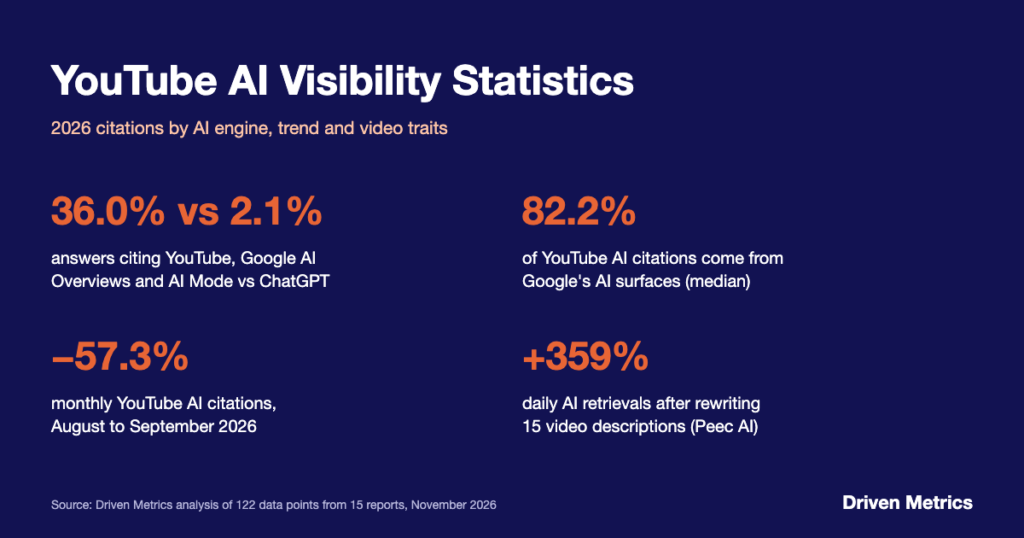
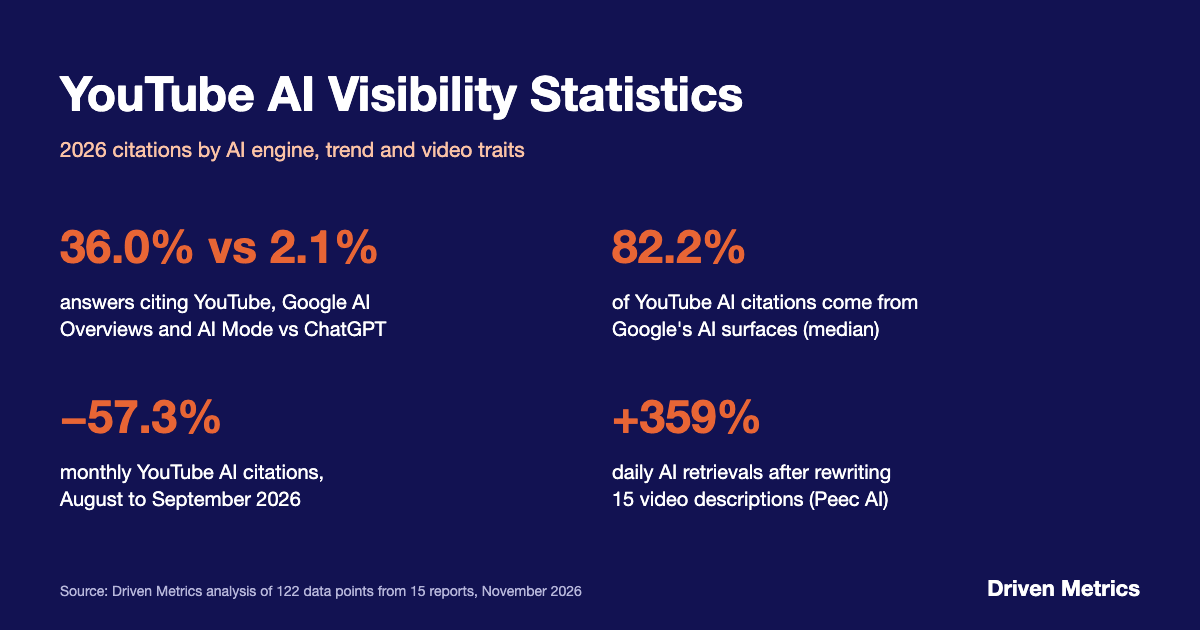
- Google AI Overviews and AI Mode cited YouTube in 36.0% of 127,558 B2B software answers from June to September 2026, compared with 2.1% of 55,073 ChatGPT answers, a 17.1x gap (our calculation).
- Google’s AI surfaces produced a median 82.2% of all YouTube citations across six 2025 and 2026 measures from Foundation, Meltwater, Goodie and OtterlyAI (our calculation).
- YouTube held a median 2.2% of all citations across six multi-engine AI citation datasets in 2026, while ranking first or second among all cited domains in Meltwater, Peec AI and Goodie data (our calculation).
- Meltwater counted 92,855 YouTube citations in AI answers in September 2026, down 57.3% from August and 59.5% below the July 2026 peak of 229,300 (59.5% is our calculation).
- In a Peec AI test reported November 6, 2026, 15 YouTube videos with rewritten descriptions and timestamps saw daily AI retrievals rise 359%, compared with 17% for unchanged videos, so the revised group grew 3.9x as much (our calculation).
YouTube AI visibility is how often AI answer engines such as Google AI Overviews, Google AI Mode, Gemini, Perplexity and ChatGPT cite, link to or retrieve YouTube videos when they answer a question. On November 6, 2026, Search Engine Land reported a Peec AI test in which rewriting the descriptions on existing videos lifted daily AI retrievals 359%, with no new video. That raises a practical question for any brand with a YouTube channel: how much AI visibility is actually on the table, and on which engines?
To answer it, our analysts compiled 122 data points from 15 reports by 11 research publishers, released between September 2025 and November 2026. The reports cover more than 100 million AI citations, 204,926 individually counted AI answers, 17,780 cited videos and a 75,000-brand correlation study. In this report, a citation is a link to youtube.com inside an AI answer, and a retrieval is a time an AI system pulls a video’s page while building an answer, as Peec AI tracks it.
In the following sections, we break down how often each AI engine cites YouTube, explain why published YouTube citation shares range from 1.5% to 29.5%, measure how much of YouTube’s AI visibility comes from Google, track monthly citation volume, compare the traits of the most-cited videos, and look at the description test in detail.
How Often AI Engines Cite YouTube, by Engine
In the table below, we compare the share of AI answers that cite at least one YouTube URL, by engine, across the three 2026 studies that report this answer-level rate. We also give the median for each engine.
| AI engine | Foundation, Jun–Sep 2026 (%) | Scrunch, May–Jul 2026 (%, approx.) | Analyze AI, 2026 (%) | Median across studies (%) |
|---|---|---|---|---|
| Google AI Overviews | 36.5 | 27 | n/a | 31.8 |
| Google AI Mode | 35.6 | 30 | 7.5 | 30.0 |
| Perplexity | n/a | 15 | 9.2 | 12.1 |
| Gemini | n/a | 4 | n/a | 4.0 |
| Microsoft Copilot | n/a | 0.5 | n/a | 0.5 |
| ChatGPT | 2.1 | 0.3 | 0.01 | 0.3 |
Source: Driven Metrics analysis of Foundation (182,631 answers to 5,000 B2B software prompts), Scrunch (millions of citation events across six engines) and Analyze AI (22,295 answers to 460 B2B prompts) data, November 2026. Note: Scrunch publishes rates as approximate chart values, rounded here as shown. n/a means the study did not track that engine. Medians are our calculations.
Key Findings
- Google AI Overviews (median 31.8%) and Google AI Mode (median 30.0%) cite YouTube in roughly 1 in 3 answers, while ChatGPT’s median is 0.3% across three 2026 studies (our calculation).
- Google owns YouTube, and Ahrefs reported that both AI Mode and AI Overviews cite YouTube more than any other domain. ChatGPT cited YouTube in 1 of 7,651 answers in Analyze AI’s B2B sample and 2.1% of 55,073 answers in Foundation’s.
- If a brand’s buyers search in Google, YouTube is a real path into AI answers. For ChatGPT visibility, YouTube does little on its own.
Our read on this: the AI Mode spread, from 7.5% to 35.6%, is mostly about prompts. Analyze AI and Foundation both used B2B prompts. Foundation’s were bottom-of-funnel queries such as “best of,” reviews and comparisons, where it found YouTube in 34.9% to 46.5% of Google answers. Analyze AI did not publish its prompt mix.
YouTube’s Share of AI Citations: Why Studies Range From 1.5% to 29.5%
Published figures for “YouTube’s share of AI citations” disagree by a factor of 20. In the table below, we line up every measure we found, with the engines each one covers, so the numbers can be compared on the same basis. Where a study published only the inputs, we did the division.
| Study | Engines covered | Period | YouTube share of all citations (%) | How we got it |
|---|---|---|---|---|
| BrightEdge | Google AI Overviews | May 2024–Sep 2025 | 29.5 | Disclosed |
| BrightEdge | Google AI Mode | May 2024–Sep 2025 | 16.6 | Disclosed |
| Ahrefs | Google AI Overviews (cited URLs) | Published Mar 2026 | 5.6 | Disclosed |
| Foundation | AI Overviews, AI Mode, ChatGPT | Jun–Sep 2026 | 3.8 | 83,835 ÷ 2,227,822 |
| Meltwater | 8 models | Aug 2026 | 2.9 | 212,500 ÷ ~7.3M |
| Meltwater | 8 models | May 2026 | 2.4 or less | 188,863 ÷ 8M+ (ceiling) |
| Goodie | ChatGPT, Gemini, Claude, Perplexity | Not stated | 2.1 | Disclosed |
| OtterlyAI | 6 engines | 30 days, published Mar 2026 | 1.8 | 5.54% social share × 31.8% YouTube share of social |
| Meltwater | 8 models | Sep 2026 | 1.5 | 92,855 ÷ ~6.1M |
Source: Driven Metrics analysis of BrightEdge, Ahrefs, Foundation, Meltwater, Goodie and OtterlyAI data, November 2026. Note: Meltwater gives total citations as approximate or “more than” figures, so its shares are approximate, and the May share is a ceiling. BrightEdge does not publish its denominator.
Key Findings
- Single-engine Google AI Overviews figures run from 5.6% (Ahrefs, share of cited URLs) to 29.5% (BrightEdge), while the six multi-engine measures sit between 1.5% and 3.8%, a median of 2.2% (our calculation).
- The gap comes from the denominator. Adding engines that rarely cite YouTube, such as ChatGPT and Claude, shrinks YouTube’s share of the total, and “share of citations” and “share of answers” are different measures.
- When a vendor quotes a YouTube citation share, check which engines and which denominator it uses before comparing it with your own tracking.
YouTube still ranks near the top of most-cited domains even at a 2% share. Peec AI ranked youtube.com second behind Reddit across 30 million sources from five US engines (published March 31, 2026), and Ahrefs found YouTube was the sixth most-cited domain in ChatGPT (December 12, 2025). Citations in AI answers are spread across thousands of domains, so 2% is a large slice.
Google Surfaces’ Share of YouTube AI Citations
In the table below, we measure how much of YouTube’s total AI citation volume comes from Google’s own AI products: AI Overviews, AI Mode and Gemini. This tells you where YouTube AI visibility actually lives.
| Study and period | Engines tracked | Google surfaces counted | Google share of YouTube citations (%) | Perplexity share of YouTube citations (%) |
|---|---|---|---|---|
| Foundation, Jun–Sep 2026 | 3 | AI Overviews, AI Mode | 98.2 | Not tracked |
| Meltwater, Sep 2026 | 8 | Gemini, AI Overviews, AI Mode | 87.0 | Not reported |
| Goodie, late 2025 to Jan 2026 | Not stated | AI Overviews, Gemini, AI Mode | 82.5 | Not reported |
| Meltwater, Aug 2026 | 8 | Gemini, AI Mode, AI Overviews | 82.0 | 14.5 |
| Meltwater, May 2026 | 8 | AI Mode, AI Overviews, Gemini | 79.3 | 13.7 |
| OtterlyAI, 30 days, published Mar 2026 | 6 | AI Overviews, AI Mode, Gemini | 56.4 | 38.7 |
| Median | 82.2 |
Source: Driven Metrics analysis of Foundation, Meltwater, Goodie and OtterlyAI data, November 2026. Meltwater and OtterlyAI shares are our calculations from per-engine counts; Foundation and Goodie are disclosed. Note: Meltwater September counts: Gemini 33,939, AI Overviews 23,588, AI Mode 23,298, of 92,855. August: 68,073, 68,011 and 38,217 of 212,500. May: 73,813, 38,002 and 37,924 of 188,863.
Key Findings
- Google’s AI surfaces produced a median 82.2% of YouTube’s AI citations across six measures, and 98.2% in Foundation’s three-engine B2B study (our calculation).
- Perplexity is the main exception. It made up 38.7% of YouTube citations in OtterlyAI’s study, but Scrunch reported that Perplexity stopped citing YouTube almost entirely around August 12, 2026.
- Track YouTube AI visibility in Google AI Overviews, AI Mode and Gemini first. A tracker that only covers ChatGPT will show almost none of it.
YouTube AI Citations Over Time
Meltwater publishes monthly YouTube citation counts across eight AI models, the only public monthly series we found. In the table below, we list each month it reported, with the month-over-month change.
| Month | YouTube citations | Change vs prior reported month | Rank among cited sources |
|---|---|---|---|
| April 2026 | ~120,756 (implied) | n/a | Not reported |
| May 2026 | 188,863 | +56.4% vs April | 1st |
| June 2026 | Not in our dataset | n/a | n/a |
| July 2026 | 229,300 | +21.4% vs May (2 months) | Not reported |
| August 2026 | 212,500 | −7.3% vs July | 1st |
| September 2026 | 92,855 | −57.3% vs August | 1st |
Source: Driven Metrics analysis of Meltwater AI Search Visibility Reports published July 3, September 11 and October 15, 2026, November 2026. Note: April is implied as 188,863 ÷ 1.564. The May-to-July change is our calculation. Meltwater reported the −57.3% September change; dividing its published September and August totals gives −56.3%, so Meltwater likely revised its August base.
Other trackers show the same rise and pullback. In the table below, we list the other dated trend signals in our dataset.
| Signal | Engine or scope | Change | Source |
|---|---|---|---|
| YouTube share of AI Mode citations | Google AI Mode, commercial prompts | More than 3x growth (Q2 2026 report) | Tinuiti with Profound |
| YouTube share of AI Overviews citations | Google AI Overviews, Jan to Apr 2026 | More than doubled | Tinuiti, as reported by Digiday |
| YouTube share of social citations | 10 AI surfaces | About 43% (late May) to about 37% (Aug 2026) | Goodie |
| Social share of all AI citations | 10 AI surfaces | 4.9% to 7.2%, Jan to Aug 2026 | Goodie |
| Citation rate in month after first citation | 6 engines, sponsored videos | 18.4% to 10.5% (−42.9%) | Scrunch |
| ChatGPT YouTube citations | ChatGPT | Dropped March 30, 2026; restored end of July; 4% of social mix mid-August | Goodie |
Source: Driven Metrics analysis of Tinuiti, Digiday, Goodie and Scrunch data, November 2026. Note: Tinuiti’s own report page states “more than 3x” for AI Mode; Digiday reported the same data as “more than quadrupled.” We use Tinuiti’s figure.
Key Findings
- Meltwater’s YouTube citation count rose from 188,863 in May 2026 to 229,300 in July, then fell to 92,855 in September, 59.5% below the peak (our calculation), while YouTube stayed the most-cited single source.
- Engines change their sourcing often. Goodie logged 16 sourcing changes across AI surfaces over seven months, five of which reversed an earlier change, and Scrunch found a video’s citation rate fell 42.9% in the month after it was first cited.
- One month of YouTube AI data says little. Measure over several months and compare against a platform-wide baseline, not against your own prior week.
What Cited YouTube Videos Have in Common
Two large studies looked at the videos themselves. In the table below, we compare the 150 most-cited videos in Foundation’s B2B dataset with videos that were cited only once, and show the gap.
| Trait | Top 150 cited videos | Videos cited once | Gap |
|---|---|---|---|
| Published in last 12 months | 68.7% | 39.3% | +29.4 pp |
| Length 5 to 15 minutes | 72.0% | 43.4% | +28.6 pp |
| Description has 3+ timestamp lines | 56.0% | 33.1% | +22.9 pp |
| Tags present | 82.7% | 67.6% | +15.1 pp |
| Manual captions | 14.0% | 16.6% | −2.6 pp |
| Length under 3 minutes | 6.7% | 14.5% | −7.8 pp |
| Length over 20 minutes | 5.3% | 23.4% | −18.1 pp |
| Median description length | 1,543 characters | 1,225 characters | +26.0% |
| Median video age | 9.3 months | 15.4 months | −6.1 months |
| Median views | 1,207 | 1,719 | −29.8% |
Source: Driven Metrics analysis of Foundation B2B Citation Index data (Google AI Overviews, Google AI Mode and ChatGPT, 13 weekly runs), November 2026. Gaps are our calculations.
OtterlyAI ran a wider version of the same test across six engines. In the table below, we list its correlations between video traits and how often a video was cited.
| Video or channel trait | Pearson r with citation frequency |
|---|---|
| Description length | 0.31 |
| Recency (publish date) | ~0.3 |
| Hashtags in description | 0.20 |
| Video duration | 0.02 |
| Title length | 0.02 |
| Video likes | −0.02 |
| Channel video count | −0.02 |
| Video views | −0.03 |
| Channel subscribers | −0.03 |
| Channel total views | −0.03 |
Source: Driven Metrics analysis of OtterlyAI YouTube Citation Study 2026 data, November 2026. Note: Foundation found the same pattern with rank correlations: −0.08 for views and −0.07 for subscribers. OtterlyAI also found 40.83% of cited videos had under 1,000 views, and long-form videos took 94% of YouTube citations vs 5.7% for Shorts.
Key Findings
- The most-cited videos were newer (68.7% under a year old vs 39.3%), mid-length (72.0% at 5 to 15 minutes vs 43.4%) and more likely to have timestamped descriptions (56.0% vs 33.1%) than videos cited once.
- Popularity barely matters. The top 150 videos had 29.8% fewer median views than videos cited once (our calculation), and OtterlyAI measured correlations near zero for views (−0.03) and subscribers (−0.03), against 0.31 for description length.
- A small channel can earn AI citations. The traits that line up with citations, such as description depth, chapters and freshness, are things a brand controls on videos it already has.
These are correlations, not causes. Google links timestamped citations to a specific moment in the video: 48.4% of Google’s YouTube citations in Foundation’s data had a timestamp, and about 71% of those pointed inside the first five minutes.
YouTube Mentions and Brand AI Visibility
YouTube also matters when your own videos aren’t the ones cited. Ahrefs measured how 75,000 brands’ search and web signals line up with how often AI answers mention those brands. In the table below, we list the correlations it published.
| Brand signal | Spearman correlation with AI brand visibility |
|---|---|
| YouTube mentions (brand named in video titles, transcripts or descriptions) | ~0.737 |
| YouTube mention impressions (mentions weighted by views) | ~0.717 |
| Branded web mentions | 0.656 to 0.709 |
| Branded anchors | 0.511 to 0.628 |
| Branded search volume | 0.352 to 0.466 |
| Backlinks and referring domains | “Very weak” (no value published) |
Source: Driven Metrics analysis of Ahrefs AI brand visibility correlation data, November 2026. Note: ranges show the lowest and highest value across the three AI surfaces. Ahrefs sampled domains with Domain Rating above 40 and a top keyword with at least 800 monthly searches.
Key Findings
- YouTube mentions had the highest correlation with AI brand visibility in Ahrefs’ 75,000-brand study (~0.737), 0.028 above the best branded web mention value (our calculation).
- The signal holds outside Google. Ahrefs reported one YouTube mention value across ChatGPT, AI Mode and AI Overviews, and charted per-engine values between 0.712 and 0.740.
- Creator coverage, reviews and sponsorships that name your brand count, not just your own channel. Scrunch found sponsors were named in about 40% of AI answers that cited the sponsored video, vs about 32.3% when the video was not cited.
YouTube Description Updates and AI Retrievals
Peec AI tracked about 60 YouTube videos and, on October 19, 2026, rewrote the descriptions and added timestamps on 15 of them. It compared daily AI retrievals from October 6–21 with October 22–November 4. In the table below, we list the results and our growth comparisons.
| Group | Engines | Change in daily AI retrievals | Ending level vs baseline | Revised growth vs comparison group |
|---|---|---|---|---|
| Revised descriptions (15 videos) | All tracked models | +359% | 4.59x | n/a |
| All YouTube videos | All tracked models | +25% | 1.25x | 3.7x |
| Unchanged descriptions | All tracked models | +17% | 1.17x | 3.9x |
| Revised descriptions | Google AI Overviews | +293% | 3.93x | n/a |
| All YouTube videos | Google AI Overviews | +27% | 1.27x | 3.1x |
| Revised descriptions | Google AI Mode | +129% | 2.29x | n/a |
| All YouTube videos | Google AI Mode | +11% | 1.11x | 2.1x |
Source: Driven Metrics analysis of Peec AI test results reported by Search Engine Land (November 6, 2026) and AEO Sherpa, November 2026. Ending levels and growth comparisons are our calculations. Note: “Revised growth vs comparison group” = (1 + revised change) ÷ (1 + comparison change). The AI Mode figure for all YouTube videos (+11%) comes from AEO Sherpa’s write-up of the same test.
Key Findings
- The 15 videos with rewritten descriptions and timestamps ended at 4.59x their baseline daily AI retrievals, 3.9x the growth of unchanged videos and 3.7x the growth of YouTube overall (our calculation).
- The lift was largest in Google’s surfaces, where YouTube visibility is concentrated: 3.1x the platform trend in AI Overviews and 2.1x in AI Mode (our calculation). Peec AI’s researcher wrote that the test does not prove longer descriptions alone caused the increase.
- Fifteen videos over about two weeks, with descriptions and timestamps changed together, is a signal worth testing, not a benchmark. It is cheap to repeat on an existing channel with a control group.
What YouTube AI Visibility Means for Brands in 2027
YouTube is one of the most-cited sources in AI answers, but its visibility is concentrated and unstable. Google’s AI surfaces produce about four of every five YouTube citations, ChatGPT barely cites it, and monthly volume fell by more than half between August and September 2026. Any YouTube AI visibility plan is mostly a Google AI Overviews, AI Mode and Gemini plan.
The encouraging part is that the traits tied to citations are inexpensive. Description depth, timestamps, chapters and recency all correlate with citation more than views or subscribers do, and the Peec AI test suggests updating existing videos can move retrievals within weeks. What we don’t have yet is a controlled test with more than 15 videos, separate description and timestamp changes, and results by industry.
So if you are deciding where to start, pick 10 to 20 existing videos that match questions your buyers ask in Google, rewrite their descriptions with clear summaries and timestamps, leave a matched set unchanged, and track AI Overviews and AI Mode citations for both groups for at least four weeks.
Data Collection and Methodology
Unit of analysis and sample. One row in our dataset is one published data point about how AI answer engines cite, retrieve or mention YouTube, tied to one study, one metric and one engine or segment. The dataset has 122 rows from 15 reports by 11 publishers: Foundation (1), OtterlyAI (1), Meltwater (3), Scrunch (1), Analyze AI (1), Goodie (2), BrightEdge (1), Ahrefs (2), Peec AI (2) and Tinuiti (1), plus Digiday’s and AEO Sherpa’s reporting on Tinuiti and Peec AI data.
Inclusion rules. We included reports that publish at least one quantitative YouTube measure for at least one AI answer engine, released between September 1, 2025 and November 16, 2026, with a stated sample or method. We used the publisher’s own page, not roundups. We excluded figures we could not open at the original source in this session, including a Surfer SEO AI Overview share, and a 5W Public Relations index whose published counts conflicted with each other. We also left out YouTube search ranking studies that don’t measure AI answers.
Definitions. Share of answers citing YouTube = answers with at least one youtube.com link ÷ all answers from that engine. Share of all citations = YouTube citations ÷ all citations. Share of YouTube citations = one engine’s YouTube citations ÷ YouTube citations from all tracked engines. Google surfaces = Google AI Overviews, Google AI Mode and Gemini when the study tracked them. A retrieval, in Peec AI’s test, is a time an AI system fetched the video page while building an answer.
Collection date and period. We captured every source on November 16, 2026. The underlying data runs from May 2024 (the start of BrightEdge’s window) to November 4, 2026 (the end of Peec AI’s test window). Most data is from 2026.
Formulas
- Median across studies = middle value of each study’s figure for the same engine and measure (average of the two middle values when the count is even)
- YouTube share of all citations = YouTube citations ÷ total citations, for example 83,835 ÷ 2,227,822 = 3.8% (Foundation)
- OtterlyAI YouTube share of all citations = 5.54% social share × 31.8% YouTube share of social citations = 1.8%
- Google share of YouTube citations = (Gemini + AI Overviews + AI Mode YouTube citations) ÷ all YouTube citations, for example (33,939 + 23,588 + 23,298) ÷ 92,855 = 87.0% (Meltwater, September 2026)
- Implied April 2026 count = May count ÷ (1 + May growth) = 188,863 ÷ 1.564 = 120,756
- Revised growth vs comparison group = (1 + revised change) ÷ (1 + comparison change), for example 4.59 ÷ 1.17 = 3.9x
- Gap in percentage points = top-150 share − cited-once share
Rounding and firmness. Percentages are rounded to one decimal place and multiples to one decimal. “More than” and “approximately” figures from Meltwater, Scrunch, Goodie and Tinuiti are kept as approximate, and shares that use a “more than” denominator are ceilings. Each CSV row is labeled disclosed (from the publisher), disclosed (approximate) or reported (from news coverage of the publisher’s data).
Limits of the data
- Every study uses its own prompts, engines, dates and markets, so cross-study medians describe the spread of published results, not one population.
- Most prompt sets are commercial or B2B. Results for consumer, local or health queries may differ.
- Engine behavior changes often. Several sources logged YouTube citation drops or removals within weeks, so 2026 figures may not hold in 2027.
- All video-trait findings are correlations. The Peec AI test is the only before-and-after test, and it changed descriptions and timestamps together on 15 videos.
- Most publishers sell AI visibility tracking or services, which gives them an interest in the topic.
- We did not run our own YouTube tracking for this report.
Download the dataset (CSV). To request the full dataset or a PDF copy of this report, contact Driven Metrics.
Further Reading
- AI Overviews Citations Statistics 2026
- AI Mode Link Statistics 2026
- Reddit Traffic Stats 2026
- Google AI Mode Usage Statistics 2026
About the Author
Emily Connor is the Founder and CEO of Driven Metrics, an SEO and generative engine optimization agency. She builds research and visibility tracking programs that show how brands appear in Google and AI answers. More about Driven Metrics.
Sources
- Driven Metrics analysis of 15 published reports on YouTube citations, retrievals and mentions in AI answers, September 2025 to November 2026, conducted November 2026. Dataset (CSV)
- Foundation, B2B Citation Index YouTube citation analysis (powered by Writesonic), Shadrack Wanjohi, October 23, 2026. https://foundationinc.co/lab/youtube-ai-citations
- OtterlyAI, “YouTube Citation Study 2026,” Rick Tousseyn, March 2, 2026. https://otterly.ai/blog/youtube-ai-citation-study-2026/
- Meltwater, “AI Search Visibility Report – June 2026” (May 2026 data), July 3, 2026. https://meltwater.com/en/blog/ai-search-visibility-report-june-2026
- Meltwater, “AI Search Visibility Report for August 2026: LinkedIn enters the top three,” September 11, 2026. https://www.meltwater.com/en/blog/ai-search-visibility-report-august-2026
- Meltwater, “AI search visibility report for September 2026: YouTube falls and YouGov enters the top 10,” Nathaniel Pallen, October 15, 2026. https://www.meltwater.com/en/blog/ai-search-visibility-report-september-2026
- Scrunch, “YouTube influencers have an AI audience: What millions of citation events reveal about influencer sponsorships,” Dr. Michael Iannelli, September 10, 2026. https://scrunch.com/blog/youtube-influencers-have-an-ai-audience-influencer-sponsorships/
- Analyze AI, “YouTube Barely Exists in ChatGPT AI Answers [2026 Study],” August 4, 2026. https://www.tryanalyze.ai/blog/state-of-ai-search-youtube-reddit
- Goodie, social media AI citations study 2026, Goodie Team, September 10, 2026. https://higoodie.com/blog/social-media-ai-citations-study-2026/
- Goodie, “YouTube AI Citations: Why Video Content Gets Cited More Than You’d Expect,” Nicole Li, November 4, 2026. https://higoodie.com/?p=8289
- BrightEdge, “AI Engines Choose YouTube 200x More Than Any Other Video Platform,” September 25, 2025. https://brightedge.com/resources/weekly-ai-search-insights/youtube-presence-ai-search
- Ahrefs, “Update: 38% of AI Overview Citations Pull From The Top 10,” Louise Linehan, March 2, 2026. https://ahrefs.com/blog/ai-overview-citations-top-10/
- Ahrefs, “Top Brand Visibility Factors in ChatGPT, AI Mode, and AI Overviews (75k Brands Studied),” Louise Linehan, December 12, 2025. https://ahrefs.com/blog/ai-brand-visibility-correlations
- Peec AI, “Top domains cited by AI search: Analysis based on 30M sources,” Tomek Rudzki, March 31, 2026. https://peec.ai/blog/top-domains-cited-by-ai-search-analysis-based-on-30m-sources
- Tinuiti, “AI Citation Trends Report Q2 2026,” accessed November 16, 2026. https://tinuiti.com/research-insights/research/ai-citation-trends-report-q2-2026/
- Digiday, “In Graphic Detail: LLMs keep citing YouTube in search results,” Krystal Scanlon, September 23, 2026. https://digiday.com/marketing/in-graphic-detail-llms-keep-citing-youtube-in-search-results/
- Search Engine Land, “YouTube description updates linked to 359% rise in AI retrievals,” November 6, 2026. https://searchengineland.com/youtube-description-updates-ai-retrievals-study-500845
- AEO Sherpa, “A 359% YouTube AI Lift Rests on 15 Edited Videos,” November 2026. https://aeosherpa.com/news/a-359-youtube-ai-lift-rests-on-15-edited-videos
Driven Metrics research · November 2026
By Emily Connor, Founder and CEO, Driven Metrics · Published November 2026 · Updated November 2026