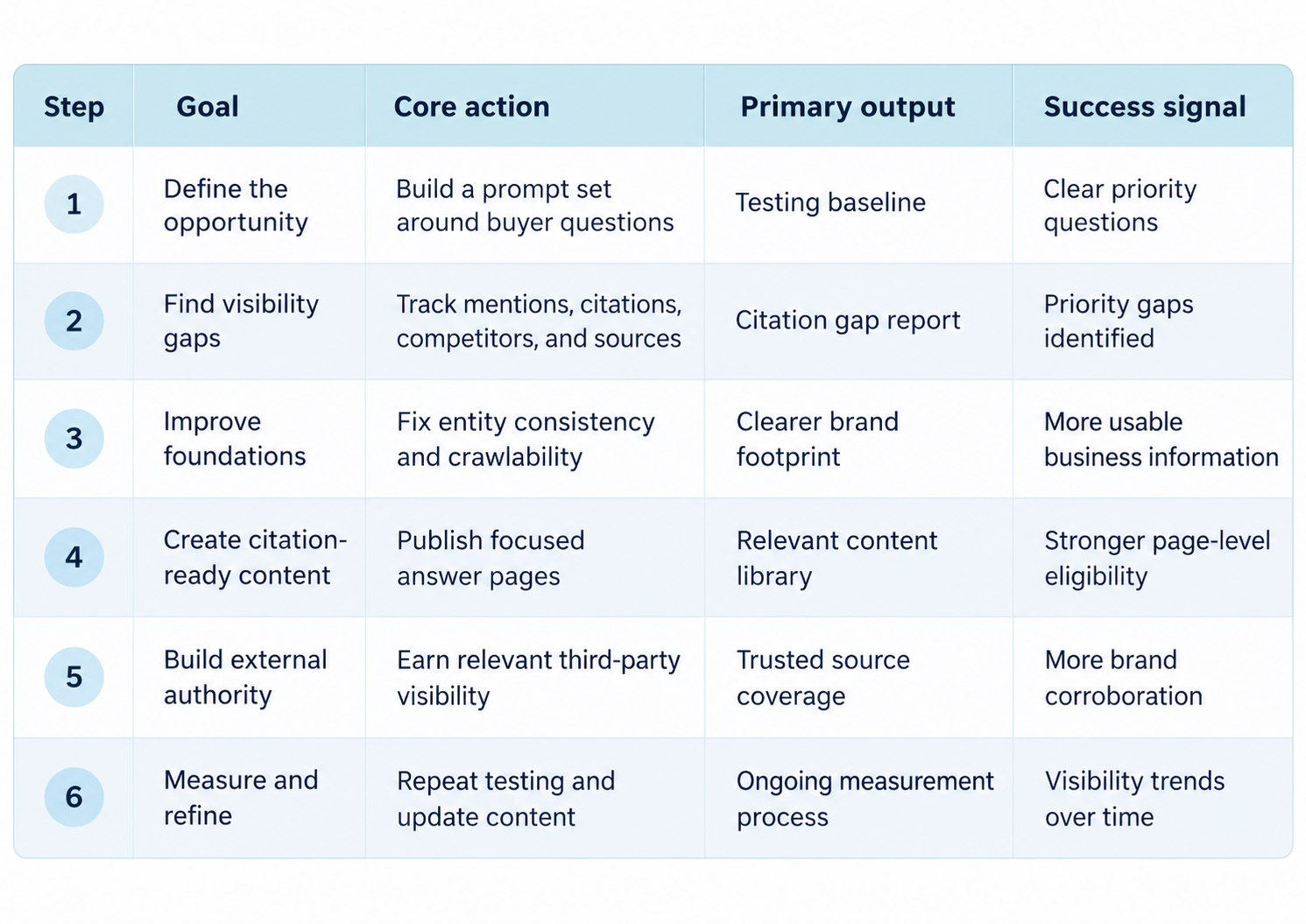


Ranking well in traditional search doesn’t guarantee that buyers will see your business when they ask ChatGPT, Google AI, Perplexity, or another AI platform for help. Search visibility now depends on how clearly AI systems can understand your business, connect it to relevant questions, and decide whether your information belongs in an answer.
Large language model optimization, or LLMO, gives businesses a way to respond to that shift. It brings together content, brand information, technical access, reputation, and measurement; the goal is a clearer and more credible presence across AI-assisted research.
In this article, you’ll learn:
- What LLMO means and how it differs from related disciplines
- How AI systems interpret a brand across multiple sources
- What LLMO changes about content, authority, and measurement
- Which limits businesses should understand before investing in AI visibility
SEO, AEO, GEO, LLMO, and ASO: A Quick Comparison
These terms describe connected parts of the modern search landscape. Here’s how their goals, platforms, and success metrics differ.
| SEO (Search Engine Optimization) | AEO (Answer Engine Optimization) | GEO (Generative Engine Optimization) | LLMO (Large Language Model Optimization) | ASO (Agentic Search Optimization) | |
|---|---|---|---|---|---|
| Primary goal | Rank in traditional search results | Provide direct answers to questions | Earn visibility in AI-generated recommendations | Make a brand understandable and citable to language models | Become easier for AI agents to evaluate and select |
| Main platforms | Google, Bing, and other search engines | Google AI Overviews, featured answers, and answer engines | ChatGPT, Perplexity, Google AI, Gemini, and similar platforms | Language-model interfaces and AI-powered search experiences | AI agents that research vendors, compare options, and take action |
| Core assets | Website, content, technical foundation, and links | Direct-answer content and structured information | Brand authority, citations, reputation, and useful content | Brand entity, content, proof, technical access, and third-party references | Structured business information, proof, workflows, and conversion paths |
| Typical user behavior | Searches, compares results, and clicks | Asks a question and reviews a direct answer | Asks AI for a recommendation or explanation | Relies on AI to interpret, summarize, and reference information | Gives an AI agent a task or buying brief |
| Success metrics | Rankings, organic traffic, leads, and revenue | Answer visibility and clicks | Mentions, citations, recommendations, and AI referrals | Citation rate, mention rate, accuracy, source share, and recommendation frequency | Shortlist inclusion, completed actions, and qualified opportunities |
These disciplines overlap, and industry definitions are still developing.[1] Our SEO, GEO, and ASO framework describes the modern search journey as three connected stages: SEO helps a business get found, GEO helps it get recommended, and ASO helps it become easier for AI agents to choose. LLMO supports all three by improving how AI systems understand and reuse a company’s information.
What Is LLMO?
LLMO is the practice of making a brand’s content, identity, expertise, and online presence easier for large language models to understand, retrieve, evaluate, mention, and cite.
In marketing, LLMO focuses on how AI systems represent a business during research. That representation may draw from the company’s website, search results, business profiles, reviews, directories, publications, communities, and other sources.
The term can describe several connected activities:
- Creating content that answers relevant buyer questions
- Making a company’s services, locations, and expertise clear
- Supporting claims with evidence and original insight
- Improving technical access to important pages
- Maintaining consistent brand information across the web
- Building relevant third-party authority
- Monitoring how AI systems describe and reference the business
LLMO is broader than optimizing a single page. A page may answer one question well; the wider brand needs enough consistent information for AI systems to understand the company in different contexts.
How AI Systems Understand a Brand
AI systems need sources they can retrieve, interpret, and connect to a user’s question. Google describes this process through retrieval-augmented generation, in which search systems retrieve relevant, up-to-date pages before an AI model generates a response.[2]
That process creates several important considerations for businesses.
Relevance shapes retrieval
AI systems need information that matches the question being asked. A general service page may explain what a company does; it may not provide enough detail for a buyer comparing providers, evaluating costs, or looking for a solution in a specific location.
A brand’s content should cover the questions that matter across the buyer journey:
- What does the company offer?
- Who does it serve?
- How does its process work?
- What does the service cost or depend on?
- How does it compare with alternatives?
- What evidence supports its claims?
- What limitations should a buyer understand?
The goal is useful topical coverage; publishing more pages alone is not an effective strategy.
Entity clarity creates context
An entity is the recognizable business, person, product, or organization represented across different sources. AI systems need to connect those references to the same entity before they can describe it accurately.
Clear entity signals include:
- Consistent company name
- Consistent service categories
- Accurate locations and service areas
- Clear leadership and author information
- Aligned descriptions across profiles and listings
- Relevant reviews and third-party references
The wording doesn’t need to be identical everywhere, but the core facts should be consistent enough that a system can connect the dots confidently.
Decision-critical information improves usefulness
AI-generated answers become more useful when the available sources include information buyers need to make a decision. For a service business, that may include process details, timelines, pricing factors, deliverables, qualifications, limitations, and expected outcomes.
Generic descriptions give AI systems less to work with. Specific information creates more opportunities for accurate answers and meaningful citations.
External sources add corroboration
A company’s website provides first-party information; external sources add context and independent validation. Reviews, trade publications, industry directories, comparison sites, expert interviews, and community discussions can all contribute to how AI systems understand a brand.
That broader source ecosystem matters when an AI platform is deciding which businesses to mention or recommend. A relevant article that connects a company to a specific service or industry can carry more value than a large number of unrelated mentions.
What LLMO Changes About Search Strategy
LLMO changes the questions marketing teams ask about visibility. Rankings and traffic still matter, but businesses also need to understand how AI systems describe, compare, and reference them.
| Traditional search focus | LLMO focus | Strategic implication |
|---|---|---|
| Which keywords should we rank for? | Which questions do buyers ask AI systems? | Plan content around buyer questions and decision stages |
| Which pages attract the most traffic? | Which sources influence AI answers? | Evaluate the wider brand footprint |
| How many backlinks did we earn? | Which relevant sources reinforce our expertise? | Prioritize context and authority over raw volume |
| Does the page rank on page one? | Does AI retrieve, understand, and cite the page? | Improve relevance, clarity, access, and evidence |
| How much organic traffic did we gain? | How accurately does AI represent the business? | Track mentions, citations, framing, and qualified demand |
From keywords to buyer questions
Keyword research still helps identify demand; LLMO adds a conversational layer. Buyers may ask an AI platform a complete question rather than enter a short search phrase.
A strong content strategy should account for both. Search terms can reveal what people care about, while real prompts show how they express those needs in an AI interface.
From individual pages to brand entities
Traditional SEO often evaluates performance at the page or keyword level. LLMO requires a broader view of the business as an entity represented across many sources.
That means a marketing team should review the website alongside business profiles, local listings, review platforms, author pages, publications, and other references. A clear page can support visibility; a consistent brand footprint gives AI systems more context to work with.
From backlinks to source ecosystems
Links remain useful, but LLMO expands the authority question. Teams also need to understand which publications, directories, communities, and comparison pages influence AI answers in their category.
The most valuable opportunities are usually relevant and contextual. A mention from a trusted source that explains your expertise may do more for AI visibility than several unrelated placements.
From rankings to representation
A company can rank well and still be described inaccurately by AI. It can also appear in an answer without receiving a link.
LLMO adds new questions to the reporting process:
- Is the business mentioned for the right topics?
- Is the company described accurately?
- Are competitors appearing in the same answers?
- Which sources influence those answers?
- Are AI referrals producing qualified visits or inquiries?
The Role of SEO, Content, and Authority in LLMO
LLMO builds on existing marketing disciplines; it doesn’t require businesses to abandon them.
SEO supports retrieval
Google says its generative search features rely on core Search systems and standard SEO foundations.[2] Crawlability, indexation, internal linking, page quality, and technical accessibility all help determine whether a source can enter the retrieval process.
This is one reason traditional SEO remains part of an AI visibility strategy. A business needs accessible, relevant information before an AI system can use it.
Content supplies the answer
Content gives AI systems the information they need to respond to buyer questions. Useful content should explain the subject clearly, address practical considerations, and support important claims with evidence.
The strongest pages usually provide direct answers early; then they add context, comparisons, examples, and limitations.
Authority supports trust
AI systems may draw from sources beyond a company’s website. Relevant reviews, profiles, publications, directories, and expert contributions help reinforce the company’s connection to its category.
Our guide to getting your brand cited in AI answers explores the relationship between content relevance, brand mentions, citations, and third-party visibility.
Measurement connects visibility to demand
AI visibility is most useful when it connects to business outcomes. A mention or citation may contribute to brand recognition, a later branded search, a referral visit, or a qualified inquiry.
The path won’t always be immediate or easy to isolate. That makes consistent measurement more useful than a single visibility snapshot.
How to Think About LLMO Measurement
LLMO measurement should combine visibility, accuracy, source, and business signals.
Important categories include:
- Brand mention frequency: How often AI systems include the company in relevant answers
- Citation presence: How often the company’s website appears as a linked source
- Framing accuracy: Whether AI describes the company’s services, locations, and expertise correctly
- Competitor visibility: Which competitors appear in the same answers
- Source influence: Which external pages shape the response
- AI referral traffic: Whether cited pages receive visits from AI platforms
- Branded demand: Whether visibility contributes to branded searches and qualified inquiries
The right measurement mix depends on the business. A local service company may prioritize location accuracy, reviews, and qualified calls. A B2B company may focus on comparison queries, expert references, referral traffic, and pipeline influence.
Our published case study for a regional pediatric mental health practice connects a combined SEO and GEO program with AI-referred sessions and qualified patient inquiries. The case study identifies the results as a combined program to make the performance context clearer.
What LLMO Can (and Can’t) Control
LLMO can improve the information available to AI systems, but it can’t control every output.
AI responses may vary by platform, prompt wording, location, date, and available sources. A page that earns a citation for one question may not appear for a closely related question.
Businesses should also keep several expectations in mind:
- No single tactic guarantees a citation
- Traditional SEO remains important
- Structured data supports interpretation but doesn’t guarantee visibility
- More content doesn’t automatically create stronger authority
- A brand mention may occur without a website citation
- A citation doesn’t automatically produce a qualified lead
- External authority takes time to build
These limits make LLMO a strategic discipline rather than a one-time technical project. The goal is to improve the conditions that support accurate, relevant visibility; then measure whether those improvements contribute to demand.
Build a Brand AI Can Understand
LLMO gives businesses a broader way to think about search visibility. It connects content, technical access, brand identity, authority, and measurement around a question that traditional rankings don’t answer on their own: How does AI understand and represent this business?
A strong LLMO strategy starts with clear information. It continues through useful content, consistent entity signals, relevant external references, and measurement that connects AI visibility to business outcomes.
If you want to understand how AI platforms currently represent your brand and where the biggest opportunities may be, Book a Call With Driven Metrics.
Last updated: October 2026
Sources
- Alexander Rus. “Large Language Model Optimization (LLMO) Explained.” Evergreen Media, February 2026. https://www.evergreen.media/en/guide/large-language-model-optimization/
- Google Search Central. “Optimizing Your Website for Generative AI Features on Google Search.” Google for Developers. https://developers.google.com/search/docs/fundamentals/ai-optimization-guide