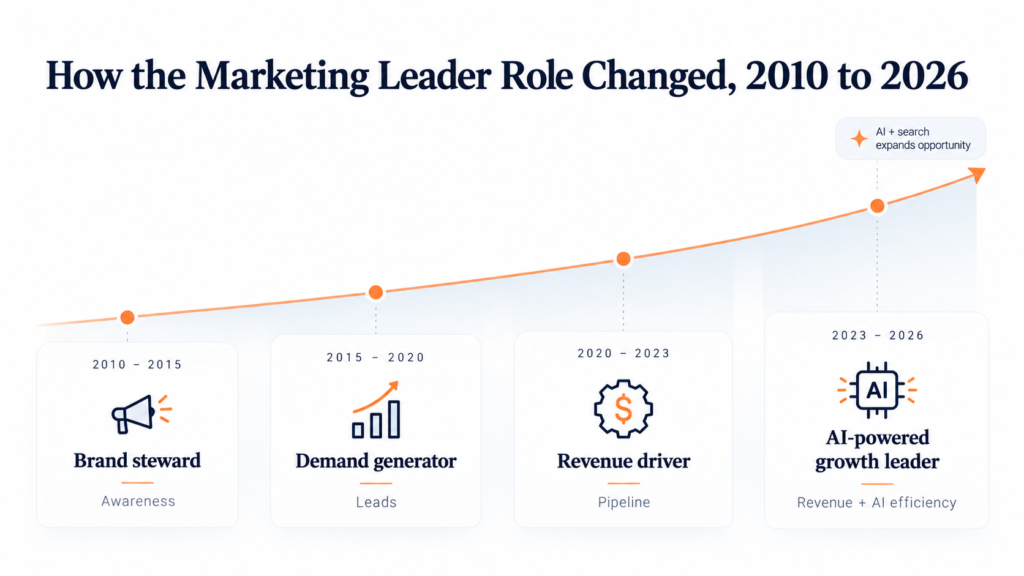
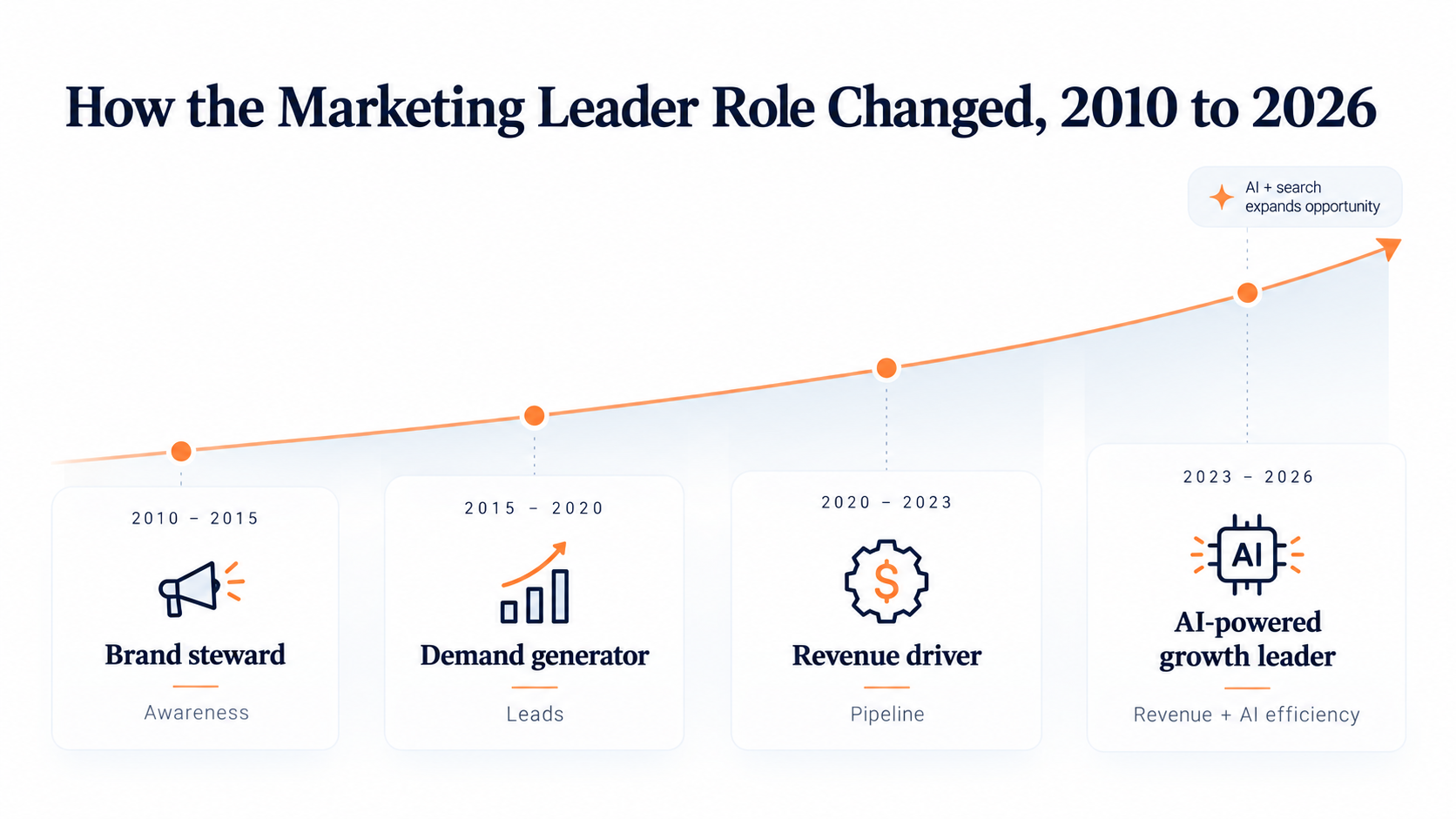

The senior marketing leader, most often titled Chief Marketing Officer, VP of Marketing, or Head of Growth, is the executive responsible for how a company is found, evaluated, and chosen by buyers. Between 2010 and 2026, the role’s core mandate moved from building brand awareness to owning measurable pipeline, and more recently to managing how a company appears in AI-generated answers.
This article traces those shifts using hiring observations from Talentfoot, a Chicago-based executive search firm that reports a 98% client success rate and 2,500+ placements. Talentfoot’s marketing executive search practice places CMOs, VPs of Marketing, Heads of Growth, and eCommerce leaders for companies nationwide.
Four Eras of the Role
Dates are approximate, and many companies operate in more than one era at once.
| Era | Approx. years | Primary mandate | How success was measured |
| Brand steward | 2010 to 2015 | Build brand awareness, reputation, and market positioning through campaigns and agency relationships. | Awareness, share of voice, impressions |
| Demand generator | 2015 to 2020 | Generate qualified leads and build predictable demand through digital marketing, automation, and account-based marketing. | Lead volume, MQLs, conversion rates, pipeline contribution |
| Revenue driver | 2020 to 2023 | Align marketing with sales to accelerate pipeline, customer acquisition, and revenue growth. | Marketing-sourced pipeline, revenue contribution, CAC, customer lifetime value |
| AI-powered growth leader | 2023 to present | Drive measurable pipeline and revenue growth, maximize marketing ROI, and leverage AI to improve visibility, productivity, and efficiency. | Qualified leads, pipeline, revenue contribution, marketing ROI, CAC, AI-driven efficiency gains |
Source: Era framing based on Talentfoot recruiter observations of marketing leadership mandates; GEO milestone from Aggarwal et al. (2023).
Revenue Driver (2020 to 2023)
The defining shift of this period was commercial accountability. CEOs and boards increasingly expected marketing leaders to demonstrate measurable contributions to pipeline, customer acquisition, and revenue growth, not simply generate leads or build awareness. Marketing became more closely aligned with sales, with leaders taking greater responsibility for customer acquisition costs, conversion rates, and marketing-sourced revenue. The rise of titles such as Chief Growth Officer and Chief Revenue Officer reflected a broader effort to unify accountability for growth across functions.
AI-Powered Growth Leader (2023 to Present)
AI has fundamentally expanded what organizations expect from marketing leadership. Today’s strongest marketing executives are responsible for accelerating pipeline and revenue growth while using AI to improve productivity, reduce acquisition costs, and maximize marketing ROI. They must demonstrate how technology translates into measurable business outcomes, not simply greater marketing activity.
AI has also transformed how buyers discover and evaluate companies. In November 2023, researchers from Princeton University and collaborating institutions published GEO: Generative Engine Optimization, introducing methods to improve content visibility in AI-generated answers. As platforms like ChatGPT, Perplexity, and Google AI features reshape buyer discovery, marketing leaders must adapt their strategies to remain visible and competitive. Success now requires combining brand building, demand generation, revenue accountability, and AI-enabled operational efficiency.
The Role in 2026
Talentfoot recruiters identify three defining expectations shaping marketing leadership searches today:
- Revenue accountability over marketing activity. CEOs and boards increasingly prioritize leaders who can demonstrate measurable contributions to qualified leads, pipeline, revenue, and marketing ROI. Brand building remains essential, but marketing executives must connect their investments to tangible commercial outcomes.
- Strategic leadership with hands-on execution. Particularly in growth-stage and mid-market organizations, companies want marketing executives who can establish a growth strategy while remaining close enough to execution to build, optimize, and scale the function. The ability to prioritize investments and deliver results with leaner teams is increasingly valuable.
- AI fluency with measurable business impact. AI proficiency is becoming a baseline expectation. Leading candidates must demonstrate how they’ve used AI to improve marketing performance, automate workflows, accelerate execution, and reduce costs. The differentiator is no longer familiarity with AI tools, but the ability to quantify their impact on revenue, ROI, and efficiency.
Camille Fetter, Founder and CEO of Talentfoot, describes the point at which companies replace a marketing leader: “When the CMO is still reporting on impressions and brand equity while the CEO is asking about cost per acquisition and lifetime value, that gap rarely closes on its own.”
This evolution is particularly pronounced in B2B SaaS, where marketing leaders are increasingly expected to combine brand strategy, demand generation, product-led growth, AI-driven personalization, and revenue attribution. The modern CMO must not only create demand but also demonstrate how marketing converts that demand into profitable, sustainable growth.
Implications for Small and Mid-Sized Companies
A company with one senior marketing hire now expects that person to cover traditional search, AI-generated answers, and pipeline reporting. Talentfoot’s guidance is to define the mandate in revenue terms before the role goes to market, since its recruiters find that timeline risk is highest where role clarity is lowest.
Companies that hire a growth-focused leader without deep search expertise can pair that hire with an outside SEO and GEO partner.
Sources
- Aggarwal, P., et al. “GEO: Generative Engine Optimization.” arXiv, November 2023, revised June 2024. arxiv.org.
- Talentfoot Executive Search. Recruiter observations on marketing leadership searches, June and July 2026. Internal data.