
Driven Metrics research · November 6, 2026
Google AI Mode usage statistics measure how many people use Google’s conversational search mode, how much of Google’s search activity it handles, and what happens to clicks when people use it. AI Mode is the full-page, chat-style answer experience inside Google Search. Google launched it to US users in May 2025 and expanded it globally in October 2025. It is separate from AI Overviews, the AI summaries that sit above the regular results. In this report, “users” means Google’s own monthly or daily active user counts, and “share” means the portion of searches or sessions that third-party panels see going to AI Mode.
To build this report, Driven Metrics combined 15 sources published between July 2025 and August 2026: Alphabet earnings calls and Google announcements, three clickstream panels (SparkToro with Similarweb, Datos and Semrush), Similarweb traffic estimates, Pew Research Center browsing data, and a preregistered field experiment from the University of Pennsylvania and Northeastern University. We reconciled conflicting usage figures into a single best estimate, calculated growth rates, converted zero-click rates into clicks per 1,000 searches, and built a scenario model of how Google’s zero-click rate changes as AI Mode takes a larger share of searches. We did not run our own survey or panel.
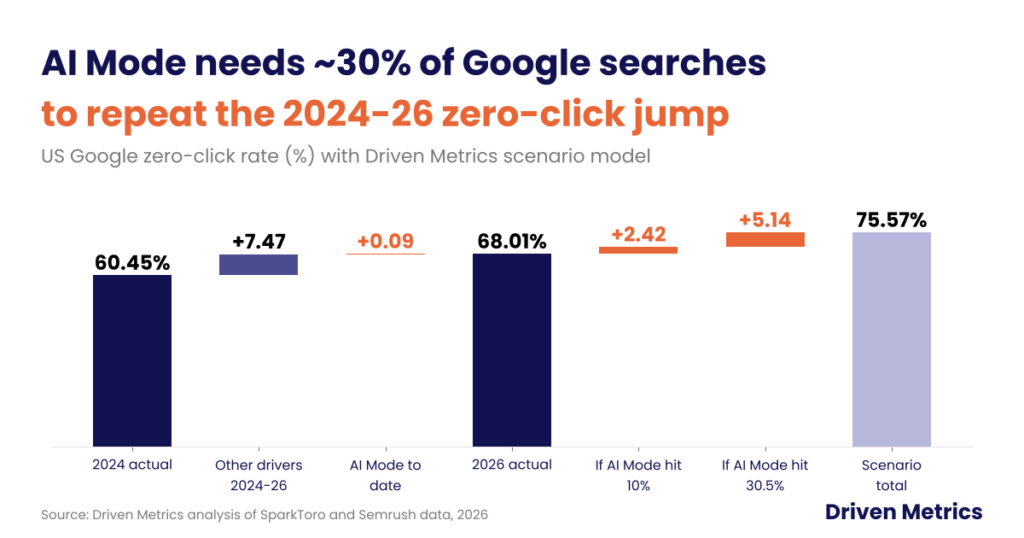
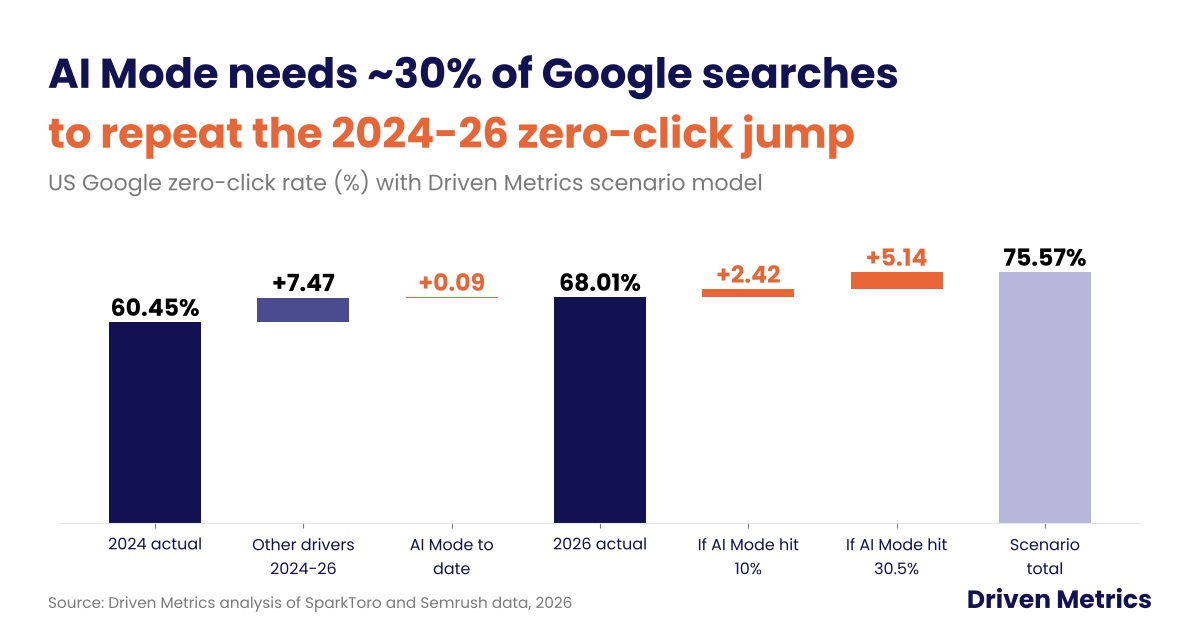
Our main findings: AI Mode reached more than 1 billion monthly users by May 2026, 10 times the 100 million Google reported in July 2025. Yet Driven Metrics estimates it handled only about 0.4% of US Google searches in early 2026, a 100-to-1 gap between reach and volume. Its share of US desktop visits rose 16x in 10 months, then fell 19% between March and Q2 2026. And our model shows AI Mode added only about 0.09 points to Google’s 68.01% zero-click rate in early 2026; it would need roughly 30% of all searches to add as many zero-click points as the 7.56-point rise from 2024 to 2026.
Key Statistics
- Google AI Mode passed 1 billion monthly active users by May 2026, according to Google’s I/O 2026 keynote, up from more than 100 million in the US and India in July 2025.
- According to a 2026 Driven Metrics analysis of three 2026 measurements, Google AI Mode handled about 0.4% of US Google searches in early 2026 (range 0.34% to 0.6%).
- SparkToro found that 0.34% of US Google searches went to AI Mode from January to April 2026, while 68.01% of all US Google searches ended without a click.
- Driven Metrics calculated that AI Mode’s 1 billion monthly users equal 40% of AI Overviews’ 2.5 billion users in May 2026, while AI Mode handles about 0.4% of US searches, a 100-to-1 gap between reach and search volume.
- Semrush measured that 92% to 94% of Google AI Mode sessions ended without a visit to an external site in US desktop data from May to July 2025.
- In a preregistered March 2026 field experiment with 1,100 US users, routing all searches to AI Mode cut click-through to external sites by 18.8 percentage points (Wang et al., 2026).
- A Driven Metrics scenario model estimates that AI Mode would need about 30% of US Google searches to raise the zero-click rate by another 7.56 points, the size of the 2024 to 2026 increase.
How Many People Use Google AI Mode?
Google AI Mode had more than 1 billion monthly active users by May 2026, and Driven Metrics calculates that this is a 10x increase in about 10 months. Google reported more than 100 million monthly users in the US and India on its Q2 2025 earnings call in July 2025, more than 75 million daily users after a global rollout in October 2025, and the 1 billion milestone at I/O on May 19, 2026. Alphabet repeated the 1 billion figure on its Q2 2026 call on July 22, 2026, without a newer number.
| Date | Product | Metric | Reported figure | Source | DM calculation |
|---|---|---|---|---|---|
| Jul 23, 2025 | AI Mode | Monthly active users, US and India | 100M+ | Alphabet Q2 2025 call | Baseline |
| Jul 23, 2025 | AI Overviews | Monthly users, 200+ countries | 2B+ | Alphabet Q2 2025 call | AI Mode = 5.0% of AI Overviews users |
| Jul 23, 2025 | Gemini app | Monthly active users | 450M+ | Alphabet Q2 2025 call | Baseline |
| Oct 29, 2025 | AI Mode | Daily active users, 40 languages | 75M+ | Alphabet Q3 2025 remarks | No matching monthly figure published |
| May 19, 2026 | AI Mode | Monthly active users, global | 1B+ | Google I/O 2026 keynote | 10x vs. Jul 2025; ~25.9% per month |
| May 19, 2026 | AI Overviews | Monthly active users | 2.5B+ | Google I/O 2026 keynote | 1.25x; AI Mode = 40% of AI Overviews users |
| May 19, 2026 | Gemini app | Monthly active users | 900M+ | Google I/O 2026 keynote | 2x vs. Jul 2025 |
| Jul 22, 2026 | AI Mode | Monthly active users | 1B+ (repeated) | Alphabet Q2 2026 call | No change disclosed |
Note: Google reports these as “over” or “more than” figures, so all are floors. The July 2025 AI Mode figure covers the US and India only; the May 2026 figure is global.
The pace stands out against Google’s other AI products. Over the same window, AI Overviews grew 1.25x, from 2 billion to 2.5 billion monthly users, and the Gemini app doubled from 450 million to 900 million. As a result, AI Mode went from the equivalent of 5% of the AI Overviews audience in July 2025 to 40% in May 2026, by our calculation.
Two cautions apply. First, part of the 10x jump is geographic: the July 2025 base covered two countries, while the May 2026 figure covers the global rollout Google says began in October 2025. Second, Google has not said how it counts a monthly user. Since I/O 2026, Google has presented AI Overviews and AI Mode as one connected experience, so a person handed off from an AI Overview into a follow-up conversation may count as an AI Mode user.
What Share of Google Searches Happen in AI Mode?
Driven Metrics estimates that AI Mode handled about 0.4% of US Google searches in early 2026, with a range of 0.34% to 0.6%. That estimate is the median of the three 2026 measurements that use Google searches as the denominator: SparkToro’s 0.34% for January to April 2026, and the Wang et al. field experiment’s 0.6% at baseline and 0.4% in its unmodified control group in March 2026. Google itself has not published AI Mode’s share of total queries.
| Study | Population | Period | Base | AI Mode share | DM note |
|---|---|---|---|---|---|
| Semrush | US desktop clickstream, ~69M sessions | Early May 2025 | Google search sessions | 0.25% | Launch month |
| Semrush | Same | Early Jul 2025 | Google search sessions | A little over 1% | 4x in two months |
| Datos, via PPC Land | US desktop panel | Mar 2026 | All desktop web visits | 0.16% | Not comparable to search share |
| Datos, via SEJ | US desktop panel | Q2 2026 | All desktop web visits | 0.13% | Down from 0.16% |
| Datos, via SEJ | EU/UK desktop panel | Q2 2026 | All desktop web visits | 0.29% | More than 2x US level |
| SparkToro / Similarweb | US desktop and mobile web, excl. Google app | Jan-Apr 2026 | Google searches | 0.34% | Used in DM estimate |
| Wang et al. (arXiv) | 1,100 US Chrome users | Mar 2026, baseline | Google searches | 0.6% | Used in DM estimate |
| Wang et al. (arXiv) | Control group, unmodified Google | Mar 2026, 7 days | Google searches | 0.4% | Used in DM estimate |
| Driven Metrics best estimate | US | Early 2026 | Google searches | 0.4% (0.34%-0.6%) | Median of the three 2026 search-based readings |
Note: Datos measures AI Mode’s share of all desktop web activity, not of searches, so its figures are much smaller by design.
Put the two halves of this report side by side and the gap is large. AI Mode’s 1 billion monthly users equal 40% of the AI Overviews user base, but its share of searches is about 0.4%. Driven Metrics calculates a reach-to-volume ratio of roughly 100 to 1 (40% divided by 0.4%). In plain terms, very many people touch AI Mode in a month, but each of them runs only a small fraction of their searches there. This ratio mixes a global user count with a US search share, so treat it as a sense of scale rather than a precise metric.
The panels also disagree on timing. Semrush saw AI Mode at a little over 1% of US desktop search sessions in July 2025, higher than the 2026 search-based readings. Session share and search share are not the same thing, because Semrush also found AI Mode sessions contain fewer searches (two to three, against about five in classic search). Launch-period curiosity may have inflated the 2025 number as well.
How Fast Is Google AI Mode Usage Growing?
Across four measures from Google and Datos, AI Mode usage grew at about 26% to 32% per month through early 2026, by Driven Metrics’ calculation, but the latest US panel reading shows a stall. Google says AI Mode queries “more than doubled every quarter” in the year after launch, which implies at least 16x growth over four quarters. Datos measured AI Mode’s share of US desktop visits rising from 0.01% in May 2025 to 0.16% in March 2026, then slipping to 0.13% in its Q2 2026 report.
| Measure | Source | Start | End | Mo. | Multiple (DM calc) | Monthly growth (DM calc) |
|---|---|---|---|---|---|---|
| AI Mode monthly active users (Google) | Alphabet Q2 2025; I/O 2026 | 100M+ (Jul 2025, US and India) | 1B+ (May 2026, global) | 10 | 10x | 25.9% |
| AI Mode queries (Google, minimum implied) | Google AI Mode U.S. insights | Launch (May 2025) | More than doubled each quarter, 4 quarters | 12 | 16x | 26.0% |
| AI Mode share of US desktop visits (Datos) | Datos Q1 2026, via PPC Land | 0.01% (May 2025) | 0.16% (Mar 2026) | 10 | 16x | 32.0% |
| AI Mode share of EU/UK desktop visits (Datos) | Datos Q1 and Q2 2026 reports | 0.06% (Dec 2025) | 0.29% (Q2 2026) | 6 | 4.83x | 30.0% |
| AI Mode monthly visits (Similarweb) | Similarweb, via PPC Land | ~120M (Jun 2025) | ~320M peak (Mar 2026) | 9 | 2.67x | 11.5% |
| AI Mode share of US desktop search sessions (Semrush) | Semrush, Jul 2025 | 0.25% (early May 2025) | ~1% (early Jul 2025) | 2 | 4x | 100.0% |
| Latest US change: Datos desktop share | Datos Q2 2026, via SEJ | 0.16% (Mar 2026) | 0.13% (Q2 2026) | ~3 | 0.81x | -18.75% total |
Note: Monthly growth = multiple^(1/months) – 1. Google’s query figure is a minimum implied by “more than doubled every quarter”.
The fastest rates come from the launch window. Semrush’s 4x jump in session share over two months in mid-2025 works out to 100% monthly growth, which no other measure comes close to. Once AI Mode was available everywhere, the steadier measures cluster tightly: 25.9% a month for Google’s user count, 26.0% for Google’s implied query growth, 32.0% for Datos’ US desktop share and 30.0% for the EU/UK share.
Similarweb’s web-visit estimates grew much more slowly, about 11.5% a month from roughly 120 million visits in June 2025 to a peak near 320 million in March 2026, before easing. Visits to the AI Mode web experience miss usage inside the Google app and the hand-offs from AI Overviews, which may explain part of the difference.
The most recent data points in opposite directions. Datos’ Q2 2026 report put AI Mode at 0.13% of US desktop visits, down from 0.16% in March, while the EU/UK share kept rising to 0.29%. Google, meanwhile, has not disclosed a user number above 1 billion since May. Our read: growth in the US may have slowed in mid-2026 even as Google integrated AI Mode more deeply into Search.
How Do People Search Differently in AI Mode?
AI Mode queries are longer and sessions are shorter, and Driven Metrics calculates that an AI Mode session carries about the same total words as a classic Google session, packed into half as many queries. Semrush measured an average of 7.22 words per AI Mode query against 4.0 in classic search, and two to three queries per AI Mode session against about five. That works out to roughly 18 words per AI Mode session and 20 per classic session.
| Metric | AI Mode | Classic Google Search | Source and period | DM calculation |
|---|---|---|---|---|
| Average query length (Google) | 3x a traditional query | 1x | Google, US, Apr 2025-May 2026 | – |
| Average query length (Semrush) | 7.22 words | 4.0 words | Semrush, US desktop, May-Jul 2025 | 1.8x longer |
| Queries per session | 2 to 3 | About 5 | Semrush, US desktop, May-Jul 2025 | Words per session: 18.05 vs. 20.0 |
| Searches using voice or images | More than 1 in 6 | Not reported | Google, US | At least 16.7% |
| Image search growth | 40%+ month over month | Not reported | Google, US | – |
| Planning queries | Grew 80% faster than AI Mode overall, last 6 months | – | Google Trends, US | – |
| Brainstorming queries | Grew 30% faster than queries overall since launch | – | Google Trends, US | – |
| All Google queries, average length | – | 3.33 words (mid-2024) to 3.51 (May 2026) | Similarweb, via PPC Land | +5.4% |
| Minutes per search session | +0.43 minutes when all searches go to AI Mode | Control group | Wang et al., US, Mar 2026 | – |
Note: Words per session = average queries per session x average words per query; we use 2.5 as the midpoint of “2 to 3”.
Google’s own description of AI Mode use points the same way. In its May 2026 U.S. insights report, Google said more than 1 in 6 AI Mode searches use voice or images and that planning and brainstorming queries are growing faster than AI Mode as a whole. These are relative growth rates, not shares, so they say which uses are rising rather than how large each one is.
The behavior shift is spilling into regular search too. Similarweb’s data shows the average length of all Google queries rising 5.4%, from 3.33 words in mid-2024 to 3.51 words in May 2026, by our calculation. For marketers, the practical signal is that people are writing more complete questions and doing more of their comparing inside a single conversation.
How Many AI Mode Searches End Without a Click?
About 93% of AI Mode sessions end without a visit to another website, which Driven Metrics converts to roughly 70 clicks per 1,000 sessions, compared with 320 per 1,000 for the average US Google search in early 2026. Semrush measured 92% to 94% zero-click AI Mode sessions in US desktop data from May to July 2025. SparkToro found 68.01% of all US Google searches ended without a click in January to April 2026, up from 60.45% in 2024.
| Surface or measure | Source and period | Reported figure | Clicks per 1,000 (DM calc) |
|---|---|---|---|
| Google Search, no AI Overview | Semrush (separate 2025 study, cited in AI Mode study) | ~34% zero-click | 660 |
| Google Search with AI Overview | Semrush (same) | ~43% zero-click | 570 |
| All US Google searches, 2024 | SparkToro (Datos panel) | 60.45% zero-click | 396 |
| All US Google searches, Jan-Apr 2026 | SparkToro (Similarweb panel) | 68.01% zero-click | 320 |
| Google AI Mode sessions | Semrush, US desktop, May-Jul 2025 | 92%-94% zero-click | 70 (at 93% midpoint) |
| Traditional result click, no AI summary | Pew Research Center, Mar 2025 | 15% of visits | 150 |
| Traditional result click, AI summary shown | Pew Research Center, Mar 2025 | 8% of visits | 80 |
| External click-through when all searches go to AI Mode | Wang et al., Mar 2026 | -18.8 percentage points (95% CI -22.2 to -15.3) | – |
| Daily clicks when all searches go to AI Mode | Wang et al., Mar 2026 | -2.27 clicks per day vs. 4.1 baseline | About 55% fewer (DM calc) |
Note: Clicks per 1,000 = (100 – zero-click %) x 10. SparkToro counts clicks to Google-owned properties and ads as clicks; Pew counts only clicks on standard results. These studies use different panels, devices and definitions, so compare directions rather than exact gaps.
The strongest evidence on cause comes from the field experiment. Researchers at the University of Pennsylvania and Northeastern University randomly assigned 1,100 US Chrome users to three versions of Google for seven days in March 2026. Sending every search to AI Mode cut external click-through by 18.8 percentage points against unmodified Google. It also lowered the share of users clicking through to Reddit by 21.2 points, news sites by 12.5 points and Wikipedia by 9.9 points, and it raised the share of users who tried Bing, DuckDuckGo or Yahoo by 11.2 points. Driven Metrics calculates the click drop at about 55% of baseline daily clicks.
Citations inside AI Mode do not always mean outbound visits either. SE Ranking’s February 2026 study of 1.3 million AI Mode citations, reported by Search Engine Journal, found Google was the most-cited source at about 17% of citations, up from 5% in July 2025, with 59% of those Google links pointing to Google’s own search results. Google, for its part, says its AI features send “billions of clicks to websites every week” and that AI Mode is driving an increase in overall queries. For more on ads inside AI Mode, see our Google AI Mode ads statistics report.
What Happens to Website Traffic as AI Mode Usage Grows?
So far, almost nothing: Driven Metrics estimates AI Mode added about 0.09 points to Google’s 68.01% zero-click rate in early 2026, and it would need roughly 30% of all searches to add as many zero-click points as the 7.56-point rise from 2024 to 2026. That rise came almost entirely from other changes, mainly AI Overviews, which SparkToro notes appear on more than 20% of searches. At 10% of searches, AI Mode would add 1.8 to 2.4 points, depending on which click estimate is used.
| AI Mode share of searches | Modeled zero-click rate (DM calc) | Change vs. 2026 (DM calc) | Change, experiment-based (DM calc) | Clicks per 1,000 (DM calc) |
|---|---|---|---|---|
| 0.34% (Jan-Apr 2026 actual) | 68.01% | +0.00 pts | +0.00 pts | 320 |
| 1% | 68.18% | +0.17 pts | +0.12 pts | 318 |
| 5% | 69.18% | +1.17 pts | +0.88 pts | 308 |
| 10% | 70.43% | +2.42 pts | +1.82 pts | 296 |
| 25% | 74.19% | +6.18 pts | +4.64 pts | 258 |
| 30.5% (matches the 2024-26 rise) | 75.57% | +7.56 pts | +5.67 pts | 244 |
| 50% | 80.46% | +12.45 pts | +9.34 pts | 195 |
Note: Model: zero-click = classic rate x (1 – s) + 93% x s, where the classic rate (67.92%) is backed out of SparkToro’s 68.01% at s = 0.34%. Experiment-based column applies Wang et al.’s -18.8 point click-through effect to the added share. Illustrative only; it holds everything else constant.
The model works by treating every Google search as either a classic search or an AI Mode search. We backed out a 67.92% zero-click rate for classic searches from SparkToro’s 2026 total, then blended in AI Mode at 93%. Each percentage point of searches that moves into AI Mode adds about 0.25 points to the overall zero-click rate. Using the field experiment’s 18.8-point effect instead gives about 0.19 points per percentage point, and the share needed to match the 2024 to 2026 rise climbs to about 41%.
How soon could that happen? If AI Mode’s share doubled every quarter from 0.34%, matching the query growth Google described, it would reach 10% of searches in about five quarters (around mid-2027) and 30% by late 2027. At Similarweb’s slower visit growth of about 11.5% a month, 10% would take about 31 months, into late 2028. Datos’ flat Q2 2026 reading in the US suggests neither path is guaranteed. These are illustrations of the math, not forecasts: query growth and share growth are not the same, because total Google queries are growing too.
The bigger near-term traffic risk is not people choosing AI Mode, but Google moving more of the classic results page toward it. Google merged AI Overviews and AI Mode into one experience in 2026, and the field experiment found that a forced, full switch cut external click-through by 18.8 percentage points in a week. For the wider picture on AI answers and clicks, see our AI search statistics and zero-click search statistics reports.
Frequently Asked Questions
Google AI Mode had more than 1 billion monthly active users as of May 19, 2026, according to Google’s I/O 2026 keynote, and Alphabet repeated that figure on July 22, 2026. That is about 10 times the 100 million monthly users Google reported in the US and India in July 2025.
Driven Metrics estimates about 0.4% of US Google searches went to AI Mode in early 2026, with a range of 0.34% to 0.6% across three 2026 measurements. SparkToro measured 0.34% for January to April 2026. Google has not published AI Mode’s share of total queries.
Semrush found 92% to 94% of AI Mode sessions ended without a visit to an external site in US desktop data from May to July 2025. That compares with 68.01% of all US Google searches ending without a click in early 2026, per SparkToro.
Yes, when people use it. In a March 2026 field experiment with 1,100 US users, sending all searches to AI Mode cut external click-through by 18.8 percentage points. Because AI Mode still handles under 1% of searches, Driven Metrics estimates its effect on overall Google traffic was about 0.09 points of zero-click rate in early 2026.
Partly. Google’s Search Central documentation says clicks and impressions from AI Overviews and AI Mode are included in the Performance report under the “Web” search type, combined with regular search traffic rather than shown as a separate AI Mode line.
Methodology
This report combines 15 sources published between July 2025 and August 2026, covering data from March 2025 to Q2 2026: Alphabet earnings calls (Q2 2025, Q3 2025, Q2 2026), Google’s I/O 2026 keynote and AI Mode U.S. insights report, Google Search Central documentation, clickstream studies from SparkToro with Similarweb (US, January to April 2026), Datos (US and EU/UK desktop, May 2025 to Q2 2026) and Semrush (US desktop, May to July 2025), Similarweb’s 2026 Generative AI Landscape report, Pew Research Center browsing data (March 2025), SE Ranking citation data (February 2026) and the Wang et al. preregistered field experiment (1,100 US users, March 2026). Datos, Similarweb and SE Ranking figures were taken from trade press coverage where the original reports were gated.
Our calculations: growth multiples (end value divided by start value); compound monthly growth (multiple to the power of 1 over months, minus 1); AI Mode as a share of AI Overviews users (AI Mode users divided by AI Overviews users); best-estimate share (median of three 2026 search-based readings); reach-to-volume ratio (40% divided by 0.4%); clicks per 1,000 ((100 minus zero-click rate) times 10); words per session (queries per session times words per query); and a two-surface scenario model (classic zero-click rate times the classic share, plus 93% times the AI Mode share). Limitations: sources use different panels, devices, countries and definitions; Google’s user figures are self-reported floors without a published definition; the scenario model holds everything else constant; and the field experiment is a preprint that measured a forced seven-day switch rather than voluntary use.
Have AI Mode traffic data you would like to share, or want us to update a figure? Contact Driven Metrics.
Sources
- I/O 2026: Welcome to the agentic Gemini era. Google. Sundar Pichai. May 19, 2026.
- How AI Mode is changing the way people search in the U.S. Google (Think with Google). Shivani Mohan. May 21, 2026.
- Alphabet Q2 2026 Earnings Call Transcript. Alphabet. July 22, 2026.
- Q3 earnings call: Remarks from our CEO. Google. Sundar Pichai. October 29, 2025.
- 2025 Q2 Earnings Call Transcript. Alphabet. July 23, 2025.
- In 2026, Less than One Third of Google Searches Still Send a Click. SparkToro (data: Similarweb). Rand Fishkin. June 9, 2026.
- Google AI Mode’s Early Adoption and SEO Impact. Semrush. Luke Harsel. July 30, 2025.
- AI still under 2% but growing: Datos Q1 2026 state of search report. PPC Land (data: Datos). Luis Rijo. April 27, 2026.
- Zero Click Searches At An All-Time High. Search Engine Journal (data: Datos). Harry Clarkson-Bennett. August 3, 2026.
- ChatGPT loses web share to Gemini and Claude as ad penetration hits 26%. PPC Land (data: Similarweb 2026 Generative AI Landscape). Luis Rijo. July 22, 2026.
- AI in Search Reduces Publisher Referrals Without Improving User Experience: Experimental Evidence. University of Pennsylvania and Northeastern University (arXiv preprint). Stephanie T. Wang, Jeffrey Gleason, Yakov Bart, Christo Wilson, Danaé Metaxa. August 18, 2026.
- Google users are less likely to click on links when an AI summary appears in the results. Pew Research Center. Athena Chapekis, Anna Lieb. July 22, 2025.
- Google AI Mode Cites Itself More Often, With More Organic Links. Search Engine Journal (data: SE Ranking). Matt G. Southern. March 6, 2026.
- AI features and your website. Google Search Central. Last updated December 10, 2025.
- Google zero-click searches hit 68% in early 2026: Study. Search Engine Land. Danny Goodwin. June 2026.