
Key Findings
In this Driven Metrics analysis of AI shopping agents, covering 72 data points from 25 sources:
- We tracked 21 AI shopping agent launches, blocks and pullbacks between April 2025 and November 18, 2026, and 8 of them (38.1%) came in the 10 weeks after Meta launched its Muse agent on September 8, 2026 (our calculation).
- Of 16 AI shopping agent launches where shopper approval applies, 10 (62.5%) say the shopper approves each purchase or sets a spending limit, and 6 do not say approval is required (our calculation, n=16).
- About 7.9% of shoppers have had an AI tool or agent complete a purchase for them, the median of three 2026 surveys that range from 5% to 11% (our calculation).
- AI agents completed 1.52% of U.S. e-commerce orders in October 2026, up from 0.36% in August 2026 before Muse launched, according to First Page Sage’s brand panel.
- In September 2026, 43% of online shoppers in five countries wanted to approve every AI agent purchase, 6.1 times the 7% who were comfortable letting AI buy without approval (our calculation, Riskified survey, n=5,100).
On November 11, 2026, two companies that sit behind AI shopping agents made news on the same day. Imprint, a co-branded credit card company, raised $130 million at a valuation of about $1.9 billion and launched an MCP server that lets AI agents use its members’ rewards, virtual cards and transaction history, with tools for members to review and authorize agent-initiated purchases. Riskified, which screens online orders for fraud, reported third-quarter 2026 revenue of $115.2 million, up 41% from $81.9 million a year earlier, and highlighted Agent Identity Risk Intelligence, a tool it announced on October 8, 2026 that identifies the AI agent behind an order or customer service request.
AI shopping agents are AI tools that can complete checkout or payment for a shopper, not only recommend products. Driven Metrics analysts compiled a dataset of 21 dated public events from April 2025 to November 18, 2026: 19 launches or expansions, 1 pullback and 1 block, each traced to the company announcement or news report that published it. We coded every event by layer (consumer agents, payments, protocols, identity and fraud, and merchant access) and by how the shopper approves a purchase, then compared the tracker with 51 data points from three 2026 shopper surveys and panels by McKinsey, First Page Sage and Riskified, plus Riskified’s and Imprint’s November 11 disclosures.
In the following sections, we list every tracked launch, count launches by layer and half-year, compare the agents that can buy as of November 2026 and how they pay, break down how each launch handles shopper approval, estimate how many shoppers let an agent buy, chart the agent-completed share of U.S. online orders, and rank the categories where shoppers use AI agents most.
AI Shopping Agents Tracker: 21 Launches, Blocks and Pullbacks
In the table below, we list every AI shopping agent event in our dataset from April 2025 to November 18, 2026, oldest first, with the layer it belongs to and how its announcement describes shopper approval.
| Date | Company | Launch or event | Layer | Shopper approval | What it does |
|---|---|---|---|---|---|
| April 2025 | Amazon | Buy for Me | Consumer agent | Per-purchase approval | Amazon’s agent buys from brand websites inside the Amazon Shopping app; shopper confirms shipping, tax and payment first |
| Apr 29, 2025 | Mastercard | Agent Pay (Agentic Tokens) | Payments | Shopper-set limits | Tokenized credentials for registered, verified AI agents; consumers control what an agent may buy |
| Apr 30, 2025 | Visa | Visa Intelligent Commerce | Payments | Shopper-set limits | AI-ready tokenized cards and APIs for agent developers; consumers set spending limits and conditions |
| September 2025 | Agent Payments Protocol (AP2) | Protocol | Shopper-set limits | Open standard for agent-led payments, including purchases without the shopper present; Google later described it as working within spending guardrails the shopper sets | |
| Sep 29, 2025 | OpenAI and Stripe | Instant Checkout and Agentic Commerce Protocol (ACP) | Consumer agent | Per-purchase approval | In-chat checkout for U.S. ChatGPT users, starting with Etsy sellers; users confirm each step |
| Oct 14, 2025 | Visa | Trusted Agent Protocol | Identity and fraud | Not applicable | Signed agent messages so merchants can tell trusted shopping agents from malicious bots; built with Cloudflare |
| Oct 16, 2025 | Mastercard | Agent Pay Merchant Acceptance Framework | Identity and fraud | Not applicable | No-code framework that registers and authenticates agents before they transact |
| Nov 13, 2025 | Agentic checkout in Search and AI Mode | Consumer agent | Per-purchase approval | Buys a price-tracked item with Google Pay when it hits the shopper’s budget; Google asks permission first | |
| Nov 25, 2025 | Perplexity and PayPal | Instant Buy | Consumer agent | Not stated | In-chat checkout with PayPal for U.S. users; retailer stays merchant of record |
| January 2026 | Microsoft | Copilot Checkout | Consumer agent | Not stated | Checkout inside Copilot with PayPal, Shopify and Stripe; Shopify merchants enrolled by default with an opt-out |
| Jan 11, 2026 | Google, Shopify, Etsy, Wayfair, Target, Walmart | Universal Commerce Protocol (UCP) | Protocol | Not stated | Open standard for agents to discover, check out and handle post-purchase across retailers; 5 co-developers, 10 named endorsers |
| Mar 24, 2026 | OpenAI | Instant Checkout handed back to merchants (pullback) | Consumer agent | Not applicable | OpenAI lets merchants use their own checkout and focuses ChatGPT on discovery |
| May 19, 2026 | Universal Cart | Consumer agent | Per-purchase approval | One cart across Search, Gemini, YouTube and Gmail that tracks price and stock; checkout in a few taps with Google Pay or hand-off to the merchant | |
| Sep 8, 2026 | Meta | Muse personal agent | Consumer agent | Optional or default not stated | Personal agent that browses, fills forms and checks out with a one-time Link by Stripe card; purchases ‘can require explicit approval’ |
| Sep 20, 2026 | Amazon | Blocks Meta Muse on Amazon.com (block) | Merchant access | Not applicable | Amazon bars Muse from its store, citing privacy and security risk from agents capturing credentials |
| Sep 21, 2026 | Shopify and Meta | Shop Pay agentic checkout for Muse on all Shopify stores | Payments | Not stated | Muse can check out with Shop Pay on every Shopify store |
| Oct 8, 2026 | Riskified | Agent Identity Risk Intelligence | Identity and fraud | Not applicable | Identifies the AI agent behind an order or service request, resolves it to a consumer and returns a risk signal; Zendesk integration |
| Oct 21, 2026 | Walmart | Agent Gateway, Agent Profiles and terms for AI agents | Merchant access | Shopper chooses per-purchase or limit | MCP server for approved agents to search and buy; shoppers approve each order or set a spending limit; non-compliant agents blocked |
| Oct 21, 2026 | Anthropic | Claude Duet (research preview) | Consumer agent | Per-purchase approval | Proactive agent that pays with Link and Shop Pay one-time cards and pauses for approval before payments |
| Oct 28, 2026 | Shopify | Fall ’26 Edition: Shop Pay in personal agents and shop.md | Payments | Optional or default not stated | Shop Pay checkout in Muse, Claude Duet, Grok Bot and Instinct, plus a skill that turns any agent into a shopper; customers can approve purchases |
| Nov 11, 2026 | Imprint | MCP server for AI agents | Payments | Per-purchase approval | Lets AI agents use members’ rewards, virtual cards and transaction history, with tools to review and authorize agent-initiated purchases |
Source: Driven Metrics analysis of 21 company announcements and news reports, April 2025 to November 2026. Approval is coded from the opened announcement only. “Not applicable” marks identity tools, blocks and pullbacks.
Key Findings
- Consumer agents and AI checkout features account for 9 of the 21 events (42.9%), payments and credentials for 5, agent identity and fraud tools for 3, and protocols and merchant access policies for 2 each (our calculation).
- The 2025 events were mostly rails: card networks, protocols and in-chat checkouts built before shoppers had personal agents. The 2026 events follow the agents. Meta’s Muse launched on September 8, 2026, Amazon blocked it on September 20, Shopify opened Shop Pay to it on September 21, and Walmart opened an agent gateway on October 21.
- Whether an AI shopping agent can buy from a store now depends on the store’s platform settings, payment wallets and agent policy, not only on its product data.
AI Shopping Agent Launches by Layer and Half-Year
In the table below, we count the 21 tracked events by layer and half-year. The second half of 2026 covers July 1 to November 18, 2026.
| Layer | H1 2025 | H2 2025 | H1 2026 | H2 2026 (to Nov 18) | Total |
|---|---|---|---|---|---|
| Consumer agents and AI checkout | 1 | 3 | 3 | 2 | 9 |
| Payments and credentials | 2 | 0 | 0 | 3 | 5 |
| Protocols and standards | 0 | 1 | 1 | 0 | 2 |
| Agent identity and fraud | 0 | 2 | 0 | 1 | 3 |
| Merchant access policy | 0 | 0 | 0 | 2 | 2 |
| All layers | 3 | 6 | 4 | 8 | 21 |
Source: Driven Metrics analysis of 21 company announcements and news reports, April 2025 to November 2026. All figures are our calculations.
Key Findings
- The second half of 2026 has 8 tracked events through November 18, the most of any half-year, compared with 6 in the second half of 2025 and 4 in the first half of 2026 (our calculation).
- Payments and credentials launches stopped after Visa and Mastercard’s April 2025 programs and restarted in the second half of 2026, with 3 launches (Shop Pay for Muse, Shop Pay in personal agents and Imprint’s MCP server) once personal agents needed a wallet to pay with.
- For the next edition of this tracker, the layer to watch is payments: an AI shopping agent that cannot hold a credential cannot finish a purchase.
Which AI Shopping Agents Can Buy, and How They Pay
In the table below, we compare the 7 consumer-facing AI shopping agents and in-chat checkouts in our tracker by launch date, payment method, merchants named at launch and status on November 18, 2026.
| Agent or checkout | Launched | How it pays | Merchants named at launch | Status, Nov 18, 2026 |
|---|---|---|---|---|
| Amazon Buy for Me | April 2025 | Shopper’s Amazon checkout details on the brand’s site | Small number of brand stores (beta) | Beta for a subset of U.S. customers |
| ChatGPT Instant Checkout | Sep 29, 2025 | ACP with Stripe | U.S. Etsy sellers; 1M+ Shopify merchants announced | Checkout handed back to merchants on Mar 24, 2026 |
| Google agentic checkout / Universal Cart | Nov 13, 2025 / May 19, 2026 | Google Pay, or hand-off to merchant site | Wayfair, Chewy, Quince, select Shopify; later Nike, Sephora, Target, Ulta, Walmart | U.S.; Canada and Australia announced |
| Perplexity Instant Buy | Nov 25, 2025 | PayPal | Abercrombie & Fitch, Ashley, Fabletics, Adorama, Newegg named | U.S. users |
| Microsoft Copilot Checkout | January 2026 | PayPal, Shopify, Stripe | Etsy sellers first; Shopify stores enrolled by default | U.S., Copilot.com |
| Meta Muse | Sep 8, 2026 | One-time Link by Stripe card; Shop Pay from Sep 21 | Any site it can browse; all Shopify stores via Shop Pay | U.S.; blocked on Amazon.com since Sep 20, 2026 |
| Claude Duet | Oct 21, 2026 | One-time Link or Shop Pay card | Stripe Link and Shop Pay merchants | U.S. research preview, Pro and Max waitlist |
Source: Driven Metrics analysis of OpenAI, Google, PayPal, Meta and Anthropic announcements and Digital Commerce 360, GeekWire, Modern Retail, PYMNTS, TechRepublic and VKTR reporting, April 2025 to November 2026.
Key Findings
- All 7 consumer AI shopping agents in our tracker launched in the U.S. first, and 5 of the 7 pay through a third-party wallet or processor (Stripe and Link, PayPal or Shop Pay) rather than one the platform owns. Google and Amazon use their own (our calculation).
- In-chat checkout did not hold on its first try. OpenAI handed checkout back to merchants on March 24, 2026, and Walmart’s Daniel Danker told Modern Retail that items sold directly inside ChatGPT converted at one-third the rate of items that required a click-out, in part because Instant Checkout bought one item at a time.
- A merchant set up for Stripe, PayPal, Shop Pay and Google Pay covers the payment methods of every agent in this table except Amazon’s.
How AI Shopping Agents Get Permission to Pay
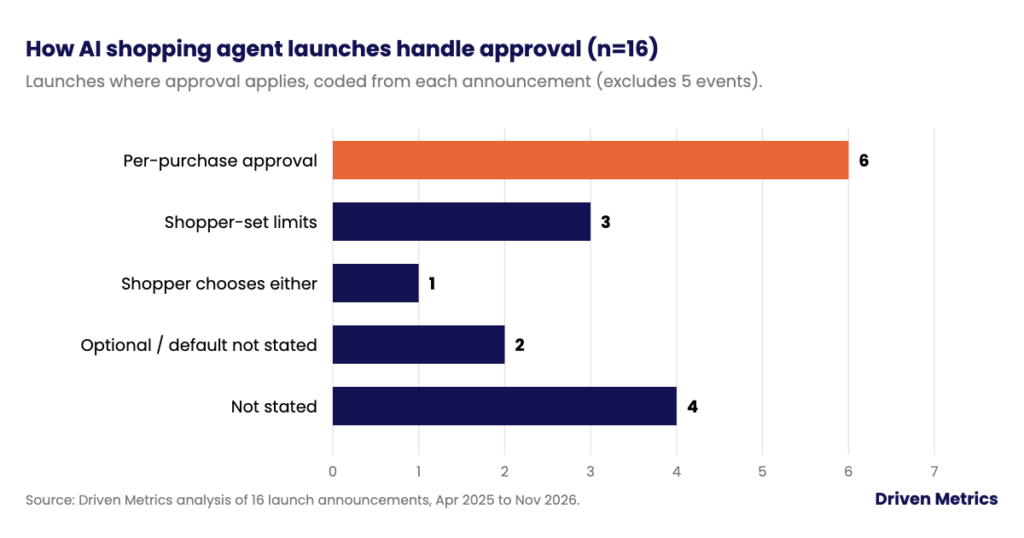
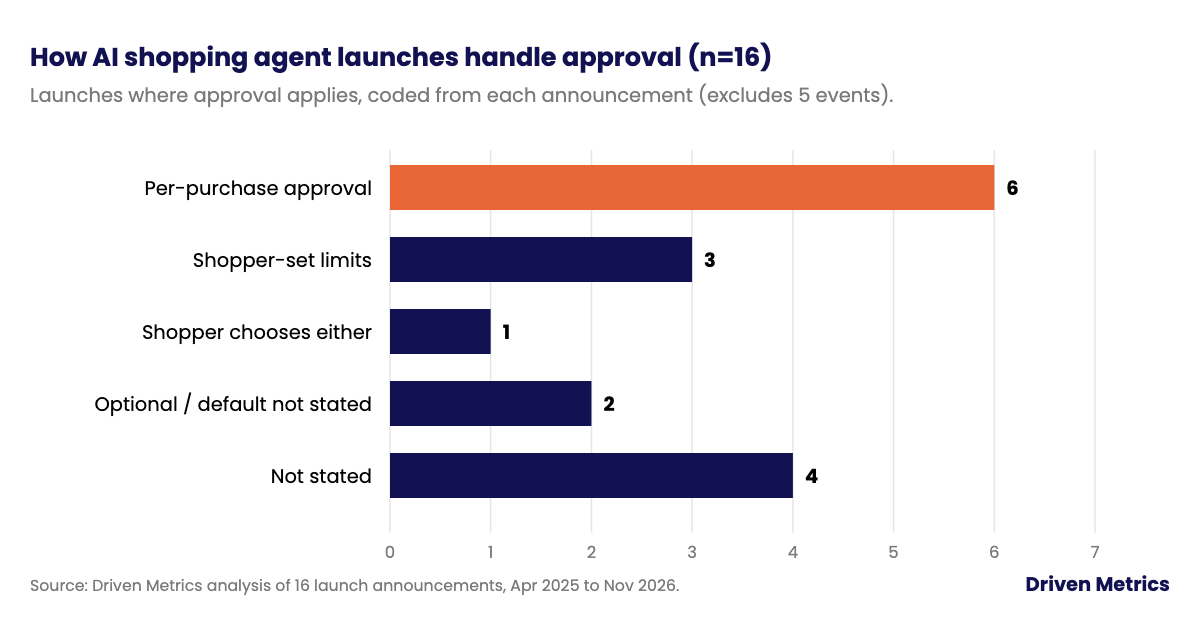
In the table below, we group the 16 tracked launches where shopper approval applies by the approval model their announcements describe. We left out the 3 identity and fraud tools, Amazon’s block and OpenAI’s pullback, since none of them asks a shopper to approve anything.
| Approval model | Launches | Share of 16 | Launches in this group |
|---|---|---|---|
| Per-purchase approval | 6 | 37.5% | Amazon Buy for Me; ChatGPT Instant Checkout; Google agentic checkout; Google Universal Cart; Anthropic Claude Duet; Imprint MCP server |
| Shopper-set limits | 3 | 18.8% | Mastercard Agent Pay; Visa Intelligent Commerce; Google AP2 |
| Shopper chooses per-purchase or limit | 1 | 6.3% | Walmart Agent Gateway |
| Optional or default not stated | 2 | 12.5% | Meta Muse; Shopify Fall ’26 Shop Pay in agents |
| Not stated | 4 | 25.0% | Perplexity Instant Buy; Microsoft Copilot Checkout; Google Universal Commerce Protocol; Shop Pay for Muse |
| Approval or limit required | 10 | 62.5% | First three groups combined |
Source: Driven Metrics analysis of 16 AI shopping agent launch announcements, April 2025 to November 2026. Shares are our calculations. Meta’s Muse announcement says purchases “can require explicit approval,” so we coded it as optional.
In the next table, we compare those approval models with what shoppers say they want, from Riskified’s survey of 5,100 online shoppers in the U.S., UK, Japan, Mexico and Brazil in September 2026.
| Preference or behavior | Share of shoppers |
|---|---|
| Want to approve every purchase | 43% |
| Would let an agent buy within rules they set | 29% |
| Have completed a purchase inside an AI tool | 11% |
| Comfortable letting AI buy without approval | 7% |
| Would trust an agent run by: General AI platform (e.g., ChatGPT, Gemini) | 33% |
| Would trust an agent run by: Retailer or brand they already shop with | 17% |
| Would trust an agent run by: Bank, card company or digital wallet | 9% |
| Want per-purchase approval or rules they set (our calculation) | 72% |
Source: Driven Metrics analysis of Riskified, Agentic Commerce Pulse, October 27, 2026. The combined row adds two answer options that Riskified reports separately; it assumes they do not overlap.
Key Findings
- 6 of 16 launches require approval of each purchase, 3 rely on spending limits the shopper sets and Walmart lets the shopper choose either. None of the 16 announcements describes an agent buying with neither, though 6 do not say what the default is (our calculation).
- Shoppers split the same way. 43% want to approve every purchase and 29% would let an agent buy within rules they set, so 72% want some checkpoint, while 7% are comfortable with no approval at all (our calculation, n=5,100).
- Per-purchase confirmation and spending limits both have an audience. A checkout that supports only one of them will lose the shoppers who prefer the other.
How Many Shoppers Let AI Shopping Agents Buy
In the table below, we compare three 2026 estimates of how many shoppers have had an AI tool or agent complete a purchase. They measure different populations, so we show each population and take the median as our best estimate.
| Source | Share | Population and measure | Period |
|---|---|---|---|
| McKinsey (U.S. adults) | 5% to 10% | U.S. general population, purchase completed through an AI tool, past 3 months | June 2026 |
| First Page Sage (U.S. online shoppers) | 7.9% | U.S. online shoppers, agent checkout with shopper approval (n=5,212) | October 2026 |
| Riskified (5 countries) | 11% | Online shoppers in U.S., UK, Japan, Mexico, Brazil, completed a purchase inside an AI tool (n=5,100) | September 2026 |
| Driven Metrics best estimate | 7.9% | Median of the three point estimates (McKinsey midpoint 7.5%) | 2026 |
Source: Driven Metrics analysis of McKinsey (June 2026), First Page Sage (October 2026) and Riskified (September 2026) surveys, November 2026.
First Page Sage also measured how far U.S. online shoppers let AI go at each stage of a purchase. In the table below, the share falls at every step from research to an unattended purchase.
| Shopping stage | Share of U.S. online shoppers | Change since July 2026 |
|---|---|---|
| Product research and discovery | 62.3% | +6.7 pts |
| Price and feature comparison | 49.8% | +7.4 pts |
| Review summaries | 40.1% | +5 pts |
| Cart building by an agent | 16.1% | +6.7 pts |
| Agent checkout with shopper approval | 7.9% | +5 pts |
| Scheduled or price-triggered reorders | 3.8% | +1.5 pts |
| Fully autonomous purchase, no approval | 1.5% | +0.9 pts |
Source: Driven Metrics analysis of First Page Sage, Agentic Commerce Statistics, November 2026.
Key Findings
- About 7.9% of shoppers have had an AI tool or agent complete a purchase for them, the median of three 2026 estimates that run from 5% of U.S. adults (McKinsey, June 2026) to 11% of online shoppers in five countries (Riskified, September 2026) (our calculation).
- Among U.S. AI users, McKinsey found the share who bought through an AI tool rose from 10% in December 2025 to 17% in June 2026, a 70% increase. Most of that buying still has a human checkpoint: First Page Sage counts 7.9% of U.S. online shoppers using agent checkout with approval in October 2026, 5.3 times the 1.5% who let an agent buy with no approval (our calculation).
- For every 100 U.S. online shoppers who use AI for product research, about 2 let an agent buy without approval (our calculation from First Page Sage, 1.5% of 62.3%).
Share of U.S. Online Orders Completed by AI Shopping Agents
In the table below, we show First Page Sage’s monthly estimate of the share of U.S. e-commerce orders that an AI agent completed, alongside the share of U.S. retail site visits referred by AI. For broader traffic data, see our AI referral traffic statistics.
| Period | AI-referred share of retail site visits | Agent-completed share of e-commerce orders |
|---|---|---|
| Q4 2024 | 0.43% | 0.02% |
| Q1 2025 | 0.71% | 0.03% |
| Q2 2025 | 1.08% | 0.05% |
| Q3 2025 | 1.57% | 0.09% |
| Q4 2025 | 2.26% | 0.14% |
| Jan 2026 | 2.71% | 0.17% |
| Feb 2026 | 2.86% | 0.19% |
| Mar 2026 | 3.07% | 0.21% |
| Apr 2026 | 3.58% | 0.25% |
| May 2026 | 3.77% | 0.27% |
| Jun 2026 | 4.02% | 0.29% |
| Jul 2026 | 4.38% | 0.33% |
| Aug 2026 | 4.61% | 0.36% |
| Sep 2026 | 5.20% | 1.35% |
| Oct 2026 | 5.46% | 1.52% |
Source: Driven Metrics analysis of First Page Sage, Agentic Commerce Statistics, November 2026. Order data come from 46 ecommerce, travel and insurance brands, normalized to U.S. Census e-commerce totals. Quarters to Q4 2025, then months. October 2026 is partial (through October 26).
Key Findings
- The agent-completed share of U.S. e-commerce orders rose from 0.02% in Q4 2024 to 1.52% in October 2026, 76 times higher, according to First Page Sage’s panel (our calculation).
- Most of that growth came in one month. The share jumped 0.99 points, or 275%, from August to September 2026 (our calculation), and First Page Sage attributes 71% of the third-quarter increase to Meta’s Muse, which launched on September 8.
- Even after the jump, agents completed about 1 in 66 U.S. online orders in October 2026 (our calculation), so AI shopping agents are still a small channel measured in fractions of a percent.
AI Shopping Agent Purchases by Category
In the table below, we break down McKinsey’s June 2026 survey of U.S. AI users by the categories where they had bought through an AI tool in the past three months, with the change since December 2025 where McKinsey reported it.
| Category | Share of U.S. AI users, June 2026 | Change since Dec 2025 | Share, Dec 2025 | Growth multiple |
|---|---|---|---|---|
| Apparel, footwear and accessories | 18.0% | +8.5 pts | 9.5% | 1.9x |
| Grocery | 16.8% | +11.1 pts | 5.7% | 2.9x |
| Restaurants or food delivery | 16.6% | +8.8 pts | 7.8% | 2.1x |
| Travel and hospitality | 16.4% | Not reported | – | – |
| Beauty or personal care | 16.2% | Not reported | – | – |
| Consumer electronics | 16.2% | Not reported | – | – |
| Streaming, mobile and internet | 14.4% | Not reported | – | – |
| Secondhand or resale | 7.0% | Not reported | – | – |
Source: Driven Metrics analysis of McKinsey, From prompt to purchase, November 5, 2026 (McKinsey Agentic Commerce Consumer Survey, June 2026). December 2025 shares and growth multiples are our calculations from McKinsey’s reported point changes.
Key Findings
- Apparel, footwear and accessories led AI purchases among U.S. AI users at 18.0% in June 2026, and 7 of the 8 categories with reported values sat between 14.4% and 18.0%.
- Grocery grew fastest. Its share rose 11.1 points from about 5.7% in December 2025 to 16.8%, 2.9 times higher, compared with 1.9 times for apparel (our calculation). Repeat purchases suit agents, and grocery is mostly repeat purchases.
- Brands in grocery, restaurants and apparel are the most likely to see AI agent orders first. Secondhand and resale, at 7.0%, lags the rest.
Agent Identity and Fraud Tools for AI Shopping Agents
In the table below, we list the three agent identity and fraud tools in our tracker, plus Riskified’s third-quarter 2026 results, released the same day Imprint launched its MCP server.
| Item | Date | Detail |
|---|---|---|
| Visa Trusted Agent Protocol | Oct 14, 2025 | Signed agent messages carry agent intent, consumer recognition and optional payment data so merchants can separate trusted agents from bots |
| Mastercard Agent Pay Merchant Acceptance Framework | Oct 16, 2025 | No-code framework that registers and authenticates agents before they transact |
| Riskified Agent Identity Risk Intelligence | Oct 8, 2026 | Identifies the agent behind an order or service request; limited beta for enterprise merchants in December 2026, general availability expected in 2027 |
| Riskified Q3 2026 revenue | Nov 11, 2026 | $115.2 million, up 41% from $81.9 million in Q3 2025 |
| Riskified Q3 2026 gross merchandise volume | Nov 11, 2026 | $44.6 billion, up 18% from $37.8 billion |
| Riskified revenue per $100 of GMV (our calculation) | Q3 2026 | 25.8 cents, up from 21.7 cents in Q3 2025 |
| Riskified full-year 2026 revenue guidance | Nov 11, 2026 | $427 million to $433 million, raised from $400 million to $410 million |
Source: Driven Metrics analysis of Visa, Digital Commerce 360 and Riskified releases, October 2025 to November 2026. Revenue per $100 of GMV = revenue ÷ GMV × 100.
Key Findings
- Riskified’s revenue grew 41% in Q3 2026 while the order volume it screened grew 18%, so its revenue per $100 of gross merchandise volume rose from 21.7 cents to 25.8 cents (our calculation).
- The release does not report how many of those orders came from AI agents, so the growth cannot be attributed to agentic commerce. What the tools have in common is the problem they solve: an agent order arrives without the human signals fraud systems were built on.
- Merchants that open their checkout to AI shopping agents will need a way to tell a verified agent from a scraper, whether that comes from their card network, their fraud vendor or their platform.
What AI Shopping Agents Mean for Brands in 2027
AI shopping agents changed shape in 2026. The first wave put checkout inside AI chat apps, and OpenAI, the most visible of them, handed checkout back to merchants in March. The second wave is personal agents such as Meta’s Muse and Anthropic’s Claude Duet that browse ordinary websites and pay with one-time cards, and that wave forced retailers to pick a side. Amazon blocked Muse, while Shopify and Walmart built ways in.
What to watch in 2027 is whether approval stays the norm. Most launches and most shoppers still want a human checkpoint, and agents completed about 1.5% of U.S. online orders in October 2026. That share will move faster if spending limits, the model Visa, Mastercard and Google’s AP2 are built on, replace per-purchase approval.
So if you are deciding whether to let AI shopping agents buy from your store, look first at your platform’s agent settings, the wallets you accept and your fraud vendor’s agent tools.
Data Collection and Methodology
Unit of analysis. The tracker’s unit is one dated public event: a launch, an expansion, a pullback or a block that changes whether or how an AI agent can complete a purchase for a shopper. The dataset holds 21 such events from April 2025 to November 18, 2026, plus 51 survey, panel and financial data points, for 72 rows in total.
Inclusion rules. We included an event if it (1) let an AI agent check out or pay for a shopper, (2) gave agents a payment credential or protocol to do so, (3) gave merchants a way to identify, accept or block agent purchases, or (4) withdrew one of those. We excluded brand-hosted shopping assistants that only answer questions on a retailer’s own site (such as Microsoft Brand Agents and Google Business Agent), merchant back-office tools, developer blueprints, and announcements with no public date. Geography is global, though every event in the dataset launched in the U.S. first. Data were collected November 18 and 19, 2026.
Definitions. An AI shopping agent is an AI tool that can complete checkout or payment for a shopper. Layer is the part of the purchase an event serves: consumer agent or in-chat checkout, payments and credentials, protocols and standards, agent identity and fraud, or merchant access policy. Approval model is coded only from the announcement we opened: per-purchase approval, shopper-set limits, shopper chooses either, optional or default not stated, or not stated. Agent-completed order means, in First Page Sage’s definition, an order where the AI platform built the cart, filled checkout or completed payment.
Calculations. Share of events = events in group ÷ 21. Approval share = launches in group ÷ 16. Best estimate = median of the three survey point estimates, using the midpoint of McKinsey’s 5% to 10% range (7.5%). December 2025 category share = June 2026 share − reported point change; growth multiple = June 2026 share ÷ December 2025 share. Revenue per $100 of GMV = revenue ÷ GMV × 100. Percentages are rounded to one decimal place and dollar figures are U.S. dollars.
Firmness. Event dates, features and Riskified and Imprint figures are disclosed by the companies. McKinsey, First Page Sage and Riskified figures are survey or panel estimates. We treated “more than” figures, such as Imprint’s two million members, as floors.
Limits of the data
- The tracker counts public announcements, not usage. A launch that few shoppers use counts the same as one that many use.
- Approval coding depends on what each announcement says. Six launches do not state a default, so the true share with required approval could be higher.
- The three adoption surveys cover different populations (U.S. adults, U.S. online shoppers and online shoppers in five countries) and different wording, so the 7.9% best estimate is a cross-survey reference point, not a measured rate.
- First Page Sage’s order data come from a panel of 46 brands normalized to Census totals; the method for selecting and weighting those brands is not published, and October 2026 is partial.
- Riskified is a fraud vendor and First Page Sage is a marketing agency, so both have a commercial interest in the topic.
- Events after November 18, 2026 are not included. The next edition will add them.
To request the full dataset or a PDF copy of this report, contact Driven Metrics.
Further Reading
- AI Referral Traffic Statistics 2026
- Black Friday ChatGPT Ads Statistics: 2026 Report
- Google AI Mode Usage Statistics 2026
About the Author
Emily Connor is the Founder and CEO of Driven Metrics, an SEO and GEO agency that helps brands get found in Google and in AI answers. She builds Driven Metrics’ research reports on AI search, AI shopping and how buyers find businesses. Read more about Emily and Driven Metrics.
Sources
- Driven Metrics analysis of 21 AI shopping agent launches, blocks and pullbacks and 51 survey, panel and financial data points, April 2025 to November 18, 2026, conducted November 2026. Dataset: ai-shopping-agents-dataset.csv.
- Imprint via Business Wire, Imprint raises $130 million and launches MCP server, Nov 11 2026. Accessed November 19, 2026.
- Riskified via Business Wire, Riskified reports third quarter 2026 results, Nov 11 2026. Accessed November 19, 2026.
- Riskified via Business Wire, Riskified launches Agent Identity Risk Intelligence, Oct 8 2026. Accessed November 19, 2026.
- Digital Commerce 360, Amazon pilots ‘Buy for Me’ agentic AI shopping tool, Apr 8 2025. Accessed November 19, 2026.
- Mastercard, Mastercard unveils Agent Pay (press release), Apr 29 2025. Accessed November 19, 2026.
- Visa, Find and buy with AI: Visa unveils new era of commerce (press release), Apr 30 2025. Accessed November 19, 2026.
- Digital Commerce 360, Visa and Mastercard both launch new agentic AI payments tools, Oct 16 2025. Accessed November 19, 2026.
- OpenAI, Buy it in ChatGPT: Instant Checkout and the Agentic Commerce Protocol, Sep 29 2025. Accessed November 19, 2026.
- Visa, Visa introduces Trusted Agent Protocol (press release), Oct 14 2025. Accessed November 19, 2026.
- Google, Let AI do the hard parts of your holiday shopping (Vidhya Srinivasan), Nov 13 2025. Accessed November 19, 2026.
- PayPal, PayPal and Perplexity launch Instant Buy (press release), Nov 25 2025. Accessed November 19, 2026.
- GeekWire, Microsoft launches Copilot Checkout, joining the AI shopping race, Jan 2026. Accessed November 19, 2026.
- PYMNTS, Google debuts ‘Universal’ protocol for agentic commerce, Jan 2026. Accessed November 19, 2026.
- Modern Retail, What went wrong with ChatGPT’s Instant Checkout, Mar 27 2026. Accessed November 19, 2026.
- Google, Introducing the Universal Cart and more ways to help you shop, May 19 2026. Accessed November 19, 2026.
- TechRepublic, Meta launches Muse AI agent to run errands, book travel, and shop, Sep 9 2026. Accessed November 19, 2026.
- PYMNTS, Shopify brings Shop Pay checkout solution to Meta’s Muse AI agent, Sep 22 2026. Accessed November 19, 2026.
- TechCrunch, While Amazon blocks AI agents, Walmart rolls out the welcome mat, Oct 21 2026. Accessed November 19, 2026.
- VKTR, Claude Duet: Anthropic previews an AI agent that messages you first, Oct 22 2026. Accessed November 19, 2026.
- Shopify, Editions Fall ’26. Accessed November 19, 2026.
- Shopify, Fall ’26 Edition feature (Shopify News), Oct 28 2026. Accessed November 19, 2026.
- McKinsey & Company, Who wins when AI does the shopping? New evidence on agentic commerce, Oct 28 2026. Accessed November 19, 2026.
- McKinsey & Company, From prompt to purchase (chart), Nov 5 2026. Accessed November 19, 2026.
- First Page Sage, Agentic Commerce Statistics, last updated Nov 2 2026. Accessed November 19, 2026.
- Riskified, Agentic Commerce Pulse consumer survey, Oct 27 2026. Accessed November 19, 2026.
Driven Metrics research · November 2026
By Emily Connor, Founder and CEO, Driven Metrics · Published November 2026 · Updated November 2026